Salesforce AI Integration: Best Practices & Guide (2026)
⏱ 5 min read
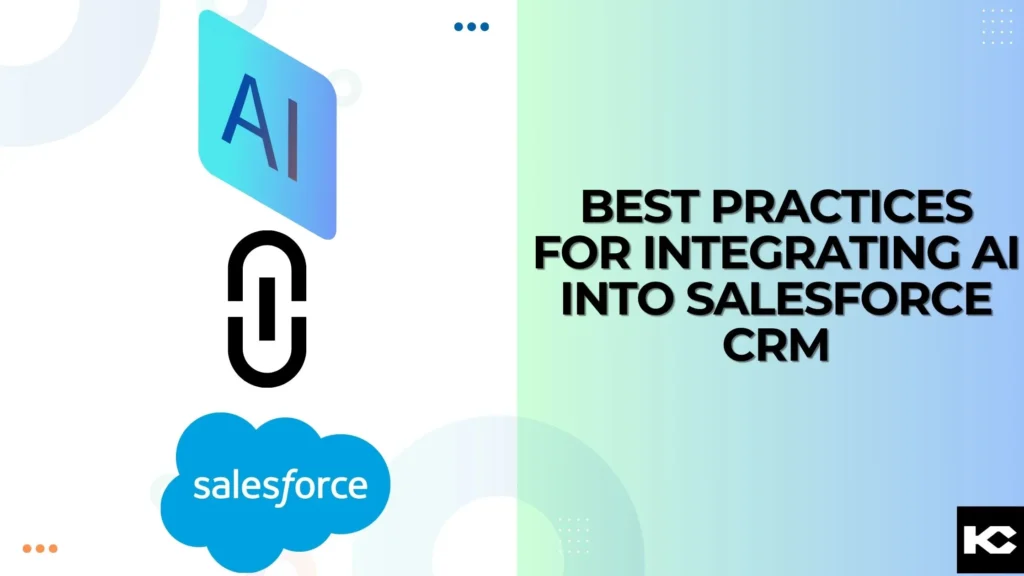
Salesforce AI integration is becoming an important part of modern CRM strategy. By connecting artificial intelligence with Salesforce CRM data, workflows, automation, and customer processes, businesses can improve productivity, generate better insights, automate repetitive tasks, and create more personalized customer experiences.
In 2026, Salesforce AI integration goes beyond traditional predictive analytics. Organizations can combine Salesforce CRM, Einstein AI, Agentforce, Data 360, automation, APIs, and enterprise data to create intelligent workflows that support employees and, in selected use cases, execute business tasks automatically. The key is to begin with a clear business objective, prepare trustworthy data, select the right AI capability, and continuously measure the business outcome.
By Sanjeet Mahajan – CEO/Founder of
Kizzy Consulting
Executive Quick Answer
What is Salesforce AI integration?
Salesforce AI integration connects artificial intelligence capabilities with Salesforce CRM data and business processes to improve customer insights, automate workflows, assist employees, and support decision-making. A successful implementation combines clean CRM data, the right AI technology, automation, security, governance, user adoption, and measurable business objectives rather than simply enabling an AI feature.
01
Business First
Start with a measurable business problem instead of starting with an AI tool.
Start with a measurable business problem instead of starting with an AI tool.
02
Data Ready
Clean, connected, governed data is essential for useful Salesforce AI.
Clean, connected, governed data is essential for useful Salesforce AI.
03
Measure Results
Track adoption, productivity, accuracy, revenue, service, and operational impact.
Track adoption, productivity, accuracy, revenue, service, and operational impact.
Contents
hide
1. Start With Clear Business Objectives
The first step in Salesforce AI integration is not selecting a model or activating an AI feature. It is identifying the business outcome you want to improve.
For example, a sales organization may want to improve lead conversion, while a service organization may want to reduce case resolution time. Marketing teams may want better personalization, while executives may want faster access to customer and business insights.
Define the business problem first and then determine whether AI, traditional Salesforce automation, or a combination of both is the best solution.
- Sales: lead scoring, opportunity insights, account research, sales forecasting, email generation, and follow-up automation.
- Customer Service: case summarization, knowledge retrieval, response generation, case classification, and service automation.
- Marketing: personalization, segmentation, content generation, campaign insights, and customer journey optimization.
- Operations: data entry automation, workflow execution, task management, and cross-system processes.
- Management: predictive insights, reporting assistance, forecasting, and decision support.
Before implementing AI, establish a baseline KPI. For example, measure current lead conversion rates, average case handling time, sales productivity, customer satisfaction, or hours spent on repetitive administrative work. This gives you a measurable benchmark for evaluating your Salesforce AI implementation.
Not Sure Where AI Fits Into Salesforce?
Kizzy Consulting helps businesses identify high-value Salesforce AI, Agentforce, automation, and integration opportunities.
Salesforce CRM AI Integration: How It Works
Salesforce CRM AI integration connects artificial intelligence capabilities with Salesforce customer, sales, service, marketing, and operational data. The objective is to help teams understand customer information faster, automate repetitive activities, generate useful content, and support or execute business processes.
A modern AI integration with Salesforce can combine CRM records, Data 360, Agentforce, Einstein AI capabilities, Salesforce Flow, APIs, external applications, enterprise knowledge, and business-specific automation.
For example, a sales organization can use AI to analyze leads and opportunities, generate personalized follow-up content, summarize account activity, and surface relevant customer information. A service organization can combine AI-powered knowledge retrieval, case summarization, and Agentforce automation to reduce repetitive work and improve response times.
| CRM Area | AI Opportunity | Potential Outcome |
|---|---|---|
| Sales | Lead scoring, opportunity insights, account research | Faster qualification and better sales productivity |
| Service | Case summarization, knowledge assistance, AI agents | Faster responses and reduced repetitive work |
| Marketing | Personalization, segmentation, content generation | More relevant customer experiences |
| Operations | Workflow and task automation | Less manual administrative work |
2. Choose the Right Salesforce AI Technology
Salesforce AI is not a single feature. Organizations can combine different capabilities depending on their business requirements. The right approach depends on whether the process requires prediction, content generation, data analysis, deterministic automation, or AI-driven task execution.
| Technology / Capability | Best Used For | Example |
|---|---|---|
| Agentforce | AI agents and task execution | Customer service, sales, employee workflows |
| Einstein AI | AI-powered CRM intelligence and productivity | Predictions, recommendations, summaries, generated content |
| Data 360 | Unified data and customer context | Connecting customer data across systems |
| Salesforce Flow | Rule-based workflow automation | Record updates, notifications, approvals |
| APIs & Integrations | Connecting external AI and enterprise systems | ERP, data platforms, AI services, custom applications |
Not every Salesforce workflow needs AI. Predictable, rule-based processes can often be handled more efficiently using Salesforce Flow and traditional automation. AI becomes particularly valuable when the workflow requires language understanding, contextual reasoning, recommendations, summarization, classification, or flexible task execution.
3. Prepare Your Salesforce Data for AI
One of the most important Salesforce AI integration best practices is improving data quality before scaling AI. Artificial intelligence depends on reliable business context. Duplicate, incomplete, outdated, or poorly structured records can reduce the usefulness of AI-generated insights and responses.
Before deploying AI, review the quality and availability of your Salesforce data.
- Data cleansing: remove duplicates, correct inaccurate information, standardize values, and address missing fields.
- Data enrichment: connect relevant external information where additional context can improve customer intelligence.
- Data structuring: organize CRM information so it can be consistently accessed and interpreted.
- Data integration: connect relevant ERP, marketing, service, finance, legacy, and external systems.
- Data governance: establish ownership, quality standards, retention policies, and access controls.
- Data permissions: ensure AI experiences respect appropriate Salesforce security and access requirements.
For organizations adopting Agentforce or broader Salesforce AI capabilities, data readiness should be treated as an ongoing program rather than a one-time cleanup exercise.
How Can CRM + AI + Data Benefit Your Business?
The combination of Salesforce CRM + trusted data + AI + automation creates a connected operating model where employees can access customer context, generate insights, and complete repetitive work without manually searching across multiple systems.
CRM
Provides customer, sales, service, and operational context.
DATA
Provides trusted information and broader business context.
AI
Turns business context into insights, recommendations, content, and actions.
4. Start With Focused Salesforce AI Pilot Projects
Avoid attempting to transform every Salesforce process simultaneously. Start with one or two high-value use cases where AI can produce a measurable improvement.
Potential Salesforce AI use cases include:
- Lead qualification and scoring
- Opportunity and account research
- Sales email generation
- Case summarization
- Customer service knowledge assistance
- Customer response generation
- Workflow and task automation
- Employee knowledge assistance
- Customer data enrichment
A successful pilot should have a clearly defined business owner, user group, data scope, security model, success metric, and review process. This allows your organization to prove value before expanding the Salesforce AI implementation to additional teams and workflows.
5. Train Your Salesforce Users and Teams
AI adoption is not only a technical challenge. Employees need to understand how AI changes their workflows and how to use AI-generated information responsibly.
- Role-based training: provide different training for sales, service, marketing, administrators, and leadership teams.
- Hands-on practice: allow employees to test AI capabilities using realistic business scenarios.
- AI literacy: explain AI limitations, hallucinations, data grounding, prompts, and human review.
- Governance training: explain approved AI use cases and how sensitive business information should be handled.
- Ongoing enablement: continue training as Salesforce, AI capabilities, and business processes evolve.
The objective is not simply to teach employees how to use an AI feature. The objective is to help them understand how AI can improve the way work gets done inside Salesforce CRM.
Is Your Salesforce Org AI-Ready?
Assess your Salesforce data, architecture, workflows, AI use cases, and readiness before investing in large-scale AI implementation.
6. Monitor Salesforce AI Performance and ROI
Launching an AI capability is not the end of Salesforce AI integration. Continuously monitor whether the implementation is improving the business outcome it was designed to address.
| Metric | What to Measure | Example |
|---|---|---|
| AI Adoption | How frequently employees use the AI capability | Weekly active users |
| Accuracy | Quality and reliability of AI output | Correct recommendations and summaries |
| Productivity | Time saved through AI and automation | Hours saved per employee |
| Revenue | Impact on pipeline and conversion | Conversion rate improvement |
| Service | Impact on support operations | Resolution time and case deflection |
A useful Salesforce AI ROI model should connect AI activity to business outcomes. Instead of measuring only how many AI responses were generated, measure what those responses helped the organization accomplish.
7. Prioritize Salesforce AI Security and Governance
Salesforce AI can work with sensitive customer, employee, financial, and operational information. Security and governance should therefore be part of the architecture from the beginning.
- Access controls: ensure AI experiences respect appropriate user permissions and data access.
- Data protection: protect customer information throughout storage, processing, and integration.
- AI governance: define approved use cases, ownership, review requirements, and escalation processes.
- Human oversight: require appropriate human review for sensitive or high-impact decisions.
- Auditability: maintain visibility into AI interactions, actions, outputs, and business outcomes.
- Compliance: assess applicable privacy and regulatory requirements for your organization and industry.
A strong Salesforce AI governance framework should define who can use AI, what data can be accessed, which workflows can be automated, when human approval is required, and how AI performance is monitored.
8. Test, Iterate, and Improve Your Salesforce AI
AI integration should be treated as an ongoing capability rather than a one-time Salesforce implementation project. AI technology, Salesforce releases, business processes, customer expectations, and data requirements continue to change.
Build a continuous improvement cycle:
- Measure: review AI usage, quality, cost, and business outcomes.
- Identify: find workflows where AI is underperforming or where additional automation could create value.
- Test: evaluate prompts, agent instructions, actions, data grounding, and workflow changes.
- Validate: involve business users before releasing major changes.
- Deploy: release validated improvements using appropriate governance and change management.
- Optimize: continuously improve the AI experience based on data and user feedback.
Salesforce AI Integration: 8-Step Implementation Framework
Use this framework to move from AI experimentation to a structured Salesforce AI implementation.
| Step | Focus | Key Question |
|---|---|---|
| 1. Define | Business objective | What business outcome should AI improve? |
| 2. Assess | AI readiness | Is our Salesforce org ready for AI? |
| 3. Prepare | Data and governance | Can AI access trustworthy data safely? |
| 4. Select | AI capability | Do we need Agentforce, Einstein AI, automation, or integrations? |
| 5. Pilot | Focused use case | Can we prove value on a limited workflow? |
| 6. Train | User adoption | Will employees actually use the AI capability? |
| 7. Measure | Business impact | Did AI improve the target KPI? |
| 8. Scale | Continuous optimization | Where should we expand next? |
Salesforce AI Integration Use Cases by Business Function
The best Salesforce AI use cases are usually those where large amounts of customer information, repetitive processes, and human decision-making intersect.
| Business Function | AI Use Case | Business Benefit |
|---|---|---|
| Real Estate | Lead qualification, property inquiry automation, follow-ups | Faster response and better lead engagement |
| Healthcare | Patient communication and workflow assistance | Reduced administrative workload |
| Financial Services | Customer insights, service automation, document workflows | Faster service and improved productivity |
| Retail | Personalization and customer service automation | Better customer engagement |
| Education | Student support and knowledge assistance | Faster support and improved communication |
Frequently Asked Questions
What is Salesforce AI integration?
Salesforce AI integration is the process of connecting artificial intelligence capabilities with Salesforce CRM data, workflows, applications, and business processes. It can help organizations generate insights, automate repetitive tasks, personalize customer interactions, support employees, and execute selected business processes.
How do you integrate AI with Salesforce CRM?
A typical Salesforce AI integration starts by defining the business objective, assessing CRM data quality, selecting the appropriate AI capability, connecting required data sources, configuring workflows and permissions, testing the solution, training users, and measuring business outcomes after deployment.
What is Salesforce CRM AI integration?
Salesforce CRM AI integration connects AI capabilities with Salesforce customer and business data to provide intelligent insights, recommendations, generated content, workflow automation, and AI-powered task assistance directly within CRM processes.
What is the difference between Einstein AI and Agentforce?
Einstein AI refers broadly to Salesforce’s AI capabilities across CRM experiences, predictions, recommendations, and generative AI features. Agentforce focuses specifically on AI agents that can understand requests, use business context, and perform configured actions within business workflows.
How can AI be integrated with Salesforce?
AI can be integrated with Salesforce through native Salesforce AI capabilities, Agentforce, automation, Data 360, APIs, external AI services, custom applications, and connected enterprise data sources. The best architecture depends on the use case, data requirements, security model, and desired level of automation.
Can Kizzy Consulting help with Salesforce AI integration?
Yes. Kizzy Consulting provides Salesforce consulting, AI integration, Agentforce consulting, AI agent development, enterprise integrations, and AI strategy services. Kizzy can help assess your existing Salesforce environment, identify high-value AI opportunities, prepare the data foundation, and implement AI-powered workflows.
Conclusion: Build Salesforce AI Around Business Outcomes
Salesforce AI integration can transform how businesses sell, serve customers, manage data, automate workflows, and make decisions. But successful AI adoption requires more than enabling an AI feature.
The strongest Salesforce AI implementations begin with a clear business objective, prepare trustworthy data, select the right AI capability, start with focused pilots, establish security and governance, train users, measure results, and continuously improve.
Whether you are exploring Salesforce CRM AI, Einstein AI, Agentforce, AI automation, or enterprise AI integration, the goal should remain the same: use AI to create measurable business value while keeping customer data secure and business processes under control.