Agentic RAG Explained (2026): Architecture, Examples, Cost, Frameworks & Best Practices
⏱ 6 min read
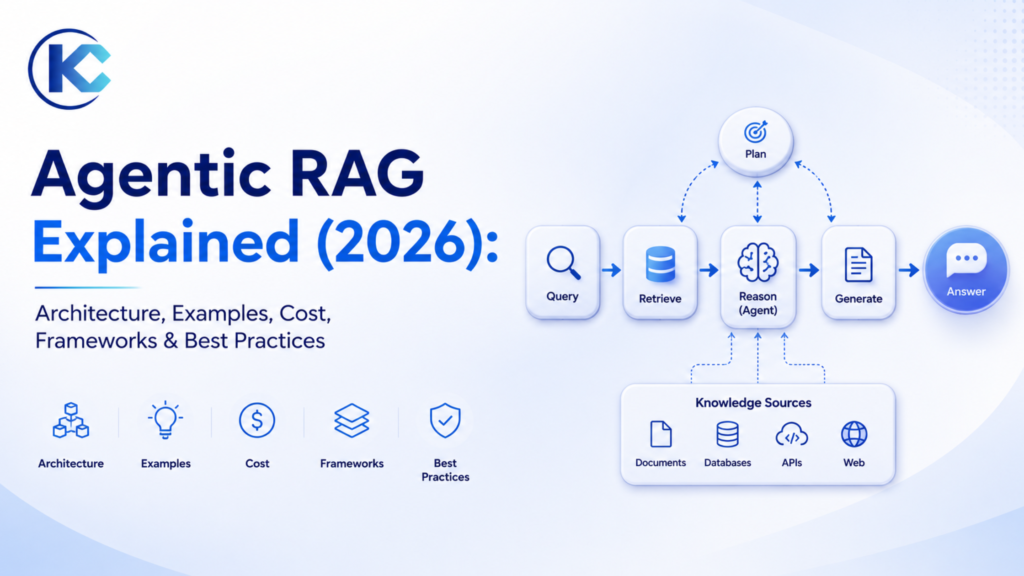
Agentic RAG transforms enterprise AI search. Instead of running a single, static lookup, an Agentic RAG architecture places autonomous AI agents in front of your data. These agents plan their own search steps, evaluate what they find, and repeat the retrieval process until they solve complex, multi-hop questions. While traditional RAG struggles with cross-document reasoning, Agentic Retrieval-Augmented Generation thrives on it. However, this multi-agent system comes with significantly higher costs. Here is everything you need to know to build, evaluate, and scale Agentic RAG.
Quick Answer
Agentic RAG is an AI architecture where autonomous agents control retrieval instead of running one fixed search. They plan queries, evaluate results, and search again until they solve multi-step questions but this reasoning loop costs 3 to 10 times more tokens than traditional RAG.
3 to 10×
The token cost increase compared to traditional RAG due to multi-hop reasoning loops.
33%
Of enterprise applications will include Agentic AI by 2028 (up from <1% in 2024).
40%
Of agentic RAG projects will be canceled by 2027 due to runaway costs and missing guardrails.
Source: Gartner Industry Projections & Enterprise AI Development Trends, 2026
Agentic RAG Glossary: Core Definitions
What is Agentic RAG?
Agentic RAG is an AI architecture that gives autonomous models the ability to control the retrieval process. Instead of fetching data once, the agent reads the query, decides which databases to search, evaluates the retrieved information, and loops back to search again if facts are missing.
What is an Autonomous AI Agent?
An Agent is a large language model (LLM) call provided with a specific goal, system memory, and a set of tools (like SQL search or API access). The agent independently plans and executes its next steps to achieve the desired outcome.
What is Multi-hop Reasoning?
Multi-hop reasoning is the process of answering a complex question by chaining multiple pieces of information together. The AI retrieves a document, extracts a clue, and uses that clue to formulate a second, distinct search query.
What is the Orchestrator?
The Orchestrator is the control layer in a multi-agent system. It receives the user prompt, routes the work to specialized retrieval or reasoning agents, manages the workflow loops, and determines when the final task is successfully completed.
Why Enterprises Are Upgrading to Agentic RAG
Teams often deploy a basic RAG system, watch it answer simple questions perfectly, and then see it completely fail on complex business logic. Traditional RAG relies on a single vector search. If the answer requires connecting a CRM record to an unstructured PDF policy, single-pass systems hallucinate or fail. Agentic RAG solves this by introducing dynamic AI workflow automation.
3 Enterprise Examples of Agentic RAG in Action
1. Financial Services & Investment Research
- The Problem: A single search cannot cross-reference a company’s SEC 10-K filing against live market feeds.
- The Solution: A reasoning agent decomposes the query. One agent retrieves risk factors from the SEC database, while an API agent pulls live ticker data. The orchestrator merges the synthesis into a single market report.
2. Legal Document & Contract Analysis
- The Problem: Lawyers need to trace how a specific contract clause interacts with recent case law.
- The Solution: The agent uses multi-hop reasoning. It first finds the clause in the contract. Then, it extracts the governing jurisdiction. Finally, it queries a legal database for precedents specifically in that jurisdiction.
3. AI Customer Support Copilot
- The Problem: A customer asks, “Why was my shipment delayed, and does my warranty cover the damage?”
- The Solution: An orchestration agent routes the tracking question to the logistics SQL database, and routes the warranty question to the unstructured knowledge base. The final AI assistant combines both answers for first-contact resolution.
The Cost Warning
- While these multi-agent systems are incredibly powerful, they drive up API costs. Because an agent thinks, searches, grades, and repeats, one user prompt can generate 15 distinct model calls.
10 Core Components & Patterns of Agentic RAG Architecture
A production-grade Agentic RAG framework is separated into distinct, modular parts. Keeping them isolated makes enterprise knowledge management easier to secure, trace, and scale. Here are the 10 elements required for successful AI implementation.
1. The Orchestration Layer
- Coordinates all AI agents in the system.
- Decides which specialized agent acts next.
- Passes context and memory between different tools.
- Built using frameworks like LangGraph or CrewAI.
2. Retrieval Agents
- Specialized bots that fetch data from specific sources.
- Vector search agents for unstructured PDFs.
- SQL agents for structured enterprise data.
- API agents to retrieve live, real-time metrics.
3. Reasoning Agents
- Perform the “thinking” between data retrievals.
- Decompose complex prompts into simpler sub-queries.
- Identify when fetched data is insufficient.
- Synthesize multiple facts into a final, coherent answer.
4. Action Agents
- Designed to write data, not just read it.
- Can update a CRM, send an email, or trigger a webhook.
- Carries the highest security risk (requires human-in-the-loop).
- Must be heavily constrained by system guardrails.
5. Guardrails & Validation
- Enforces strict output formatting and tone rules.
- Checks generated answers against retrieved source texts.
- Blocks prompt injection attacks.
- Stops infinite agentic loops with hard token caps.
6. Pattern: Query Decomposition
- Splits a multi-part question into independent searches.
- Runs retrievals in parallel to reduce system latency.
- Best for tasks like comparing multiple product lines.
- Cost: ~5x baseline token usage.
7. Pattern: Self-Correcting Retrieval
- Agent retrieves documents, grades them, and rejects bad matches.
- Automatically rewrites the search query and tries again.
- Massively improves accuracy on vague user prompts.
- Cost: 2–4x baseline (must cap maximum retries).
8. Pattern: Multi-Source Routing
- The LLM dynamically decides which database to query.
- Prevents wasting tokens by searching irrelevant databases.
- Ideal for enterprise RAG spanning CRM, HR, and IT docs.
- Cost: 2–5x baseline (due to routing overhead).
9. Pattern: Memory-Augmented Agents
- Maintains short-term memory for conversational continuity.
- Uses vector stores for long-term user preferences.
- Creates highly personalized AI assistant experiences.
- Requires strict PII data governance.
10. Pattern: Graph-Enhanced Agentic RAG
- Combines Graph RAG (Knowledge Graphs) with autonomous agents.
- Agent navigates entity relationships rather than text similarity.
- Perfect for supply chain maps or hierarchical corporate data.
- Cost: 3–6x baseline.
Implementation Guide: The 10-Week Rollout Plan
Deploying multi-agent systems requires strict planning. Follow this practical, 10-week roadmap to transition from traditional RAG to an enterprise-grade Agentic RAG architecture.
Phase 1: Discovery & ROI Go/No-Go (Weeks 1–2)
- Measure how many queries fail under your current traditional RAG setup.
- Determine if failures are due to poor data, or a genuine need for multi-hop reasoning.
- Calculate the projected token cost multiplier (expect a 5x increase).
- Proceed only if the business value justifies the higher infrastructure costs.
Phase 2: Architecture & Framework Selection (Weeks 3–4)
- Map which databases (SQL, APIs, Vector) each query type will touch.
- Select an orchestration framework (e.g., LangGraph for strict control, CrewAI for roles).
- Define explicit boundaries and permissions for every agent.
- Document the final AI architecture design.
Phase 3: Development & Agent Wiring (Weeks 5–6)
- Build the core orchestrator and connect it to retrieval tools.
- Program the reasoning agent’s synthesis logic.
- Optimize query chunking and embedding strategies.
- Establish a working prototype in a sandbox environment.
Phase 4: Evaluation, Guardrails & Security (Weeks 7–8)
- Implement hard loop caps to prevent runaway token billing.
- Build automated evaluations to grade AI grounding and accuracy.
- Red-team the system to test for prompt injection vulnerabilities.
- Ensure all multi-step reasoning processes write to an audit log.
Phase 5: Production Rollout & Optimization (Weeks 9–10)
- Roll out the AI assistant to 10% of live traffic.
- Monitor agentic traces (using LangSmith or Langfuse) to catch infinite loops.
- Tune retry caps and routing logic based on real-world latency.
- Expand to full enterprise deployment with continuous monitoring.
Decision Matrix: Traditional RAG vs. Agentic RAG
Cost Analysis & AI Security Management
The recurring failure of Agentic RAG is a cost that climbs without per-request limits, fed by reasoning loops that never stop. You must implement robust infrastructure observability to ensure your AI agents do not become financial liabilities.
How to Secure and Optimize Agentic AI
1. Manage the Token Multiplier
- The Risk: One complex prompt expands into 15 model calls, crushing your API budget.
- The Solution: Route simple queries to traditional RAG (or smaller open-source models). Only trigger expensive multi-agent reasoning for complex prompts.
- Actionable Tip: Enforce hard limits on reasoning loops and retry steps per request.
2. Prevent Prompt Injection
- The Risk: A malicious instruction hidden in a retrieved PDF document hijacks the agent, instructing it to export data.
- The Solution: Treat all retrieved content as untrusted. Isolate retrieved facts from the LLM’s core instruction context.
- Actionable Tip: Constrain which outbound tools each agent may call.
3. Implement Audit Logging
- The Risk: An agent makes a bad decision, but you cannot trace how it arrived at that answer because intermediate steps were not saved.
- The Solution: Use AI observability tools (like LangSmith) to log the complete trace.
- Actionable Tip: Regulators require an auditable decision path. Log every retrieval, tool call, and reasoning step.
“Without tracing tools, an agentic system is a black box you cannot debug. And a black box that spends money on every autonomous step is a massive corporate liability.”
Agentic RAG Frequently Asked Questions
1. What is the difference between Agentic RAG and Traditional RAG?
Traditional RAG runs one fixed retrieval pass per question. Agentic RAG puts an autonomous agent in control. The agent plans its searches, evaluates the results, and retrieves again if data is missing, enabling complex multi-hop reasoning.
2. How much more expensive is Agentic RAG?
You should plan for 3 to 10 times the token cost of a standard RAG system. One question expands into many internal LLM calls for planning, fetching, grading, and synthesizing data. Every call is billed.
3. When should you NOT use Agentic RAG?
Do not use it if 90% of your queries are simple single-hop lookups. You should also avoid it if you have strict budget constraints, require sub-two-second latency, or operate in highly regulated environments where non-deterministic AI steps are prohibited.
4. What are the best frameworks for building Agentic RAG?
LangGraph is excellent for explicit workflow control. CrewAI is great for role-based agent teams. LlamaIndex Agents work best for document-centric retrieval, and the Microsoft Agent Framework is ideal for enterprise Azure integrations.
5. How does Graph RAG differ from Agentic RAG?
Graph RAG dictates *how* knowledge is stored (as connected entities). Agentic RAG dictates *who* controls the search loop (an autonomous AI). They work perfectly together to navigate complex, highly connected enterprise data.
6. What is a “runaway agent loop”?
A runaway loop happens when an agent reasons in circles, continuously searching the same data without finding an answer. This burns tokens and skyrockets API costs. It is prevented by setting hard retry limits in the orchestrator.
7. What is prompt injection in an agentic system?
Prompt injection occurs when a maliciously crafted document is retrieved by the AI, and the agent accidentally follows the hidden instructions inside that document instead of the user’s original request.
8. Can Agentic RAG work securely with proprietary enterprise data?
Yes. The architecture is designed for secure internal use. By linking retrieval agents to internal vector databases and SQL servers, and implementing strict role-based access controls, sensitive data remains protected.
9. How do you evaluate the quality of Agentic RAG?
Create a dataset of known multi-hop questions with expected answers. Use automated tools to score the agent’s accuracy and grounding, while simultaneously tracing latency and token cost for every query.
10. Is Agentic RAG ready for production in 2026?
Yes, the tooling is highly mature. However, your organization is only ready if you have established robust AI observability, implemented cost controls, and identified a genuine business need for multi-step AI reasoning.
Conclusion: Treat Agentic RAG as a Targeted Tool
Agentic RAG is exceptionally capable, but it is also expensive and complex. The secret to a successful deployment is recognizing exactly which slice of your user queries actually requires multi-agent reasoning.
Agentic RAG Decision Framework:
- Route dynamically: Send 80% of simple questions through a cheap, traditional RAG pipeline. Route the complex 20% to your multi-hop agents.
- Govern aggressively: Always cap retries and log every agent step to prevent token explosion.
- Prioritize security: Sanitize retrieved context to eliminate prompt injection risks before giving the agent permission to use tools.
Organizations that get massive ROI from Agentic RAG do not use it as their default AI assistant. They use it selectively to solve high-value, complex knowledge retrieval problems that single-pass AI systems simply cannot handle.
Planning an Agentic RAG Deployment?
Don’t let runaway agent loops and poor routing destroy your AI budget. Get an expert architecture review to ensure your system is secure, scalable, and cost-effective.
Talk to our RAG engineering team today.