Salesforce CPQ to Revenue Cloud Advanced Migration: A Revenue Operations Case Study
⏱ 4 min read
Case Study | Enterprise Software
Industry: Enterprise Software | Region: North America (Client location withheld)
What is Salesforce CPQ to Revenue Cloud Advanced migration?
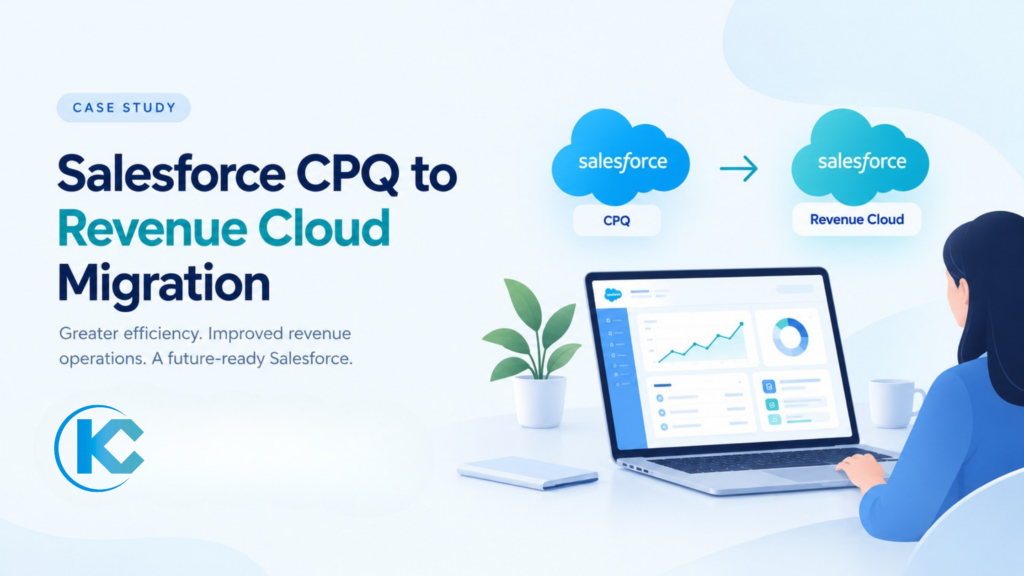
It is the process of moving from Salesforce Configure, Price, Quote (CPQ) to Revenue Cloud Advanced to support changing product catalogs, pricing models, subscriptions, contracts, and sales processes. This case study explores how an enterprise software provider can approach Salesforce CPQ migration to simplify quoting and build a more flexible revenue operations system.
CPQ → RCA
Revenue platform migration
5 phases
Structured migration plan
40%
Efficiency figure to validate
Note: The 40% figure was supplied for this draft. Confirm the calculation and supporting project records before describing it as an achieved result. Client details and implementation specifics should also be verified before publication.
Contents
hide
Salesforce CPQ to Revenue Cloud Advanced Migration: Client Background
The client is described for this case study as an enterprise software provider that sells software subscriptions and related services to business customers. Its sales process involves product selection, pricing, quote creation, contract changes, and subscription renewals.
As software businesses grow, their pricing models and customer agreements often become more complex. Sales teams may need to handle different subscription plans, customer-specific discounts, contract amendments, and renewal terms.
When these processes depend on too many custom rules or manual checks, preparing quotes can take longer and become harder to manage. The business therefore needed to assess whether its existing Salesforce CPQ setup could continue to meet its changing requirements.
The proposed Salesforce Revenue Cloud migration approach focuses on simplifying product and pricing rules, improving subscription and contract processes, and creating a stronger foundation for quote-to-cash operations.
Key Challenges Before Salesforce CPQ Migration
The main concerns in this scenario relate to the way products are configured, prices are calculated, and customer agreements are managed. These are common areas to review during a Salesforce CPQ replacement or modernization project.
1. Complex pricing rules
Different plans, discounts, and contract terms can make it difficult to maintain consistent pricing across quotes.
2. Slow quote preparation
Manual checks and complicated product rules can increase the time needed to prepare and approve customer quotes.
3. Subscription changes
Upgrades, downgrades, renewals, and contract amendments require accurate records and clear business rules.
4. Disconnected workflows
Sales, finance, and contract teams may need to repeat checks when information does not move smoothly between systems.
5. Difficult system maintenance
Older customizations can make pricing updates and changes to the product catalog harder to manage.
These challenges highlight why Salesforce CPQ migration planning should cover more than moving data. It should also review business rules, integrations, subscription records, and the full quote-to-cash process.
Your migration roadmap
Planning Your Salesforce CPQ to Revenue Cloud Migration?
Learn how to plan your Salesforce CPQ migration, prepare your product and pricing data, and understand the key steps involved in moving to Revenue Cloud.
Revenue Cloud Advanced Implementation: The Migration Approach
A successful Salesforce CPQ to Revenue Cloud Advanced migration starts with understanding how the current system works. The team must identify which product rules, pricing calculations, integrations, and customer records need to be retained, redesigned, or removed.
Instead of copying every old customization into the new platform, the goal is to keep what the business needs and simplify what creates unnecessary work.
Five Phases of Salesforce Revenue Cloud Migration
| Phase | What happens | Expected benefit |
|---|---|---|
| 1. System assessment | Review existing CPQ rules, product structures, pricing logic, custom code, and integrations. | Clearer migration scope and priorities. |
| 2. Product and pricing redesign | Organize product catalogs, discount rules, pricing methods, and approval requirements. | Easier pricing maintenance and quoting. |
| 3. Data migration | Map and validate the records required for the new setup, including relevant quotes, contracts, and subscriptions. | Better data consistency and continuity. |
| 4. Testing and integration | Test pricing calculations, approvals, contract changes, renewals, and connected systems. | Early identification of errors. |
| 5. Cutover and adoption | Move approved processes to production, train users, reconcile records, and monitor the new system. | A more controlled transition. |
Key Areas of Revenue Cloud Advanced Implementation
- Product catalog migration: Review product structures and make sure the required products and options are represented correctly in the target system.
- Pricing and discount management: Configure approved pricing methods and business rules for the company’s commercial requirements.
- Subscription management: Plan how relevant subscription changes, upgrades, downgrades, and renewals will be handled.
- Quote-to-cash automation: Review handoffs between quoting, approvals, contracting, orders, and applicable billing processes.
- Integration and data validation: Check the flow of information between Salesforce and connected business systems.
- User training and testing: Help sales and operations teams understand the new workflows and test important business scenarios.
Every migration should be designed around the organization’s requirements, existing Salesforce products, licensing, and supported capabilities. The final solution should be confirmed during technical discovery.
Exclusive Checklist
Get Your Revenue Cloud Implementation Checklist
Planning your move to Salesforce Revenue Cloud? Fill out the form below to get your exclusive complimentary checklist and review the key steps to prepare for a smoother implementation.
Enter your details to access your complimentary checklist.
Salesforce CPQ Migration: Three Practical Business Scenarios
These examples show how Salesforce Revenue Cloud capabilities may address common revenue operations challenges. They are illustrative scenarios, not verified transactions from the client.
Scenario 1: A customer changes a subscription
Challenge: A customer wants to upgrade a plan before the current contract ends. The sales team must check the existing terms and calculate the updated price.
Target state: Suitable subscription and pricing rules guide the change and help maintain accurate contract information.
Scenario 2: A sales team prepares a complex quote
Challenge: A quote includes several products, different discounts, and approval requirements.
Target state: Approved product and pricing rules help the sales team prepare a consistent quote with fewer manual checks.
Scenario 3: A contract approaches renewal
Challenge: Teams need to review current contract details, subscription terms, and renewal pricing before preparing an offer.
Target state: Clear renewal processes and validated records help teams manage the next contract period more consistently.
The actual results of these scenarios depend on the configured capabilities, data quality, integrations, and business processes.
Salesforce consulting
Simplify Your Salesforce Operations
Get support with Salesforce platform maintenance, workflow improvements, system changes, and ongoing operational needs.
Results and Expected Benefits of Salesforce Revenue Cloud Migration
The headline figure supplied for this case study is a 40% efficiency gain. However, the specific metric and supporting evidence have not been provided. The figure should therefore be treated as unverified until project records confirm what improved and how the improvement was measured.
40% efficiency gain
Supplied headline figure. Confirm the baseline, measurement period, calculation, and supporting evidence before publishing it as an achieved result.
Business Benefits to Measure
- Faster quote creation: Measure the time required to prepare and approve quotes before and after migration.
- More consistent pricing: Track pricing errors, discount exceptions, and manual corrections.
- Better subscription management: Review the effort required to process upgrades, downgrades, amendments, and renewals.
- Improved team coordination: Measure delays between sales, approvals, contracting, and downstream processes.
- Easier system maintenance: Assess whether the new design reduces unnecessary custom rules and maintenance work.
- Stronger revenue operations: Review data quality and the reliability of handoffs across the quote-to-cash process.
How to Verify the 40% Efficiency Improvement
Before claiming a measurable business outcome, document the following:
- The original performance baseline and measurement dates.
- The post-migration performance and comparison period.
- The exact metric used, such as quote preparation time or processing effort.
- The calculation used to determine the percentage improvement.
- The number of quotes, users, transactions, or workflows included.
- The evidence source and approval to publish the result.
No verified customer testimonial, implementation timeline, or additional quantified outcome has been included because supporting evidence was not supplied.
Salesforce CPQ Migration Planning and Implementation
A practical Salesforce Revenue Cloud implementation plan should cover business discovery, solution design, product and pricing configuration, CPQ data migration, integration testing, user acceptance testing, and production cutover.
The team should also agree on how active contracts, open quotes, subscriptions, and other important records will be handled. This helps reduce the risk of losing essential information or disrupting ongoing business activities.
| Planning area | What to confirm |
|---|---|
| Project timeline | Approved milestones, testing dates, and go-live plan. |
| Data migration | Records, field mappings, validation rules, and reconciliation. |
| Integrations | Actual connected systems and required data flows. |
| Testing | Pricing, approvals, renewals, amendments, and critical business scenarios. |
| User adoption | Training, user feedback, support, and production readiness. |
Actual project dates, delivery team details, integrations, and go-live information should be added after confirmation by the project team.
Salesforce CPQ to Revenue Cloud Advanced Migration: FAQs
1. Why migrate from Salesforce CPQ to Revenue Cloud Advanced?
Businesses may consider migration when their existing quoting system becomes difficult to maintain or no longer meets their pricing, subscription, or contract requirements. The decision should consider business needs, existing customizations, integrations, licensing, costs, and the target Salesforce architecture.
2. What is the difference between Salesforce CPQ and Revenue Cloud Advanced?
Salesforce CPQ focuses on configuring products, calculating prices, and preparing quotes. Revenue Cloud Advanced provides a broader revenue management approach, with capabilities that can support product configuration, pricing, quoting, and related revenue processes. The exact differences depend on the products, features, and licenses selected.
3. How long does Salesforce CPQ migration take?
The timeline depends on product catalog complexity, data volume, customizations, integrations, and the number of business processes involved. A discovery assessment should establish the scope before the team confirms implementation and go-live dates.
4. Can Revenue Cloud Advanced support subscription management?
Relevant capabilities may support subscription-related processes, depending on the selected products, configuration, and licensing. Businesses should validate their requirements for renewals, amendments, upgrades, downgrades, and integrations during solution design.
5. What are the main risks in Salesforce CPQ data migration?
Common risks include incorrect field mappings, missing relationships, pricing discrepancies, incomplete contract records, and integration failures. Data profiling, reconciliation, testing, and a controlled cutover plan can help manage these risks.
6. How can a business measure the success of a Revenue Cloud migration?
Track metrics such as quote preparation time, approval turnaround, pricing errors, manual processing effort, and subscription amendment time. Compare results against a documented baseline and report the measurement period and sample size.
Conclusion: Building a Better Revenue Operations System
Moving from Salesforce CPQ to Revenue Cloud Advanced can give businesses an opportunity to review how they manage products, pricing, quotes, subscriptions, and contracts. A well-planned Salesforce CPQ migration should focus on business requirements rather than simply moving existing configurations into a new system.
Careful data mapping, pricing validation, integration testing, and user training can help reduce migration risks and prepare teams for the new processes.
The 40% efficiency figure in this draft should be presented as an achieved result only after the measurement method, baseline, comparison period, supporting evidence, and client approval have been confirmed.
Plan your Salesforce migration
Looking for Help with Salesforce CPQ to Revenue Cloud Advanced Migration?
Discuss your product catalog, pricing rules, existing CPQ customizations, subscription requirements, and integration needs with Kizzy Consulting to explore a suitable migration approach.
Tell us about your Salesforce migration requirements.