What is an AI Gateway? A Complete 2026 Guide
⏱ 3 min read
AI Infrastructure Guide
An AI Gateway provides a centralized control layer between applications and AI models, helping organizations manage model routing, security, costs, observability, reliability, and governance.
AI Gateway
LLM Gateway
AI Security
AI Governance
LLM Gateway
AI Security
AI Governance
Executive Quick Answer
What Is an AI Gateway?
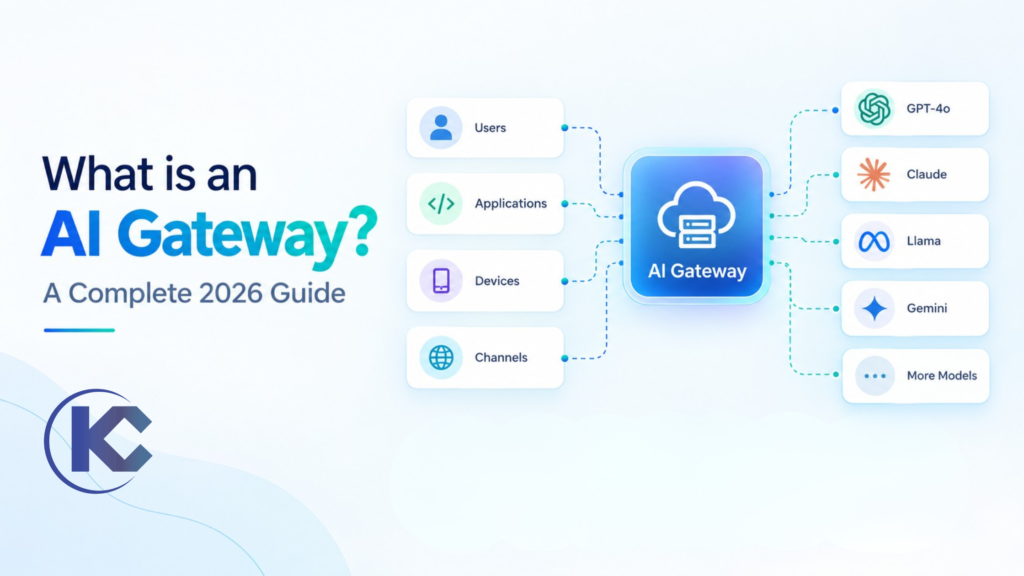
An AI Gateway is middleware between applications and AI models such as large language models (LLMs). It provides a unified interface for routing requests, enforcing security policies, tracking token usage and costs, monitoring performance, and managing access across providers.
Why AI Gateways Matter
As AI adoption grows, organizations often use multiple models, providers, and applications. Managing separate API keys, integrations, costs, security rules, and monitoring systems can become complex.
An AI Gateway centralizes these responsibilities, helping teams secure, route, monitor, optimize, and govern AI traffic without building the same controls into every application.
AI Gateway Architecture: Where Does It Sit?
An AI Gateway sits between applications and model providers. It can also integrate with identity systems, monitoring platforms, policy engines, and other AI infrastructure components.
Applications
Web apps, services, AI agents
Web apps, services, AI agents
AI Gateway
Security, routing, costs, governance
Security, routing, costs, governance
AI Models
Cloud, commercial, private, open-source
Cloud, commercial, private, open-source
How Does an AI Gateway Work?
The typical workflow includes six steps:
- Receive requests: Applications send AI requests through a unified endpoint.
- Validate access: Apply authentication, rate limits, and relevant data policies.
- Route requests: Select a model based on capability, cost, latency, or availability.
- Optimize usage: Apply caching, quotas, and token controls where appropriate.
- Return responses: Send the model output back to the application.
- Monitor performance: Track usage, costs, latency, and errors.
AI Gateway vs. Traditional API Gateway
Both can manage authentication, routing, and rate limits. An AI Gateway adds controls tailored to model-based workloads.
| Feature | API Gateway | AI Gateway |
|---|---|---|
| Primary focus | API and service traffic | AI models and LLM workloads |
| Usage metrics | Requests and latency | Tokens, model usage, costs, latency |
| Routing | Services and endpoints | Models and providers |
| AI-specific controls | Usually limited or separately configured | May include PII filtering and AI-aware policies |
Key Features of an AI Gateway
Model Routing
Choose providers based on task requirements, cost, latency, and availability.
Security & Access
Centralize credentials, access controls, and approved model policies.
Cost Management
Monitor tokens, set quotas, and identify expensive workloads.
Caching & Reliability
Reduce repeated calls and support retries or provider fallback where configured.
Observability
Monitor latency, errors, throughput, model usage, and operational trends.
Governance
Apply consistent policies across applications, teams, and AI providers.
AI Gateway Security, Privacy and Data Governance
An AI Gateway can help organizations protect sensitive information and manage access to external and internal models. Depending on the platform, controls may include:
- PII detection or masking.
- Authentication, authorization, and credential management.
- Prompt and input filtering.
- Usage policies and audit logging.
Important:
A gateway does not automatically eliminate hallucinations, prompt injection, or insecure application logic. It should complement application-level safeguards, evaluations, and broader security controls.
A gateway does not automatically eliminate hallucinations, prompt injection, or insecure application logic. It should complement application-level safeguards, evaluations, and broader security controls.
AI Gateways, MCP and Agentic AI
AI agents increasingly use models, tools, and enterprise data to complete multi-step tasks. The Model Context Protocol (MCP) standardizes how AI applications connect with tools and data sources.
An AI Gateway can complement these integrations by helping centralize model access, monitor traffic, and enforce supported policies. It does not replace agent orchestration or tool-level authorization.
Benefits of an AI Gateway
- Centralized control: Manage model access and policies in one place.
- Cost visibility: Track AI spending across teams and applications.
- Provider flexibility: Simplify testing or switching between model providers.
- Improved resilience: Support fallback and retry strategies where available.
- Faster development: Reduce duplicated model integration and monitoring work.
When Do You Need an AI Gateway?
A small prototype using one model may not need a dedicated gateway. It becomes more valuable when an organization:
- Uses multiple AI providers or models.
- Needs better visibility into AI costs and usage.
- Processes sensitive or regulated information.
- Requires consistent security and governance policies.
- Runs production AI agents or business-critical workloads.
AI Gateway Deployment Models
Deployment depends on latency, data residency, infrastructure, and operational needs.
- Centralized: One gateway manages traffic across applications.
- Regional: Gateways operate within specific geographic or regulatory zones.
- Multi-cloud: AI traffic spans providers and cloud environments.
- Private or local: Gateway infrastructure runs within a controlled environment or close to workloads.
- Hybrid: A central governance layer works alongside regional gateways.
What Role Does an AI Gateway Play in AI Governance?
An AI Gateway can help enforce governance policies by controlling who accesses models, which providers are approved, what data may be sent, and how much AI capacity teams can consume.
It can also provide operational records for auditing and troubleshooting. For a broader view, explore Kizzy’s guide to AI governance trends.
AI Gateway Best Practices
- Inventory existing models, applications, data flows, and costs.
- Centralize credentials and define approved model access.
- Establish security, privacy, and usage policies.
- Monitor tokens, latency, errors, and spending.
- Configure and test retries, fallbacks, and failure handling.
- Review performance and governance policies regularly.
How to Implement an AI Gateway
Use a phased approach to introduce the gateway without adding unnecessary complexity.
- Assess: Map AI usage, requirements, and risks.
- Integrate: Route approved requests through the gateway.
- Observe: Establish cost, latency, and error monitoring.
- Secure: Apply access, privacy, and governance policies.
- Optimize: Refine model routing, caching, and resource usage.
- Scale: Extend the architecture as production needs grow.
Kizzy Perspective
An AI Gateway Is Part of the AI Foundation
Moving AI into production requires more than a capable model. Organizations also need reliable integrations, strong data foundations, security, evaluation, monitoring, and governance.
An AI Gateway can connect these operational needs through a centralized control layer. The goal is to make AI easier to adopt while keeping it secure, observable, and manageable.
AI Gateway FAQs
What is an AI Gateway?
It is a middleware layer that manages AI model access, routing, security, monitoring, costs, and governance.
How is an AI Gateway different from an API Gateway?
An API Gateway manages general API traffic, while an AI Gateway adds capabilities such as model routing, token tracking, AI cost management, and AI-specific controls.
Does every AI application need a gateway?
No. A small prototype may not need one. Gateways become more valuable when applications, models, teams, security requirements, and production workloads grow.
Can an AI Gateway reduce AI costs?
It can improve cost visibility and help reduce unnecessary spending through routing, quotas, caching, and usage controls. Actual savings depend on workload and configuration.
Build With Kizzy
Ready to Build a Production-Ready AI Architecture?
Kizzy helps organizations move from AI experimentation to production through AI strategy, data foundations, integrations, agents, and governance.