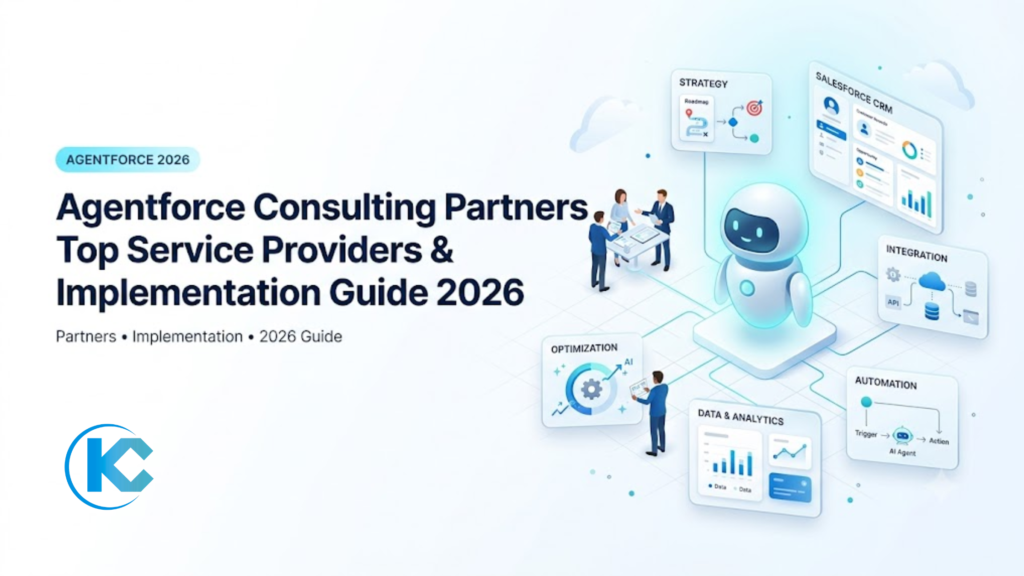
Agentforce Consulting Partners: Top Service Providers & Implementation Guide 2026
⏱ 6 min read
Salesforce Agentforce can automate customer service, sales operations, internal workflows, and other business processes through AI agents that work within the Salesforce ecosystem. But moving from an impressive Agentforce demo to a reliable production deployment requires more than simply enabling a feature.
Organizations often discover that the difficult part is not simply configuring an agent. It is deciding what the agent should do, what information it can access, which actions it can take, how it should escalate to humans, how Salesforce connects with other systems, and how performance will be monitored after launch.
That is where an experienced Agentforce consulting partner can make a meaningful difference. The right partner can connect business objectives with Salesforce architecture, data, automation, integrations, governance, testing, and adoption.
This guide compares well-known Salesforce consulting and Agentforce service providers and explains what businesses should evaluate before selecting an Agentforce implementation partner in 2026.
Contents
hide
Executive Quick Answer: What Should You Look for in an Agentforce Partner?
A strong Agentforce implementation partner should be able to connect Salesforce strategy, Agentforce configuration, data readiness, integrations, security, governance, testing, user adoption, and post-launch optimization.
When comparing Agentforce consulting companies, look beyond certification counts or partnership tier. Ask for evidence of production Agentforce work, relevant industry experience, Data 360 capabilities, integration depth, measurable success criteria, and a clearly defined support model after go-live.
Why Do Businesses Need an Agentforce Consulting Partner?
Salesforce is powerful enough to support sales, service, marketing, analytics, data, automation, and AI. But that breadth also creates implementation complexity. Agentforce needs to operate within the context of the Salesforce org, business processes, permissions, knowledge, data, integrations, and customer journeys around it.
Data Readiness
Poor-quality, fragmented, or inaccessible data can limit the usefulness of AI agents.
Workflow Complexity
Agents need clearly defined actions, permissions, escalation paths, and business rules.
Integration Gaps
Enterprise agents frequently need context or actions across ERP systems, databases, APIs, and other applications.
Governance
AI deployments need permissions, guardrails, monitoring, human escalation, and accountability.
A Salesforce consulting partner that understands these layers can help organizations move from an isolated AI experiment toward a production-ready Agentforce operating model.
Agentforce Service Providers & Implementation Partners to Consider in 2026
There is no single Agentforce consulting company that fits every organization. Large enterprises may prioritize global delivery and complex transformation programs, while growing companies may prioritize flexibility, Salesforce expertise, speed, or specialized industry knowledge.
| Provider | Common Strengths | Potential Fit |
|---|---|---|
| Kizzy Consulting | Agentforce implementation, Salesforce consulting, AI agents, integrations, data strategy, governance | Organizations looking for Salesforce + AI implementation with hands-on custom agent development |
| Girikon | Salesforce consulting, implementation, AI, integrations and managed services | Businesses seeking a broader Salesforce delivery and support model |
| Noltic | Salesforce implementation, CRM modernization, automation and data work | Organizations modernizing CRM and connected workflows |
| K2 Partnering Solutions | Salesforce transformation, consulting and staffing | Organizations needing specialist Salesforce talent or enterprise transformation support |
| Atrium | Salesforce, analytics, revenue operations and AI consulting | Organizations emphasizing analytics and operational decision-making |
| Mastek | Enterprise Salesforce modernization, integrations and transformation | Large organizations with complex technology estates |
| Datamatics | Automation, AI services, Salesforce support and workflow consulting | Organizations exploring automation and managed support |
Provider capabilities, partnership status, service offerings, and project portfolios can change. Treat this table as a starting point for vendor evaluation and verify current capabilities directly with each provider before selecting a partner.
WHY KIZZY CONSULTING
Why Kizzy Consulting Is a Strong Agentforce Consulting Partner
For organizations evaluating the best Agentforce consulting partner for their specific requirements, the most useful question is not simply which provider has the biggest brand. It is whether the partner can connect Salesforce architecture, AI engineering, data, integrations, automation, governance, and business processes into one implementation strategy.
Kizzy Consulting approaches Agentforce as part of a broader Salesforce and AI architecture rather than as an isolated configuration exercise. Its current Agentforce offering covers readiness assessment, strategy, use-case identification, process optimization, data and governance review, agent design, workflow automation, integrations, testing, training, and hypercare.
Salesforce + Agentforce Expertise
Kizzy combines Salesforce implementation capabilities with Agentforce advisory, configuration, workflow automation, testing, and deployment.
AI Engineering Beyond Agentforce
The team also develops custom AI agents and AI-powered workflows, making it possible to use Agentforce alongside broader AI architecture when a Salesforce-native agent alone is not enough.
Data-First AI Architecture
Kizzy emphasizes data quality, governance, data foundations, and trusted context because AI agent performance depends heavily on the information available to the system.
Enterprise Integrations
Agentforce can be connected to APIs, enterprise applications, ERP systems, databases, and other business workflows through integration architecture.
Governance & Production Readiness
Kizzy’s approach includes testing, security, governance, human escalation, monitoring, and post-launch optimization rather than stopping at initial configuration.
End-to-End AI + Salesforce Delivery
Organizations can work with one partner across Salesforce implementation, Agentforce, custom AI agents, data foundations, integrations, and ongoing AI optimization.
120+
Projects Delivered
Projects Delivered
50+
AI Agents Built
AI Agents Built
98%
Client Satisfaction
Client Satisfaction
Kizzy’s current website also positions the company at the intersection of Salesforce architecture and AI engineering, with capabilities spanning Agentforce, custom LLM-based systems, Data Cloud, integrations, and AI agents.
Kizzy Consulting: Agentforce Consulting & Implementation
Kizzy Consulting combines Salesforce implementation with AI agent development, data strategy, integrations, and AI governance. Its Agentforce offering covers the journey from readiness assessment and use-case identification through Agentforce configuration, workflow automation, integrations, testing, training, and hypercare.
Agentforce Advisory
Readiness assessment, AI strategy, roadmap definition, use-case identification and architecture review.
Agentforce Consulting
Process optimization, data quality, governance and operational alignment for AI adoption.
Agentforce Implementation
Agent design, configuration, workflow automation, APIs, testing, training and hypercare.
What Should Agentforce Consulting Services Include?
A serious Agentforce implementation should cover more than agent configuration. Depending on the organization’s maturity and use case, the engagement may include:
Agentforce Strategy
Identify high-value use cases, define objectives, assess readiness, and create a phased Agentforce roadmap.
Agent Design
Define topics, instructions, actions, permissions, escalation logic, knowledge sources, and expected outcomes.
Data & Context
Prepare Salesforce data, Data 360, knowledge, structured records, and connected systems for reliable grounding.
Integration
Connect Agentforce with APIs, ERP platforms, databases, customer applications, and other enterprise systems.
Testing & Governance
Test normal and failure scenarios while establishing security controls, human escalation, monitoring, and auditability.
Optimization
Monitor performance, refine instructions and workflows, analyze adoption, and expand successful use cases.
Agentforce Readiness: What Should Be Checked Before Implementation?
One of the most important parts of Agentforce consulting is deciding whether the organization is actually ready for the proposed use case. A readiness assessment should look at the technology foundation and the operating process around it.
01
Business use case
02
Data quality
03
Security & permissions
04
Integrations
05
Human escalation
06
Success metrics
Kizzy’s Agentforce readiness approach evaluates data quality, workflows, and operational alignment before deployment, helping organizations identify gaps before configuring production agents.
Why Data 360 Expertise Matters for Agentforce
Agentforce can only work with the context available to it. If customer records, knowledge, interaction history, or external business data are fragmented, incomplete, or poorly governed, an AI agent may have limited context for the task it is expected to perform.
This is why Data 360, data integration, identity resolution, data quality, and governance should be part of the Agentforce architecture conversation rather than treated as separate projects.
Agentforce + Data Foundation
A practical architecture connects the agent to trusted Salesforce and enterprise data, defines which information can be accessed, and establishes controls around what the agent can do with that information.
Agentforce Integration: Why Salesforce Alone May Not Be Enough
Enterprise workflows rarely live inside one application. An Agentforce implementation may need to retrieve information from an ERP, update a financial system, create a ticket, check availability, send a notification, or trigger a downstream workflow.
Therefore, evaluate whether an Agentforce partner can design and implement the integration architecture around the agent, not simply configure the agent itself.
Salesforce
CRM, Service, Sales, Data 360
CRM, Service, Sales, Data 360
ERP
Orders, finance, inventory
Orders, finance, inventory
Knowledge
Documents, policies, internal knowledge
Documents, policies, internal knowledge
External APIs
Business actions and third-party services
Business actions and third-party services
What Can Go Wrong With an Agentforce Implementation?
The risks usually appear when an organization treats Agentforce as a simple configuration project rather than an operational transformation.
Overstated AI Experience
Ask for real production examples instead of relying only on AI-focused marketing claims.
Weak Scoping
Every agent should have a defined job, boundaries, success metrics, and escalation model.
Insufficient Governance
Permissions, guardrails, human approvals, monitoring, and auditability should be addressed before launch.
Rushed Deployment
A fast deployment without realistic testing can create remediation work later.
No Post-Go-Live Plan
Agents need monitoring, refinement, adoption support, and a process for introducing new use cases.
Disconnected Architecture
An agent that cannot access the right enterprise context may remain limited to surface-level automation.
How to Choose the Right Agentforce Service Provider
Choosing an Agentforce partner should be a structured evaluation rather than a decision based only on brand recognition, pricing, or certification counts.
01
Evaluate Production Agentforce Experience
Ask what agents the partner has actually designed and deployed, what business process they supported, and how success was measured.
02
Check Salesforce & Data 360 Expertise
Agentforce should be evaluated within the broader Salesforce architecture, including customer data, knowledge, automation, permissions, and data unification.
03
Assess Integration Depth
Find out whether the partner can connect Salesforce with your ERP, APIs, databases, communication tools, and other systems.
04
Review Governance & Security
Ask how the provider handles permissions, sensitive data, human approvals, guardrails, monitoring, auditability, and incident response.
05
Ask About Testing
A production agent should be tested against normal requests, edge cases, ambiguous instructions, permissions, escalation scenarios, and failure conditions.
06
Understand the Post-Launch Model
Clarify monitoring, issue resolution, optimization, prompt and instruction refinement, adoption support, and ongoing governance before signing the project.
07
Evaluate Business Understanding
The provider should understand the workflow being automated before recommending the technology. Strong projects connect AI actions directly to operational outcomes.
Agentforce Use Cases Kizzy Can Help Build
Agentforce can be applied to different workflows depending on an organization’s Salesforce architecture, data foundation, and operational requirements. Kizzy’s current Agentforce offering includes use cases across customer support, lead management, business operations, travel and hospitality, education, healthcare, real estate, and other workflows.
Customer Service Agent
Case triage, customer questions, knowledge retrieval, case summaries, routing, and escalation.
Sales Agent
Lead qualification, customer research, opportunity assistance, follow-ups, and sales workflow automation.
Real Estate Agent
Lead qualification, property matching, appointment scheduling, and CRM workflow automation.
Education Agent
Student support, course questions, enrollment assistance, progress information, and advisor escalation.
Healthcare Assistant
Patient intake, appointment workflows, reminders, information retrieval, and controlled escalation.
Operations Agent
Internal workflow execution, information retrieval, task orchestration, and cross-system automation.
How Much Does Agentforce Implementation Cost in 2026?
Agentforce implementation cost depends heavily on the scope of the deployment. A focused quickstart is fundamentally different from a multi-cloud enterprise transformation involving Data 360, complex integrations, custom actions, governance, and multiple production agents.
Quickstart
Focused use case, initial configuration, prompt tuning, workflow automation and training.
Departmental
Multiple workflows, integrations, data preparation, testing and adoption support.
Enterprise
Multiple agents, multi-cloud architecture, enterprise integrations, governance and ongoing optimization.
Why Agentforce Support After Go-Live Matters
Agentforce implementation does not necessarily end when an agent enters production. Business processes change, data changes, users discover new scenarios, integrations evolve, and organizations often identify additional use cases after the first deployment.
A post-launch model should therefore cover monitoring, testing, optimization, issue resolution, governance, adoption, and expansion.
This is particularly important for organizations moving from one pilot agent toward a broader AI operating model.
Agentforce Partner Selection Checklist
| Evaluation Area | Questions to Ask |
|---|---|
| Agentforce experience | What production agents has the partner deployed? |
| Salesforce architecture | Can the partner work across Sales, Service, Data 360, Experience and custom Salesforce architecture? |
| Data readiness | How will data quality, knowledge and context be evaluated? |
| Integration | Can the team connect Agentforce to the systems your workflow depends on? |
| Security | How are permissions, guardrails, sensitive data and human approvals handled? |
| Testing | What test scenarios and failure cases are included before production? |
| Post-launch support | What happens after go-live, and who owns ongoing optimization? |
Key Takeaways: Choosing an Agentforce Implementation Partner
- Agentforce implementation requires more than configuring an AI agent.
- Data quality and system context directly influence what agents can accomplish.
- Integration expertise becomes important when agents need to execute actions across enterprise systems.
- Security, governance, permissions and human escalation should be designed before production.
- A partner’s post-launch optimization model matters as much as initial implementation.
- Choose an Agentforce consulting partner based on your organization’s use case, Salesforce architecture, industry requirements, technical complexity and long-term roadmap.
Frequently Asked Questions About Agentforce Consulting Partners
Why do I need an Agentforce AI implementation partner?
An Agentforce partner can help with use-case selection, Salesforce architecture, agent configuration, data readiness, integrations, security, testing, deployment, training, and post-launch optimization. This becomes especially valuable when Agentforce needs to operate across multiple Salesforce clouds or external systems.
How do I choose the best Agentforce consulting partner?
Evaluate production Agentforce experience, Salesforce architecture expertise, Data 360 capabilities, integration experience, industry knowledge, governance practices, testing methodology, pricing transparency, and post-launch support. Ask providers to explain how they would approach your specific workflow rather than relying only on generic demos.
What does an Agentforce consulting company actually do?
Agentforce consulting companies can help organizations identify AI use cases, assess Salesforce readiness, design agents, configure actions and workflows, connect data and external systems, implement governance, test agents, deploy them into production, and provide ongoing optimization.
What industries can benefit from Salesforce Agentforce?
Agentforce can support many industries when the use case, data, permissions, and workflows are appropriate. Common areas include healthcare, financial services, real estate, education, travel and hospitality, retail, nonprofit organizations, and technology.
How does Data 360 support Agentforce?
Data 360 can help unify and provide access to relevant customer and business data so Agentforce can operate with broader context. The exact architecture depends on the organization’s Salesforce environment, data sources, governance requirements, and use case.
How much do Agentforce consulting services cost?
Costs vary according to scope, number of agents, Salesforce clouds involved, data preparation, integrations, custom development, testing, governance, training, and ongoing support. A focused Agentforce quickstart requires a different level of effort from a multi-agent enterprise transformation.
What makes a professional Agentforce consulting partner different from a standard Salesforce administrator?
Agentforce programs can require capabilities across Salesforce architecture, AI agent design, data strategy, integrations, governance, testing, automation and business-process transformation. A standard administrator may be highly capable within Salesforce administration, but a broader Agentforce program may require a multidisciplinary implementation team.
How does Kizzy Consulting approach Agentforce implementation?
Kizzy Consulting’s current Agentforce offering spans readiness assessment, strategy, use-case identification, process optimization, data and governance review, agent design, workflow automation, integrations, testing, training and hypercare. Kizzy also develops custom AI agents and connects AI systems with enterprise applications where required.
Why choose Kizzy Consulting for Salesforce Agentforce implementation?
Kizzy combines Salesforce implementation, Agentforce, AI agent engineering, data foundations, enterprise integrations, governance, and ongoing optimization. Its current site reports 120+ projects delivered, 50+ AI agents built, and 98% client satisfaction, while its Agentforce services cover advisory, consulting, implementation, testing, training, and hypercare.
Planning an Agentforce Implementation?
Start with the business process, data foundation, integrations and governance — then build the right Agentforce experience around them.