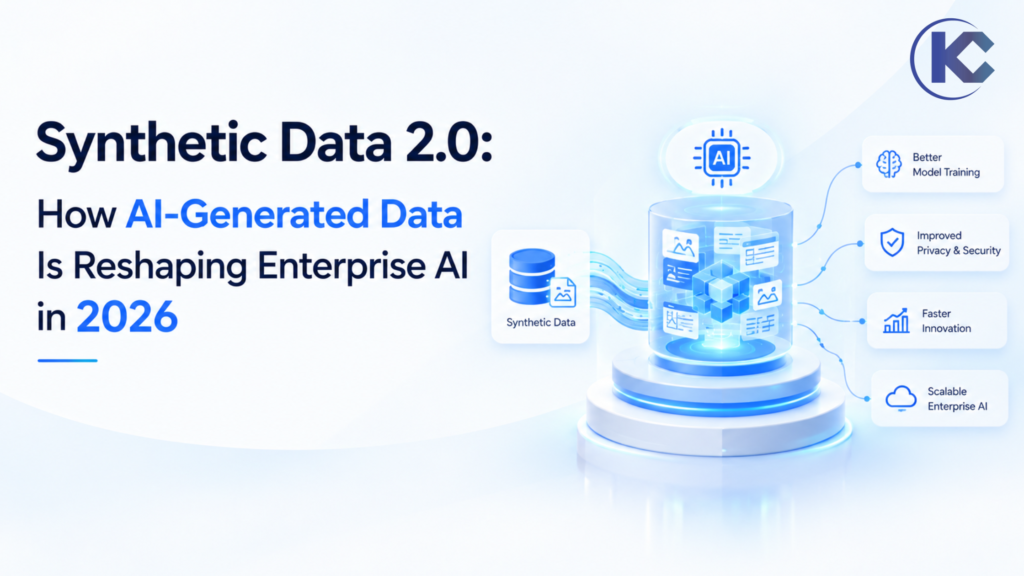
Synthetic Data 2.0: How AI-Generated Data Is Reshaping Enterprise AI in 2026
⏱ 4 min read
Synthetic Data 2.0
AI Training Data
Digital Twins
Privacy-Aware AI
AI Governance
AI Training Data
Digital Twins
Privacy-Aware AI
AI Governance
Contents
hide
Executive Quick Answer: What Is Synthetic Data 2.0?
Synthetic data is artificially generated data designed to reproduce useful characteristics, relationships or behaviors found in real-world data. It can include structured records, text, images, transactions, sensor streams and simulated events.
Synthetic Data 2.0 describes the newer generation of these workflows, where generative AI, foundation models, simulators, verification systems and digital twins are used to create targeted datasets for specific AI capabilities, rare scenarios, testing environments and enterprise applications. The goal is not simply to create more data. It is to create fit-for-purpose data that can be measured, verified and governed.
However, synthetic data is not automatically private, unbiased, or accurate. Its effectiveness depends on proper generation, validation, evaluation, and governance.
What Is Synthetic Data?
Synthetic data is data generated by algorithms, statistical models, simulations or AI systems rather than directly collected from real-world events. A synthetic dataset can be designed to preserve selected statistical properties, relationships, distributions or behaviors of a source population without simply copying individual records.
Structured Data
Synthetic customers, transactions, products, claims, accounts and operational records.
Synthetic Text
Generated conversations, documents, support cases, contracts and domain-specific language.
Synthetic Images
Artificial images for computer vision, inspection, autonomous systems and rare visual scenarios.
Synthetic Time Series
Simulated sensor, telemetry, financial, IoT and operational data for forecasting and testing.
What Makes Synthetic Data 2.0 Different?
Earlier synthetic-data approaches often focused on statistical sampling, rule-based generation or techniques such as SMOTE and GANs. Modern synthetic-data pipelines can combine generative AI, foundation models, simulators, domain constraints, reinforcement learning and automated verification.
The shift is from “more data” to “designed data”
Synthetic Data 2.0 focuses on generating data for a defined purpose: training a fraud detector, testing an AI agent, simulating a factory failure, creating rare clinical scenarios, evaluating a recommendation system or stress-testing an enterprise workflow.
Generative models
Generate realistic records, text, images and scenarios.
Generate realistic records, text, images and scenarios.
Simulators
Model physical, financial, operational or digital environments.
Model physical, financial, operational or digital environments.
Verification
Filter generated examples using rules, tests or external validators.
Filter generated examples using rules, tests or external validators.
Governance
Track provenance, privacy, quality, bias and permitted use.
Track provenance, privacy, quality, bias and permitted use.
Why Enterprises Are Turning to Synthetic Data in 2026
The enterprise case for synthetic data is broader than reducing the amount of real data an organization needs. The strongest applications combine privacy-aware data access, faster experimentation, rare-event generation, controlled testing and AI model development.
1. Privacy and Data Access
Synthetic datasets can reduce direct access to sensitive production records, making development and testing easier to separate from operational data. Privacy protection still requires appropriate technical and governance controls.
2. Rare-Event Generation
Synthetic generation can create scenarios that are difficult to collect naturally, such as fraud patterns, equipment failures, unusual customer behavior or rare visual conditions.
3. Faster Experimentation
Teams can create controlled datasets for prototyping, QA, model evaluation and application development without repeatedly extracting production data.
4. Better Coverage
Generation can be targeted toward missing classes, underrepresented cases and specific operating conditions instead of relying entirely on naturally occurring observations.
Why AI Is Creating a Data-Supply Problem
The AI data challenge is not simply about how many bytes exist. Enterprises and AI labs need data that is relevant, diverse, correctly labeled, legally usable and representative of the scenarios a system will encounter.
Public web data can contain duplication, outdated information, low-quality content and increasing amounts of AI-generated material. Meanwhile, high-value enterprise data may be locked inside CRM systems, ERP platforms, data warehouses, private repositories or regulated environments.
The enterprise data problem is becoming a quality problem
The question is increasingly not “How much data do we have?” but “Do we have enough of the right data to train, test and evaluate this system safely?”
Synthetic Data and Digital Twins: How They Work Together
A digital twin is a virtual representation of a physical asset, process, environment or system. Synthetic data can supply the scenarios a digital twin needs to simulate behavior under different conditions.
REAL WORLD
Operational signals
Operational signals
→
DIGITAL TWIN
Virtual representation
Virtual representation
→
SYNTHETIC SCENARIOS
What-if simulations
What-if simulations
This combination is especially useful when organizations need to test conditions that are rare, expensive or dangerous to reproduce in the physical world.
Synthetic Data Use Cases Across Industries
| Industry | Synthetic Data Use Case | Business Objective |
|---|---|---|
| Financial Services | Synthetic transactions and fraud scenarios | Test fraud detection and risk models |
| Healthcare | Synthetic patient records and clinical scenarios | Support research and model development |
| Manufacturing | Synthetic sensor and equipment-failure data | Predict maintenance and test operational models |
| Automotive | Rare driving and component-failure scenarios | Validate safety and autonomous systems |
| Retail | Synthetic customer behavior and demand scenarios | Test personalization and forecasting |
| Cybersecurity | Synthetic attack and anomaly patterns | Stress-test detection and response systems |
Synthetic Data for AI Model Training
Synthetic data can also be used directly in machine learning and generative AI training pipelines. Instead of relying entirely on naturally collected examples, teams can deliberately generate examples for a capability they want a model to learn.
Self-Play and Synthetic Reasoning Data
In self-play approaches, models can generate multiple candidate solutions to problems, after which external checks or evaluation systems determine which outputs are useful. This is particularly attractive for domains such as mathematics, programming and formal reasoning where generated results can be tested against objective criteria.
A practical synthetic-data loop:
- Define the capability or scenario to improve.
- Generate multiple candidate examples.
- Verify candidates using rules, tests, simulations or trusted evaluators.
- Filter low-quality, duplicated or unsafe examples.
- Train or fine-tune using the approved dataset.
- Evaluate against held-out real-world data.
- Repeat only when the evaluation evidence supports another iteration.
The Model Collapse Problem: Why More Synthetic Data Is Not Always Better
One of the biggest risks in AI-generated training data is model collapse. Research published in Nature demonstrated that recursively training models on generated data can cause models to lose information from the original data distribution, particularly rare patterns and the tails of distributions.
The problem can be visualized as a feedback loop:
Real Data
Diverse distribution
Diverse distribution
Model
Learns distribution
Learns distribution
Synthetic Data
Generated outputs
Generated outputs
Next Model
Learns the generated distribution
Learns the generated distribution
The solution is not to abandon synthetic data. It is to maintain strong connections to trusted real-world data, use verification and diversity controls, track data provenance and evaluate models against independent datasets.
Ready to Build an AI-Ready Data Strategy?
Kizzy Consulting helps organizations connect enterprise data, AI systems, automation and governance into practical AI-ready architectures.
Verification-Based Synthetic Data: The Missing Layer
Generation alone does not make a dataset useful. A production synthetic-data pipeline needs quality gates.
Correctness
Does the generated example satisfy the business or technical requirements?
Diversity
Does the dataset contain enough variation rather than repeated patterns?
Fidelity
Does synthetic data preserve the properties that matter for the intended application?
Privacy
Could generated records reveal or reproduce sensitive information?
Is Synthetic Data Actually Private?
This is one of the most important questions enterprises should ask. The answer is not automatically.
A synthetic dataset can still expose privacy risks if the generation model memorizes sensitive source records or reproduces information too closely. NIST’s 2025 guidance distinguishes techniques that provide formal differential privacy guarantees from techniques that only provide informal privacy benefits.
Synthetic Data vs Anonymized Data
| Factor | Synthetic Data | Anonymized Data |
|---|---|---|
| Source | Generated from a learned or simulated distribution | Derived from real records after transformation |
| Individual records | Intended to represent artificial records | Original records remain the starting point |
| Privacy risk | Depends on generation technique and controls | Depends on the effectiveness of de-identification |
| Best use | Simulation, testing, model development and rare-event generation | Controlled analysis where transformed real data remains appropriate |
Synthetic Data Generation Methods: SMOTE, GANs, Generative AI and Simulation
Different synthetic-data methods solve different problems. Choosing a technique should begin with the data type, target use case and required fidelity rather than with the newest model architecture.
SMOTE
Useful for addressing class imbalance by generating synthetic minority examples from neighboring observations.
GANs
Use generator and discriminator networks to create data that resembles the training distribution.
Generative Models
Modern generative models can produce synthetic text, records, images and scenario-specific examples.
Simulators
Useful when business or physical systems can be represented through rules, physics or process models.
Synthetic Data Approaches Compared
| Approach | Best Fit | Key Control | Main Risk |
|---|---|---|---|
| Self-play + verification | Math, code and reasoning | Automated correctness checks | Weak generators or flawed validators |
| Domain-specific generation | Healthcare, finance, legal and industrial data | Domain rules and expert review | Incorrect or incomplete domain assumptions |
| Generative text pipelines | Documents, conversations and NLP | Factuality, diversity and safety evaluation | Hallucination and repetition |
| Simulation-based generation | Industrial systems, robotics and digital twins | Simulation fidelity and real-world validation | Simulation-to-reality gap |
Business Benefits of Synthetic Data for Enterprise AI
Faster AI Development
Create development and test datasets without repeatedly exposing production data.
Rare-Event Coverage
Generate scenarios that naturally occurring datasets may contain too rarely.
Safer Testing
Test applications, integrations and AI agents with controlled datasets.
Scalable Experimentation
Generate large numbers of scenarios for experimentation and evaluation.
Build a Data Foundation for Enterprise AI
Synthetic data works best when it is connected to a broader data strategy covering governance, integration, evaluation, security and AI readiness.
Synthetic Data 2.0 FAQs
What is synthetic data?
Synthetic data is artificially generated data designed to reproduce selected properties, patterns or behaviors of real-world data. It can be generated using statistical methods, simulations, machine learning models or generative AI.
What is Synthetic Data 2.0?
Synthetic Data 2.0 refers to modern synthetic-data workflows that combine generative AI, foundation models, simulators, verification, domain constraints and governance to create targeted datasets for enterprise AI and software systems.
Is synthetic data better than real data?
Synthetic and real data serve different purposes. Synthetic data can improve coverage, generate rare cases and simplify controlled testing, while real data remains important for grounding models and evaluating whether systems work in real-world conditions.
Is synthetic data completely private?
No. Synthetic data is not automatically privacy-preserving. Privacy risk depends on the generation method, source data, model behavior and controls. Differential privacy and other formal privacy techniques can provide stronger guarantees than ordinary synthetic generation.
What is model collapse in synthetic data?
Model collapse describes degradation that can occur when models are repeatedly trained on recursively generated data, causing some information from the original distribution, including rare patterns, to be progressively lost.
Discuss Your AI Data Strategy
Explore synthetic data, data foundations, AI governance and enterprise AI implementation with Kizzy Consulting.