Agentic Enterprise: How Businesses Can Build an AI-Powered Operating Model in 2026
⏱ 5 min read
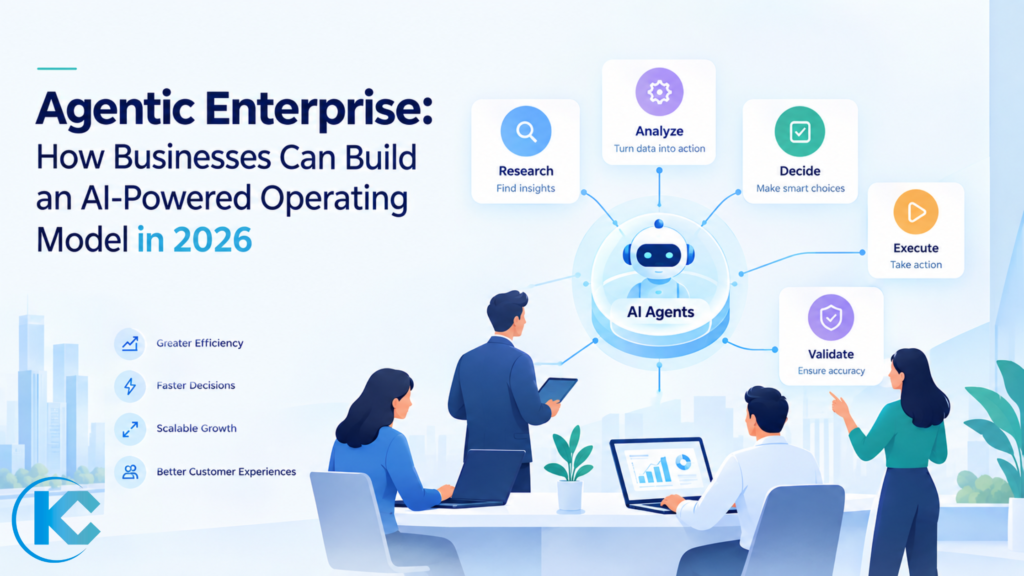
AI is moving beyond chatbots and isolated automation. The next stage is the agentic enterprise – where AI agents can understand goals, reason through tasks, interact with business systems, and execute workflows while humans remain responsible for oversight and high-impact decisions.
Agentic AI
AI Agents
Salesforce Agentforce
Enterprise AI
AI Agents
Salesforce Agentforce
Enterprise AI
Executive Quick Answer
An agentic enterprise is an organization where AI agents, employees, data, applications, and automation work together around business outcomes. Unlike traditional automation, which typically follows predefined rules, agentic systems can interpret goals, choose actions, use enterprise tools, adapt to changing conditions, and escalate exceptions to people.
The practical path is not to deploy dozens of agents at once. Start with a measurable business problem, establish a trusted data foundation, connect the agent to the systems it needs, define permissions and guardrails, keep humans involved in high-risk decisions, and continuously evaluate the agent after deployment.
Goal
Outcome-driven AI
Data
Trusted business context
Agents
Reason + act + adapt
Humans
Oversight + judgment
What Is an Agentic Enterprise?
Businesses have spent years automating individual tasks: sending emails, updating CRM fields, routing tickets, generating reports, and triggering workflows.
The agentic enterprise goes one step further.
Instead of simply asking software to execute a predefined instruction, organizations give AI agents a business objective, access to relevant context and tools, and clearly defined boundaries. The agent can then determine the steps required to move toward that objective.
For example, a traditional automation might assign a new lead to a sales representative based on territory. An AI agent could evaluate the lead, review previous interactions, research relevant account information, determine the appropriate next action, draft personalized outreach, update Salesforce, and request human approval when the action exceeds its permissions.
That difference – moving from task automation to goal-oriented execution – is at the heart of agentic AI.
Agentic AI vs Traditional Automation
Traditional automation remains extremely useful for predictable processes. The problem appears when workflows involve ambiguity, changing information, multiple systems, or decisions that cannot be represented easily through fixed rules.
The goal is not to replace automation with agents everywhere. Mature organizations will typically use both: deterministic automation for stable processes and agentic systems where reasoning, context, and adaptation create additional value.
AI Opportunity Assessment
Ready to Identify Your Best AI Agent Use Case?
Start with the workflow, not the technology. Tell us about your business process and we’ll help you identify where AI agents can create measurable value across Salesforce, sales, service, operations, and enterprise workflows.
Tell Us About Your Use Case
Share a few details and our team can help you evaluate the opportunity.
Why Businesses Are Moving Toward the Agentic Enterprise
The pressure is not simply about adopting the newest AI technology. Enterprises are looking for ways to improve productivity without continuously increasing operational complexity.
AI agents can help because they operate across workflows rather than remaining limited to a single conversational interface.
Less Manual Work
Agents can handle repetitive research, data updates, routing, documentation, and follow-up activities.
Faster Decisions
Agents can combine information from multiple systems before recommending or executing an action.
Always-On Operations
Digital agents can monitor events and workflows continuously rather than waiting for a person to initiate every step.
Better Customer Experiences
Agents can use customer context to deliver more relevant responses and execute service actions faster.
5 Foundations of an Enterprise-Ready Agentic AI Strategy
Successful agentic transformation requires more than connecting an LLM to a few APIs. Enterprises need an operating model that combines business strategy, data, technology, governance, and continuous improvement.
1. Start With a Business Outcome
The strongest agentic initiatives begin with a measurable business problem.
Instead of asking, “Where can we use AI?”, ask questions such as:
- Which workflow consumes significant employee time?
- Where do delays directly affect revenue or customer experience?
- Which decisions are repetitive but still require contextual judgment?
- Which processes involve multiple systems or handoffs?
A focused use case makes it easier to define success metrics and establish the appropriate level of autonomy.
2. Build a Trusted Data Foundation
An agent is only as useful as the context it can access.
If customer records are fragmented, knowledge bases are outdated, or permissions are unclear, adding an autonomous layer can amplify existing problems rather than solve them.
Enterprise AI therefore needs clean, governed, accessible data across CRM systems, ERP platforms, documents, APIs, knowledge repositories, and other business applications.
For organizations using Salesforce, this often means strengthening the data layer before expanding Agentforce or custom AI agents.
Explore Kizzy’s Data Foundation for AI services to understand how data quality, integration, identity resolution, governance, and AI activation fit together.
3. Give Agents the Right Tools and Permissions
An enterprise agent becomes useful when it can do more than generate text.
It may need to retrieve customer information, update a CRM record, create a case, query an inventory system, send a message, generate a document, or trigger another workflow.
That creates an important architectural requirement: every tool should have controlled access and clearly defined permissions.
- Authentication and authorization
- Role-based access
- API controls
- Action-level permissions
- Audit logging
- Human approval for sensitive actions
4. Design Human-AI Collaboration
An agentic enterprise is not a business without humans. It is a business where humans spend less time performing repetitive execution and more time supervising, deciding, designing, and handling exceptions.
A useful autonomy model is:
Assist: AI recommends an action and a person executes it.
Approve: AI prepares and executes routine work after human confirmation.
Act: AI performs low-risk actions independently.
Escalate: AI recognizes uncertainty, policy conflicts, or high-impact decisions and transfers control to a human.
5. Continuously Evaluate and Improve
Launching an agent is not the end of an AI project. Production agents encounter new inputs, changing policies, evolving customer behavior, model updates, integration failures, and unexpected edge cases.
Enterprises need ongoing evaluation covering:
- Accuracy and task completion
- Hallucination and grounding quality
- Security and policy compliance
- Cost per task or outcome
- Escalation rates
- Customer and employee experience
- Business KPI impact
This continuous-improvement model is especially important when agents are responsible for real business actions rather than simply answering questions.
What Does an Enterprise Agent Architecture Look Like?
A production-ready agent typically sits inside a larger technology ecosystem. The LLM is only one component.
Business Goal
↓
Agent Reasoning
Memory & Context
Tools & APIs
Guardrails
↓
CRM
ERP
Knowledge
Enterprise APIs
↓
Business Outcome
This is why enterprise agent implementation is fundamentally an architecture problem. The agent must operate safely inside the organization’s existing technology and governance environment.
Kizzy helps businesses connect AI agents with CRM, APIs, databases, documents, knowledge bases, and enterprise workflows through its AI Integration & Implementation services.
The Salesforce Role in the Agentic Enterprise
Salesforce is particularly relevant to the agentic enterprise because CRM systems already contain the customer, sales, service, and workflow context that agents need to perform useful actions.
With Agentforce, organizations can build AI agents that work inside Salesforce and connect their reasoning to customer information, business processes, automation, and enterprise data.
The larger opportunity is not simply adding an AI assistant to the CRM. It is turning the CRM into an execution layer for customer-facing and revenue workflows.
Examples include:
- Qualifying and routing inbound leads
- Preparing sales follow-ups
- Summarizing account activity
- Handling routine customer service requests
- Creating or updating cases
- Retrieving customer and product information
- Supporting appointment scheduling
- Triggering downstream workflows
- Escalating complex cases to human employees
Kizzy Consulting provides Agentforce consulting and implementation, including readiness assessment, use-case discovery, architecture, agent configuration, workflow integration, testing, and optimization.
Ready to Build Your Agentic Enterprise?
Whether you are evaluating your first AI agent or scaling Agentforce across the enterprise, Kizzy Consulting can help you move from experimentation to production-ready AI.
>
High-Value Agentic AI Use Cases
Sales
Lead qualification, account research, personalized outreach, opportunity updates, and next-step recommendations.
Customer Service
Case classification, knowledge retrieval, customer responses, resolution workflows, and intelligent escalation.
Operations
Workflow monitoring, document processing, data updates, exception management, and cross-system coordination.
Knowledge Management
Agents can search policies, SOPs, contracts, product documentation, and internal knowledge before taking action.
Finance
Invoice processing, financial document analysis, reconciliation support, reporting, and exception routing.
HR
Employee support, policy lookup, onboarding workflows, document handling, and internal service automation.
When Should Enterprises Use Multiple AI Agents?
Not every process requires a multi-agent architecture. A single well-designed agent is often easier to test, govern, and maintain.
Multi-agent systems become useful when a workflow naturally contains distinct responsibilities.
For example:
Research Agent → gathers relevant information
Analysis Agent → evaluates the information
Execution Agent → performs approved actions
Review Agent → checks output against policies or quality requirements
The benefit is specialization. The challenge is orchestration. As the number of agents grows, organizations need stronger routing, permissions, observability, failure handling, and communication controls.
Kizzy’s AI Agents & Automation Development practice supports custom agents and multi-agent workflows connected to enterprise systems.
Governance: The Difference Between an AI Demo and an Enterprise System
Giving an AI agent access to business systems changes the risk profile dramatically. An agent that can read data is different from an agent that can modify records, send communications, approve transactions, or trigger downstream processes.
Enterprise governance should therefore define:
- What the agent is allowed to access
- Which actions it can perform autonomously
- Which actions require approval
- What information it can retrieve
- How actions are logged
- How failures are handled
- When control moves to a human
- How the agent is evaluated over time
This aligns with broader enterprise security principles such as least privilege and zero-trust architecture. Organizations can also use resources from NIST’s Zero Trust Architecture and the OWASP GenAI Security Project when designing their AI security model.
How to Build an Agentic Enterprise: A Practical Roadmap
01. Assess
Review data, processes, systems, security, and AI readiness.
Review data, processes, systems, security, and AI readiness.
02. Prioritize
Select use cases based on business value, feasibility, and risk.
Select use cases based on business value, feasibility, and risk.
03. Prototype
Build a focused proof of concept around one measurable outcome.
Build a focused proof of concept around one measurable outcome.
04. Integrate
Connect the agent to CRM, APIs, databases, documents, and workflows.
Connect the agent to CRM, APIs, databases, documents, and workflows.
05. Govern
Add permissions, guardrails, approval flows, monitoring, and auditability.
Add permissions, guardrails, approval flows, monitoring, and auditability.
06. Scale
Expand to additional workflows only after proving reliability and ROI.
Expand to additional workflows only after proving reliability and ROI.
For organizations that need a production-focused team around a specific AI outcome, Kizzy also offers AI Pod Services combining architecture, engineering, product thinking, evaluation, and deployment.
Agentic AI Production Checklist
- Defined business objective
- Clear success metrics
- Trusted and relevant data sources
- Secure authentication and authorization
- Least-privilege permissions
- Tool and API controls
- Human escalation rules
- Prompt and policy guardrails
- Testing against realistic edge cases
- Monitoring and audit trails
- Cost and performance tracking
- Incident and fallback procedures
- Named business owner
- Continuous evaluation process
For a more detailed implementation checklist, see Kizzy’s AI Agent Implementation Guide 2026.
The Future Is Not Just AI-Powered. It Is Agent-Orchestrated.
The most important change is not that businesses will have more AI tools. It is that AI will increasingly become part of the operating layer through which work gets completed.
Instead of employees moving manually between CRM records, emails, spreadsheets, knowledge bases, ticketing platforms, and internal applications, agents can increasingly coordinate those steps.
This creates a new enterprise model:
Humans define objectives, strategy, judgment, and accountability.
AI agents perform research, reasoning, coordination, and execution.
Enterprise data provides trusted context.
Platforms and APIs provide tools and access.
Governance keeps the entire system safe, observable, and accountable.
That is the foundation of an agentic enterprise.
Frequently Asked Questions