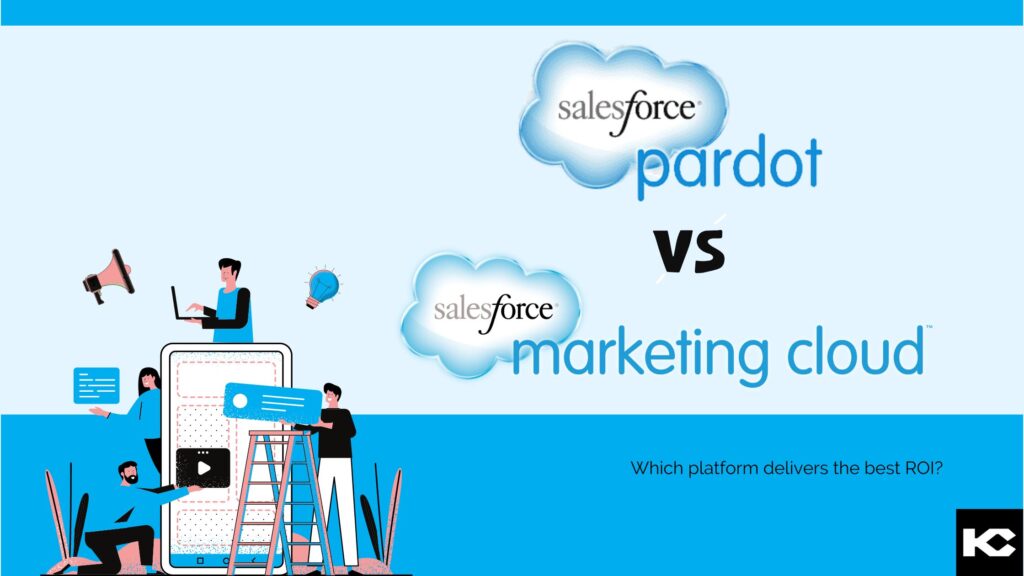
Pardot vs Salesforce Marketing Cloud: Which Is Better for Marketing ROI?
⏱ 4 min read
SALESFORCE MARKETING
Pardot, now known as Marketing Cloud Account Engagement, and Salesforce Marketing Cloud products serve different marketing needs. Understanding their audiences, automation capabilities, analytics, integrations, scalability, and costs can help businesses choose the right platform for measurable marketing ROI.
Quick Answer
Marketing Cloud Account Engagement is designed primarily for B2B marketing automation, with capabilities such as lead nurturing, scoring, engagement tracking, and alignment with Salesforce CRM. Marketing Cloud Engagement is designed for broader, cross-channel customer engagement, including email, mobile messaging, journeys, segmentation, and large-scale campaign orchestration. Salesforce also offers Marketing Cloud Next, its newer marketing platform with AI-powered and unified-data capabilities.
Understanding Marketing ROI
Marketing ROI measures the financial return generated by marketing activities relative to the investment required to run them. A simple calculation is:
Marketing ROI = (Revenue Generated − Marketing Investment) ÷ Marketing Investment × 100
For example, if a company invests €1,000 in a campaign and generates €5,000 in attributable revenue, the ROI is 400%.
Marketing automation platforms can improve ROI measurement by connecting campaigns, customer interactions, lead activity, opportunities, and revenue data. However, the platform itself does not determine ROI. Data quality, attribution models, campaign strategy, audience targeting, sales alignment, and adoption all affect the outcome.
Pardot Is Now Marketing Cloud Account Engagement
One important update before comparing the platforms: Pardot is now officially called Marketing Cloud Account Engagement. Salesforce documentation continues to reference the former Pardot name in some areas, but the current product name is Marketing Cloud Account Engagement.
At the same time, Salesforce’s marketing portfolio has expanded. Marketing Cloud Account Engagement, Marketing Cloud Engagement, Marketing Cloud Next, Marketing Cloud Personalization, and Marketing Cloud Intelligence have different purposes and capabilities.
Therefore, a modern comparison should not simply treat “Pardot” and “Salesforce Marketing Cloud” as two identical categories. The right comparison depends on the specific Salesforce marketing product being evaluated.
Explore – https://kizzyconsulting.com/pardot-salesforce-integration/
Marketing Cloud Account Engagement vs Marketing Cloud Engagement
Salesforce’s current documentation identifies Engagement Studio as the visual automation tool for Account Engagement and Journey Builder as the visual automation tool for Marketing Cloud Engagement.
Marketing Cloud Account Engagement for Marketing ROI
Marketing Cloud Account Engagement is positioned by Salesforce as a B2B marketing automation solution. It is particularly relevant when marketing teams need to nurture prospects, qualify leads, track engagement, and connect marketing activity with sales processes.
Lead Nurturing
Build automated nurture programs that move prospects through different stages of the buying journey.
Lead Scoring
Use engagement and behavioral signals to help marketing and sales teams prioritize prospects.
Engagement Tracking
Connect prospect activity with Salesforce records to give teams more context around engagement.
B2B Analytics
Higher editions can provide access to B2B Marketing Analytics and additional marketing measurement capabilities.

Need Help Choosing a Salesforce Marketing Platform?
The right architecture depends on your CRM setup, audience, campaign complexity, data model, reporting requirements, and growth plans.
Marketing Cloud Engagement for Marketing ROI
Marketing Cloud Engagement is built around large-scale customer engagement across channels. Salesforce’s current offering includes capabilities for email, mobile messaging, multi-channel journeys, content creation, segmentation, analytics, and AI-powered marketing capabilities depending on the edition.
Journey Automation
Design customer journeys that coordinate marketing interactions across multiple stages and channels.
Cross-Channel Engagement
Coordinate email, mobile messaging and other customer engagement touchpoints within broader journeys.
Segmentation
Use customer and behavioral data to create audiences for more targeted campaign execution.
Analytics
Measure campaign and journey performance to identify engagement trends and opportunities for optimization.
Explore Salesforce Marketing Automation
See how Salesforce marketing capabilities can support customer engagement, automation, and campaign management.
Which Platform Can Deliver Better ROI?
There is no universal ROI winner. ROI depends on how closely the platform’s capabilities match the organization’s marketing model and how effectively the implementation is designed.
Choose Account Engagement When
- Your marketing model is primarily B2B.
- Lead nurturing is a major requirement.
- Sales and marketing alignment is important.
- You want marketing activity closely connected to Salesforce CRM.
- Lead scoring and prospect engagement are central to your process.
Consider Marketing Cloud Engagement When
- You need broader cross-channel engagement.
- Customer journeys span multiple communication channels.
- Your organization manages large customer audiences.
- Journey orchestration is a major requirement.
- You need advanced campaign and engagement capabilities.
Where Marketing Cloud Next Fits
The Salesforce marketing landscape has continued to evolve beyond the traditional Pardot-versus-Marketing-Cloud comparison. Marketing Cloud Next provides newer marketing capabilities built around automation, unified data, AI, and multi-channel engagement.
Salesforce currently lists Marketing Cloud Next Growth and Advanced editions, with capabilities such as Agentforce campaign creation, multi-channel journeys, forms and landing pages, AI scoring, path experimentation, and two-way SMS and WhatsApp conversations depending on the edition.
Salesforce Marketing Automation Pricing
Pricing has changed considerably from the older Pardot and Marketing Cloud pricing structures, so historical pricing figures should not be used to evaluate a current implementation.
As of 2026, Salesforce lists Marketing Cloud Account Engagement+ editions starting at $1,250 per organization per month for Growth+, with Plus+, Advanced+, and Premium+ at higher price points. Marketing Cloud Engagement+ starts at $2,000 per organization per month for Pro+, with Corporate+ and Enterprise+ priced higher. These prices are billed annually and Salesforce notes that pricing and packaging are subject to change.
Marketing Cloud Next is separately priced, with Salesforce currently listing Growth Edition at $1,500 per organization per month and Advanced Edition at $3,250 per organization per month, billed annually.
Important: License price is only one component of total marketing technology cost. Implementation, integration, data preparation, configuration, training, ongoing administration, campaign operations, and additional capabilities can materially affect the overall investment.
Building a Connected Salesforce Marketing Architecture?
A strong marketing architecture starts with clean data, connected systems, clear customer journeys, and measurable business outcomes.
Integrations and Scalability
Integration architecture plays a major role in marketing ROI. A marketing platform becomes more valuable when campaign activity can be connected to CRM records, customer data, sales processes, analytics, and downstream business systems.
Account Engagement is closely aligned with Salesforce CRM and supports connected campaign functionality within Salesforce.
Marketing Cloud Engagement provides a broader architecture for customer engagement, including journeys, subscriber data, data extensions, and cross-channel marketing capabilities.
For organizations with complex environments, integration should be planned around data ownership, synchronization frequency, identity resolution, consent, security, reporting requirements, and operational workflows rather than simply connecting systems as quickly as possible.
How to Measure Marketing Automation ROI
Whichever Salesforce marketing platform you choose, establish measurable KPIs before implementation. Useful metrics can include:
Pipeline Generated
Measure opportunities influenced or generated by marketing.
Conversion Rate
Track movement from prospects to qualified leads and customers.
Customer Acquisition Cost
Compare acquisition spend against customers generated.
Campaign Revenue
Connect campaign performance with attributable revenue where appropriate.
Engagement
Monitor meaningful interactions across email, journeys, and other channels.
Sales Cycle
Analyze whether improved marketing and sales alignment affects time to conversion.
Customer Reviews and Case Studies
Customer reviews can provide useful context when evaluating marketing platforms, but review scores should not be treated as a direct measure of ROI. Results depend on company size, implementation quality, marketing maturity, integrations, use cases, and the metrics selected.
When evaluating a Salesforce marketing platform, look beyond star ratings and review volume. Review implementation complexity, available capabilities, support requirements, integration needs, reporting, and the type of organizations using the platform.
Implementation Factors That Affect ROI
Even the right platform can produce disappointing results if the implementation is poorly designed. Before choosing a solution, evaluate:
- Existing Salesforce architecture and CRM edition.
- Marketing and sales processes.
- B2B versus B2C customer journeys.
- Number and type of marketing channels.
- Contact and customer data volume.
- Data quality and governance.
- Integration requirements.
- Attribution and reporting requirements.
- Internal marketing and Salesforce expertise.
- Long-term scalability requirements.
Salesforce marketing automation should be implemented around business processes and measurable outcomes rather than simply enabling every available feature.
Planning a Salesforce Implementation?
Get your CRM, marketing automation, integrations, data, and reporting architecture aligned before scaling your Salesforce investment.
Frequently Asked Questions
Is Pardot still available?
Pardot is now called Marketing Cloud Account Engagement. Salesforce continues to use the Pardot name in some documentation and product areas, but Account Engagement is the current product name.
What is the difference between Pardot and Salesforce Marketing Cloud?
Marketing Cloud Account Engagement, formerly Pardot, is primarily a B2B marketing automation platform. Marketing Cloud Engagement focuses on broader cross-channel customer engagement and journey orchestration. Salesforce also offers Marketing Cloud Next as a newer marketing platform.
Is Marketing Cloud Account Engagement good for B2B marketing?
Yes. Salesforce positions Account Engagement as a B2B marketing automation solution with capabilities for lead nurturing, scoring, engagement tracking, and Salesforce CRM alignment.
Is Salesforce Marketing Cloud better for B2C companies?
Marketing Cloud Engagement can be well suited to organizations that need large-scale, cross-channel customer engagement. However, platform selection should be based on actual journey, data, channel, integration, and reporting requirements rather than B2C or B2B classification alone.
Which Salesforce marketing platform has the best ROI?
There is no single platform that produces the best ROI for every organization. Account Engagement may align well with B2B lead nurturing and sales alignment, while Marketing Cloud Engagement may fit organizations with broader cross-channel journey requirements. The right choice depends on business goals, data, channels, implementation effort, and measurable outcomes.
How much does Salesforce Marketing Cloud cost?
Pricing varies by product and edition. Salesforce currently lists Account Engagement+ from $1,250 per organization per month and Marketing Cloud Engagement+ from $2,000 per organization per month, billed annually. Marketing Cloud Next has separate Growth and Advanced editions. Salesforce notes that pricing and packaging can change.
Can Marketing Cloud Account Engagement and Salesforce CRM work together?
Yes. Account Engagement is designed to work with Salesforce CRM, and Salesforce provides connected campaign and user synchronization capabilities for the platform.
How can I improve Salesforce marketing ROI?
Start with clean customer data, clearly defined KPIs, appropriate segmentation, strong sales and marketing alignment, reliable attribution, automated journeys, and continuous optimization. The technology should support the marketing strategy rather than replace it.
Ready to Improve Your Salesforce Marketing ROI?
Kizzy Consulting can help you evaluate your Salesforce marketing architecture, connect CRM and marketing data, automate customer journeys, and build a measurable implementation strategy.
Conclusion
The comparison between Pardot and Salesforce Marketing Cloud has evolved as Salesforce has expanded and renamed its marketing portfolio. Pardot is now Marketing Cloud Account Engagement, a B2B marketing automation solution, while Marketing Cloud Engagement focuses on broader customer engagement and journey orchestration. Marketing Cloud Next adds another option for organizations looking for newer AI-powered and unified-data marketing capabilities.
The most appropriate platform depends on your marketing model, customer journey, data architecture, channels, Salesforce environment, reporting requirements, and growth plans. Instead of choosing based solely on licensing cost or feature count, evaluate the complete business process and the measurable outcomes you expect the platform to support.
With the right strategy, implementation, data foundation, and ongoing optimization, Salesforce marketing automation can become a measurable part of your broader revenue and customer engagement strategy.
Kizzy Consulting
Kizzy Consulting helps businesses design, implement, integrate, and optimize Salesforce solutions across CRM, marketing, data, automation, and AI. Connect with our team at [email protected] or contact us.