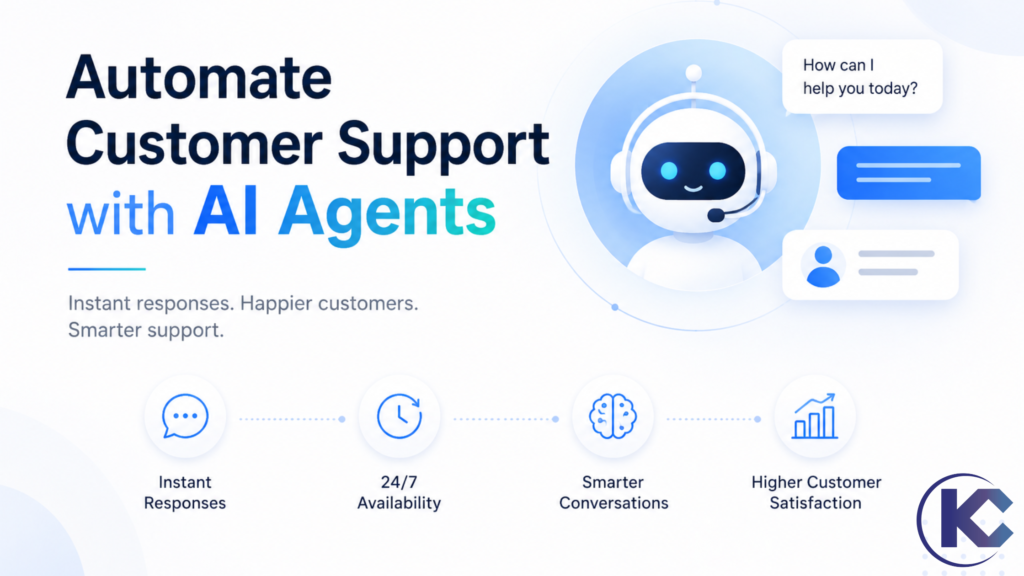
Automate Customer Support with AI Agents
⏱ 5 min read
Customer expectations are higher than ever, and businesses need faster, more efficient ways to deliver support. AI agents are transforming customer service by handling routine inquiries, providing instant responses, and offering 24/7 assistance without increasing operational costs. By automating customer support with AI agents, companies can improve response times, enhance customer satisfaction, and free human teams to focus on more complex issues. In this blog, we’ll explore how AI-powered customer support works, its key benefits, and best practices for successful implementation.
Definition
An AI agent for customer service is an autonomous software program that perceives customer intent, dynamically plans multi-step resolution workflows, and executes actions across CRM, ERP, and communication systems without requiring manual human input for each step.
In today’s hyper-competitive corporate landscape, customer experience has become the ultimate deciding factor in an enterprise’s market success. However, modern service professionals are structurally struggling to stay afloat. Recent global research from Salesforce indicates that 82% of customer service representatives report that modern consumers demand far more than they used to. This massive spike in interaction volume, paired with monotonous routine administration, has caused human agent burnout rates to reach an all-time high.
To break this bottleneck, forward-thinking enterprises are moving past legacy helpdesk setups to actively automate customer support with AI agents. Built on a foundation of machine learning, conversational AI, and natural language processing (NLP), an autonomous AI support agent acts as an independent digital coworker. Instead of forcing customers through basic keyword search forms, an autonomous system evaluates unstructured chat, voice, or text queries, maps out a multi-step task plan, and interacts directly with external environments to complete processes safely end-to-end.
Legacy Chatbots & IVR
- ✗ Answer one isolated prompt at a time
- ✗ Rigid, pre-configured rule-based FAQ trees
- ✗ Trapped inside localized web chat widgets
- ✗ Zero cross-session user memory retention
- ✗ Tell customers your policy without fixing the issue
Autonomous AI Support Agents
- ✓ Deeply evaluate customer intent and sentiment
- ✓ Dynamically plan and organize multi-step actions
- ✓ Multi-channel support (Voice, Email, WhatsApp)
- ✓ Persistent memory that tracks past interactions
- ✓ Trigger secure API callouts to resolve tickets entirely
Key Takeaways: Customer Support Automation
1
Outcome Ownership: Autonomous customer service tools focus entirely on resolving the final goal, rather than merely deflecting or closing support queries.
2
Task Decomposition: Agents take an open-ended customer complaint, break it into manageable sub-tasks, and seamlessly pass information across a networked agentic system.
3
Deep Integration: True operational efficiency requires linking AI agents directly with core enterprise ecosystems like CRM networks, ERP systems, and internal knowledge bases.
4
The Human-AI Partnership: Implementing automated digital workers shifts human agent responsibilities toward complex technical oversight, relationship building, and high emotional intelligence.
How AI Agents for Customer Service Work: The 5-Step Loop
Unlike simple bots that run on linear if-then paths, an AI agent customer service framework relies on an analytical loop to perceive user environments and alter its actions dynamically based on changing conditions. Think of it like a smart vacation-planning agent system: it reads your family profile, queries active third-party weather APIs, maps routes, coordinates with hotel logistics, and shifts your booking parameters on the fly if a sudden storm causes traffic delays. Platforms like Kizzy’s AI Integration and implementation service apply this exact loop architecture to enterprise customer support environments.
01
Ingest & Intent Parse – The agent receives unstructured inbound user data (emails, CRM tickets, real-time voice calls) and uses natural language understanding to classify intent, language, and emotional state.
02
Context Assembly & Reasoning – The model references historical profiles and pulls persistent user memory to assemble a clear context sheet, asking clarifying questions if key operational details are missing.
03
Dynamic Workflow Planning – The agent evaluates available tools, parses enterprise policy data, and designs an optimal step-by-step resolution path tailored to that specific case.
04
Tool & API Invocation – The agent executes actions within authorized systems: running database lookups, processing transactional refund payloads, updating CRM logs, or sending out texts through communication tools like Twilio.
05
Reflection Loop & Closing – The system cross-verifies its output log, flags discrepancies, crafts a clear natural summary response to notify the user, and updates internal project management trackers.
Key Use Cases for AI Agents in Customer Service
Integrating an agentic customer service system enables companies to easily delegate complex workflows that previously jammed up ticket queues. Kizzy’s AI agent solutions cover every major use case below –
- Addressing Specialized Queries: Engages in high-touch, dynamic communications regarding nuanced product updates, corporate warranty guidelines, and custom cancellation policies.
- Order Status and Tracking: Provides immediate fulfillment answers by pulling active shipping metrics, tracking courier coordinates, and cross-referencing route delays.
- Troubleshooting and Technical Support: Guides users step-by-step through complicated software configurations or hardware resets, tailoring instructions based on the specific system model.
- Knowledge Management and Real-Time Insights: Automatically structures internal documentation, updates knowledge base logs, and delivers personalized answers via AI content agents to both customers and team members.
- Identifying Customer Sentiment: Uses sentiment analysis tools to act as an early-warning radar for user frustration, generating executive meeting summaries and flagging product bugs.
- Back-Office Process Automation: Autonomously manages administrative chores, data sync pipelines, user preferences storage, and general contact center updates.
- Voice-Based Customer Engagement: AI voice agents answer inbound calls, qualify leads, resolve billing questions, and fire conversational SMS follow-ups all without a human on the line.
Salesforce Agentforce: Enterprise-Grade Customer Support Automation
For enterprises already running on Salesforce, Salesforce Agentforce is the fastest path to deploying autonomous customer support agents without rebuilding your existing tech stack. Unlike third-party bolt-on tools, Agentforce lives natively inside your Salesforce org – meaning your agents have immediate, authorized access to Service Cloud cases, Knowledge articles, customer records, and flow automation with zero data migration risk.
What can Salesforce Agentforce do for customer support teams?
Agentforce-powered support agents can autonomously handle inbound case triage, generate draft responses grounded in your Knowledge Base, update account and contact records in real time, trigger Flow automations to process refunds or order changes, and escalate edge-case tickets to a human rep with full context intact. The result is a measurable compression of average handle time (AHT) and a significant lift in first-contact resolution (FCR) rates.
Expert Perspective
“In our AI Agents deployments, the single biggest unlock isn’t speed – it’s consistency. Every customer gets the same quality of answer, grounded in the same verified Knowledge Base, whether the inquiry comes in at 9 AM or 3 AM on a Sunday. That consistency is what moves the CSAT needle.”
– Sanjeet Mahajan, Founder & CEO, Kizzy Consulting | 13x Salesforce Certified Architect
How does Agentforce differ from standard Salesforce chatbots?
Salesforce’s older Einstein Bots operate on scripted decision trees, they can answer a predefined FAQ but cannot reason through a novel problem or take action in a back-end system. Agentforce replaces that model with a reasoning engine: it reads the full case context, evaluates available tools, designs a resolution plan, and executes it. Think less “FAQ bot” and more “autonomous digital service rep.” Our team at Kizzy has helped clients across healthcare, financial services, and real estate configure and go live with Agentforce in as few as six weeks.
Watch It in Action
Agentic AI in Action: 2026 Industry Examples
Real Estate & CX
AI Voice Agents for Lead Qualification
AgentCalling.ai answers missed calls, qualifies cold inbound prospects, books property showings, and fires out conversational SMS follow-ups around the clock with zero manual coordination.
B2B Sales Operations
Salesforce Agentforce SDR Deployments
Agentforce SDR agents independently research enterprise prospects, personalize deep email outreach templates, answer basic friction points, update pipeline records, and log sales calls.
Healthcare Care Paths
Patient Journey Support Automation
AI voice agents for healthcare manage front-end medical office workflows: interpreting patient inquiries, cross-checking insurance verifications, logging appointments, and executing secure reminder notices.
Finance & Banking
Autonomous Fraud & Compliance Radar
Dedicated compliance systems scan raw ledgers constantly, trace security transaction vectors, map out compliance reports, and escalate suspicious profiles automatically.
Case Evidence: Core Business Impact
Retail Scaling
By embedding intelligent conversational AI agents into customer interaction channels, the major RV retailer boosted overall customer engagement by 40% while dropping hold times down to just 33 seconds.
Operations Engineering
Deploying automated process agents allowed the R&D firm to optimize routine account setups and administrative data pipelines, shortening new customer onboarding timelines by 25%.
Real-World Productivity Impact
An enterprise logistics and shipping provider integrated agentic workflows to handle incoming operational records. The system squeezed the time spent on manual onboarding paperwork from four hours a week down to a 30-minute window, freeing up the team to dedicate their energy to nuanced, high-touch customer care initiatives.
Measurable Benefits of AI Agents for Customer Support
True 24/7 Availability
Provides instant, personalized, multi-lingual client assistance around the clock across global time zones, eliminating backlogs.
Data-Driven Insights
Parses massive volumes of raw customer interaction logs instantly, identifying product trends and optimizing resource distribution.
Omnichannel Support
Delivers a frictionless, single conversation thread across email channels, phone lines, social platforms, and custom chat interfaces.
Infinite Elastic Scalability
Processes large, unexpected spikes in incoming ticket volume simultaneously without requiring immediate staffing increases or hardware upgrades.
Trending Support Advancements in 2026
Voice-First Agentic AI
Direct speech-to-speech processing skips high-latency text translation layers, creating human-like support call interactions. See AgentCalling for a live example.
Computer-Use Agents
AI agents navigate external application windows using computer vision and mouse path tools whenever native backend APIs are absent.
Persistent System Memory
Agents carry deep user profile history over long timelines, continuously adjusting problem-solving workflows on a personalized basis.
Market Performance Data and Statistics
The numbers supporting the deployment of autonomous enterprise AI support workforces emphasize massive operational returns. Data sourced from Salesforce Agentforce research and Grand View Research’s agentic AI market report:
84%
84% say AI has improved customer satisfaction and ROI
34%
Increase in productivity
due to generative or agentic AI
$110B+
Global agentic market size milestone (Grand View Research)
Statistical Business Advantages of Automation Deployment:
- Instant Resolution Handling: Eradicates hold times entirely, providing quick and precise answers.
- Optimized Staff Focus: Offloads routine admin logs, leaving human teams with clean context for complex cases.
- Reduced Operating Overhead: Drives down expenses by managing high-volume service ticket creation automatically.
Four Best Practices for Deploying Support Agents
To capture maximum commercial value while mitigating performance risks, follow these four implementation guidelines:
1. Integrate AI Into a Broader Customer Engagement Strategy – Support agent installations shouldn’t run in isolated silos. Align agent behavior with overall short- and long-term customer service metrics, such as improved CSAT marks or total resolution time speed.
2. Provide AI Agents with Appropriate Data and Tools – Digital workers are only as robust as the assets they access. Invest in formatting clean enterprise repositories, verify third-party API configurations, and guarantee continuous entries into your core knowledge bases. Our Content Strategist Agent can automate the ongoing maintenance of those knowledge assets.
3. Integrate Agents with Enterprise-Wide Systems – Modern automated pipelines function best when deeply integrated across corporate boundaries. Link your systems directly to central CRM platforms, billing tools, and ERP networks to facilitate accurate data access and cross-department decision-making.
4. Upskill Human Agents for Collaboration – Because autonomous systems take over routine tasks, the role of your support team must evolve. Train customer service representatives to work productively alongside AI platforms, query trace outputs effectively, and use data summaries to manage sensitive escalations with superior empathy.
Frequently Asked Questions About AI Agent Customer Service
What are AI agents and how can they help serve customers?
An AI agent is a software program that autonomously designs workflows and calls external software tools to finish complex tasks. In customer service, they resolve specialized queries, handle multi-channel interactions, track shipments, and manage repetitive tickets entirely on their own.
How does Salesforce Agentforce automate customer support?
Salesforce Agentforce deploys autonomous agents natively inside your Salesforce org. They handle case routing, draft responses from your Knowledge Base, update records in real time, and escalate to human reps when needed all without leaving Salesforce.
How do AI agents handle data protection during customer chats?
Enterprise-grade agentic platforms mask personally identifiable information (PII), strip financial card strings before database entry, and run token-based authentication schemas to interact safely with external software environments.
Can AI support systems handle complex, specialized edge cases?
Yes, via deterministic fallbacks. When an autonomous agent encounters a problem outside its guardrails, it immediately bundles the full context trace and routes a smooth handoff to an expert human representative.
What makes an AI support agent distinct from a standard language model?
A standard LLM is purely passive, it outputs text based on a manual prompt. An agentic platform connects that LLM brain to persistent task memory, reasoning loops, and system APIs, allowing it to independently carry out real actions in secondary applications.
How long does it take to implement an AI agent for customer support?
Most businesses deploy a functional agent within 4 to 12 weeks. Basic FAQ automation and ticket routing can go live in under a month; deep CRM, ERP, and knowledge base integrations typically need 8 to 12 weeks.
What is the cost of automating customer support with AI agents?
Costs vary by scale and platform. Businesses typically see a 35% reduction in per-interaction costs alongside savings from reduced staffing overhead. Most enterprises recover implementation costs within 6 to 12 months through operational efficiency gains alone.
Ready to Build Your Automated Customer Support Team?
Stop slowing down customer interactions with rigid, outdated chat forms. Kizzy Consulting specializes in designing robust corporate AI strategies, structuring automated customer support loops, and integrating autonomous AI solutions that turn customer care into an efficient, scalable growth asset.
Contact our expert Agentforce implementation team today to build your automated future!