AI Agents vs Chatbots: What’s the Real Difference?
⏱ 3 min read
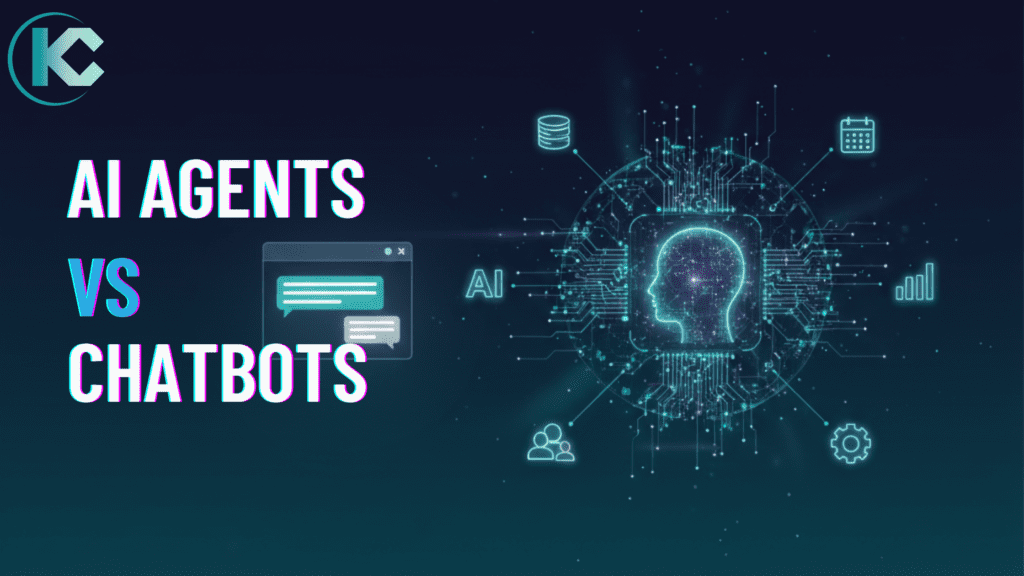
Customer communication has fundamentally changed. Today, people expect fast answers, real conversations, and most importantly – immediate action. AI agents reply the way chatbots do, then go a step further and get the work done. The difference isn’t in how they talk – it’s in what they can do. Understanding that distinction is the key to choosing the right solution and avoiding wasted automation spend.
Contents
hide
What Is a Chatbot?
A chatbot is a rule-based or scripted assistant that responds to user inputs using predefined logic flows. They are excellent for handling predictable interactions.
Chatbots Help Businesses By
- Answering frequently asked questions (FAQs)
- Sharing basic company information
- Guiding users through simple button-based menus
- Handling repetitive, low-level queries
The Limitation
Chatbots struggle when a question falls outside their script, when a complex decision needs to be made, or when a cross-platform action needs to occur. Chatbots respond, but they don’t act.
What Is an AI Agent?
An AI agent is a goal-driven system designed to understand context, reason through problems, and take independent action. In short: AI agents don’t just talk – they work.
AI Agents Provide Value By
- Understanding Intent: Identifying the “why” behind a natural conversation, voice or text.
- Autonomous Reasoning: Deciding the next best action without a pre-written script.
- Executing Tasks: Connecting to your CRM, booking appointments, or processing orders.
- Continuous Learning: Improving accuracy and helpfulness over time.
i
Deep Dive: AI agents are the foundation of Agentic AI, where systems function as digital employees rather than simple tools.
AI Agents vs. Chatbots: Comparison at a Glance
| Feature | Chatbot | AI Agent |
|---|---|---|
| Logic | Scripted & rule-based | Context-aware & reasoning |
| Capability | Answers questions | Executes end-to-end workflows |
| Action | Limited/no system actions | Updates CRM, books meetings, and more |
| Integration | Basic/surface level | Deep API & system integrations |
| Best For | Static FAQs | Lead gen, support, and sales |
Why This Difference Matters for ROI
If your goal is simply to reduce support tickets for basic questions, a chatbot may be enough. However, if you want to scale without hiring more staff, you need an AI agent. AI agents deliver tangible business outcomes by:
- Never missing an inbound call
- Qualifying leads automatically
- Updating your CRM without manual data entry
How Do AI Agents Work?
AI agents function as intelligent digital workers, powered by multiple systems that operate together in real time. Each layer plays a critical role in moving from conversation to action.
1
Input Processing (Speech & Text Understanding): The agent captures voice or text input and converts it into structured, machine-readable data using speech recognition and natural language processing. This ensures the agent understands what was said, not just the words used.
2
Intent Recognition & Context Management: The agent identifies the user’s intent – booking a meeting, asking for information, updating a record – while maintaining context from previous interactions, which allows for multi-step conversations without repetitive or irrelevant responses.
3
Reasoning & Decision Logic: Using predefined workflows, business rules, and AI reasoning models, the agent evaluates possible actions and selects the most effective path to resolve the request, prioritizing tasks and adapting based on real-time data.
4
Tool & System Integration: The agent securely connects with internal and external systems such as Calendly, HubSpot, Salesforce, CRMs, ERPs, or databases – retrieving information, updating records, scheduling events, or triggering automated workflows.
5
Action Execution & Confirmation: Once the task is completed, the agent confirms the outcome with the user – sending a calendar invite, updating a lead status, or logging an interaction – ensuring transparency and trust.
6
Learning & Optimization: Advanced AI agents continuously improve by learning from interactions, feedback, and outcomes, refining responses and decision-making over time.
Key Takeaway
AI agents don’t just chat – they understand intent, make decisions, connect to systems, and complete real work autonomously.
Industry-Specific Use Cases
Real Estate
AI agents act as Real Estate AI receptionists that qualify buyer leads and schedule property viewings 24/7.
Healthcare
Agents manage patient follow-ups, send medication reminders, and book appointments, freeing staff to focus on care. Learn more about AI in Healthcare.
Nonprofits (NGOs)
Agents handle donation inquiries and volunteer registrations automatically. See how it works: AI for Nonprofits.
The Future: From Conversations to Actions
The future of business automation isn’t about having more conversations – it’s about having better conversations that lead to results. While chatbots will remain entry-level tools for static websites, AI agents are becoming the core communication infrastructure for modern enterprises. They offer the personalization and integration required to stay competitive.
Ready to Scale Your Business with AI?
If your business relies on lead generation, customer support, or scheduling, it’s time to move beyond the script.
FAQ: Frequently Asked Questions
1. Are AI agents better than chatbots?
Not necessarily. They serve different purposes. Chatbots are cost-effective for simple FAQ redirection, while AI agents are better for complex, end-to-end business processes.
2. Can a chatbot become an AI agent?
With the right integrations and a transition to Large Language Models (LLMs), a chatbot can be upgraded into an agentic system, provided it is given the “agency” to use tools and make decisions.
3. What is Agentic AI?
Agentic AI refers to systems that can plan and execute multi-step actions autonomously to achieve a specific goal, rather than just generating text.