Agentic AI vs Automation: What’s the Real Difference?
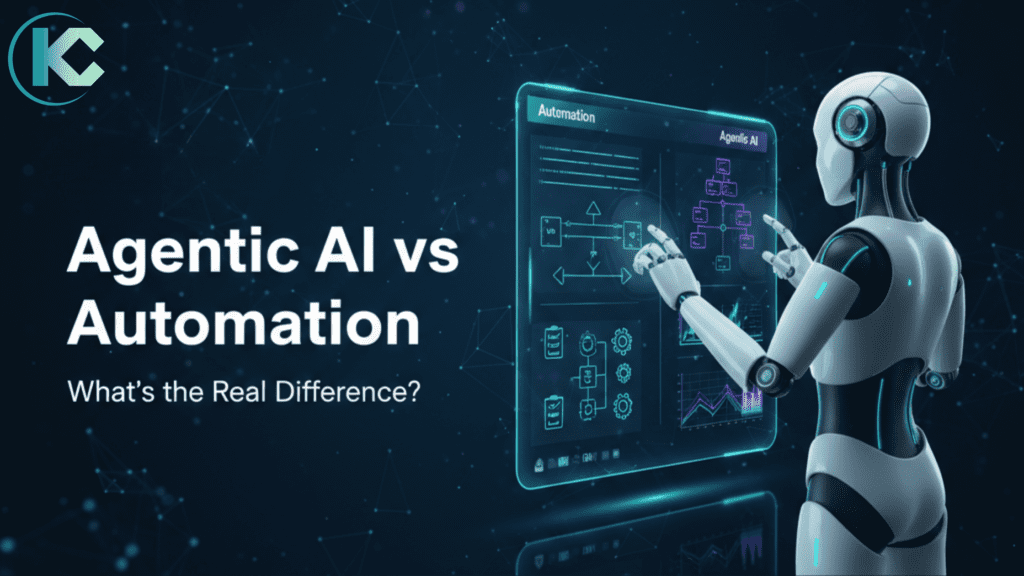
We’re living in an era where machines are doing more work than ever before. From your coffee maker starting automatically in the morning to chatbots answering customer questions, technology is handling tasks that humans used to do. But there’s a big difference between traditional automation and the newer “agentic AI” that everyone’s talking about. AI is everywhere. Automation is everywhere. And most people use both words like they mean the same thing. They don’t. If you’re a founder, CXO, or operations leader, understanding the difference can completely change how you design your systems. Let’s break it down in simple words.
Contents
hide
What is Automation?
At its core, automation refers to the use of technology to perform tasks with minimal human intervention. Automation is when you set fixed rules and the system follows them.It does exactly what you tell it to do.
No thinking. No adapting. No decision-making.
Example:
- Your email auto-responder that sends “I’m out of office” messages
- Assembly line robots that weld the same car part repeatedly
- Software that automatically backs up your files every night at 2 AM
It’s like a very obedient assistant.
But it can only follow instructions.
If something unexpected happens? It stops.
What is Agentic AI?
Agentic AI, on the other hand, introduces a new dimension: the ability of an AI system to understand, reason, plan, and execute tasks autonomously to achieve a given goal, often adapting to dynamic environments and unforeseen circumstances. An Agentic AI doesn’t just follow instructions; it thinks about how to achieve an objective.
Example:
- An AI assistant that reads your emails, understands you’re planning a trip, and starts researching flights and hotels without you asking
- A self-driving car that encounters a road closure and automatically finds a new route
- An AI customer service agent that understands complex problems and troubleshoots issues creatively
- A virtual assistant that notices you’re running low on groceries based on your past orders and suggests items to buy
Simple Analogy
Automation = Calculator
Agentic AI = Analyst
Automation executes.
Agentic AI thinks + executes.
Real Business Example
-
Automation Flow:
- Lead comes in
- System assigns to rep
- Email sent
- Done
If the lead replies with a complex question?
Human takes over.
-
Agentic AI Flow:
- Lead comes in
- AI checks CRM history
- Scores lead quality
- Drafts personalized reply
- Schedules meeting
- Updates CRM
- Notifies sales only if needed
It adapts. It decides. It moves forward.
The Difference Chart
| Feature | Automation | Agentic AI |
|---|---|---|
| Operational Mode | Reactive, rule-based | Proactive, goal-oriented |
| Decision Making | Follows predefined rules and scripts | Reasons, plans, and makes decisions autonomously |
| Adaptability | Limited; struggles with unforeseen circumstances | High; adapts to dynamic environments and learns from experience |
| Learning | Minimal or none (unless programmed specifically) | Continuously learns, optimizes strategies, and improves performance |
| Complexity | Handles repetitive, well-defined tasks | Manages complex, ambiguous tasks requiring reasoning and creativity |
| Best for | Repetitive tasks | Dynamic workflows |
| Example | Email Marketing, Data Entry, Robotic Process Automation | Dynamic Supply Chain Management, AI Driven Research Assistant |
| Role | Task executor | Digital operator |
When Should You Use Automation?
When Should You Use Agentic AI?
Agentic AI works best in dynamic, thinking-driven situations where flexibility and decision-making are important. Here’s when you should use it:
- Decisions Are Required: When the system needs to evaluate options, compare information, and choose the best next step instead of just following fixed rules.
- Context Matters: If understanding past interactions, customer history, tone, or business goals is important, Agentic AI can analyze context before acting.
- Workflows Frequently Change: When the process is not always the same and may vary based on user input, market conditions, or real-time data.
- Speed And Intelligence Are Both Important: When you need quick responses but also smart reasoning — not just fast execution.
- Goal-Oriented Outcomes: If the objective is to achieve a result (like increasing conversions or resolving an issue), rather than just completing a task.
Examples: Lead qualification based on behavior and profile data, AI-driven sales conversations, personalized follow-ups, proactive customer support resolution, and intelligent CRM updates
The Smart Approach:
The future is not about choosing between Automation and Agentic AI.
It’s about using both together.
Automation takes care of structured, repetitive tasks – like sending emails, updating CRM records, moving data between systems, or triggering reminders. These are rule-based actions that need speed and consistency.
Agentic AI sits on top of that and handles the thinking layer. It understands context, makes decisions, adapts to new information, and works toward a goal. Instead of just following steps, it figures out the best next step.
For example:
Automation can assign a lead.
Agentic AI can decide which lead is high priority, personalize the response, and guide the conversation forward.
That’s how modern AI-first companies are building systems in 202- automation for execution, Agentic AI for intelligence. Together, they don’t just save time. They build smarter, self-improving operations.
Final Thought
Want to know where AI agents can improve your workflows? Reach out to us.