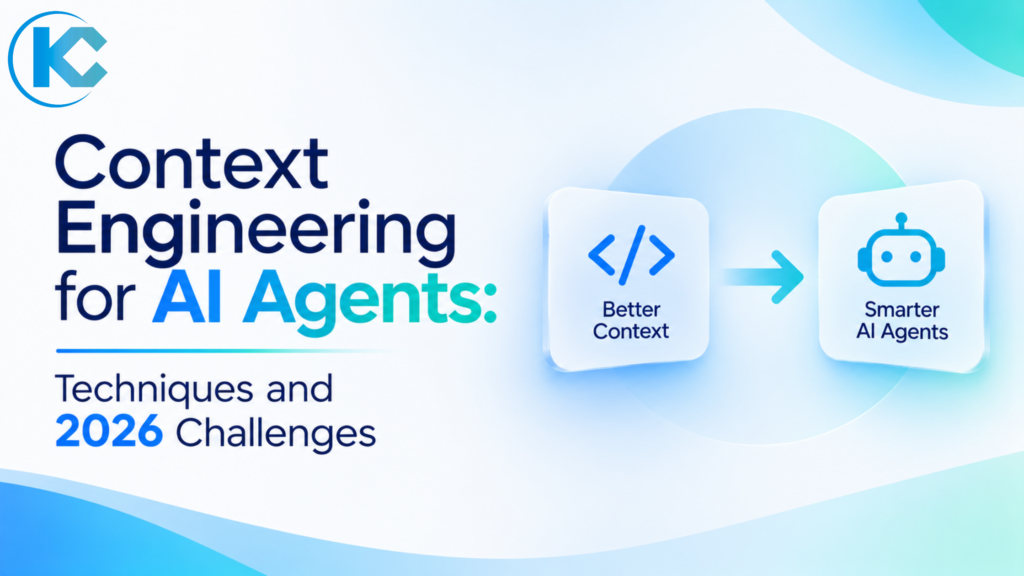
Context Engineering for AI Agents: Techniques and 2026 Challenges
⏱ 3 min read
AI Agents • Context Engineering • Enterprise AI
Context engineering decides what an AI agent sees on every model call. As agents grow more autonomous, it matters more than prompt wording. This guide combines the settled techniques with the new challenges raised by always-on agents, for engineering leads and architects building production AI agents.
SM
By Sanjeet Mahajan, Founder & CEO, Kizzy Consulting · LinkedIn
Quick Answer
Context engineering is the practice of designing everything an LLM sees at inference time: instructions, retrieved data, history, tool definitions and memory. It works largely by subtraction. Compact, rank, cap and isolate context so the agent gets the smallest set of tokens that lets it succeed.
Contents
hide
What Is Context Engineering for AI Agents?
Context engineering is the deliberate design of the full payload sent to a model on each call. That covers system prompts, user input, retrieved content, conversation history, tool schemas, tool outputs and cross-session memory. Sourcegraph’s guide stresses the word engineering: gains come from pipeline design such as retrieval order, caching, eviction and ranking, not from rewording a prompt.
Prompt engineering still exists, but as one layer inside the larger discipline. Tool descriptions, for example, are still prompts.
| Aspect | Prompt engineering | Context engineering |
|---|---|---|
| Unit of work | A single instruction | The whole runtime payload across a run |
| Typical failure | Ambiguous or contradictory wording | Wrong, stale, bloated or missing information |
| Main levers | Phrasing, examples, format | Retrieval, memory, tools, compaction, ranking |
| Owner | Prompt author | Platform and AI engineering team |
Why Context Engineering Matters: Context Rot and the Attention Budget
A larger window does not remove the problem. Chroma’s 2025 evaluation of 18 models, called context rot, found that reliability falls as input grows. The earlier “Lost in the Middle” research (Liu et al., 2023) showed accuracy is highest when relevant facts sit at the start or end of the prompt and weakens in the middle.
Cost and latency also rise with every token you send. Treat context as a budget: every item must earn its place, and bigger windows shift the failure from truncation to dilution. Needle-in-a-haystack tests mostly measure keyword matching, so they say little about real reasoning.
The Four Pillars of Context Engineering
1. Instructions
Clear system prompts. Watch for contradictions between your instructions and the model’s default tool behaviour.
2. Retrieval
Vector search, keyword search, structured queries and file reads. Irrelevant extra context lowers answer quality.
3. Memory
Short-term history that gets compacted, plus long-term conventions and decisions. Stale memory is worse than none, so build invalidation.
4. Tools
Tools cost tokens through definitions, outputs and the confusion overlapping tools create. The Model Context Protocol (MCP) standardises exposure.
Treat descriptions from untrusted MCP servers as untrusted input. For governance, pair this with an AI data classification policy that decides what an agent may read at all.
Related Read
Deciding what an agent may read is a governance decision first. See how to classify data before AI touches it.
Core Context Engineering Techniques for Long-Running Agents
Both articles describe a similar toolkit for tasks that outgrow one context window, such as multi-hour migrations or incident investigations.
- Compaction: summarise the thread near the limit and restart from the summary. Keep the task, inspected files, decisions with reasons and failed approaches, or details vanish.
- Structured note-taking (agentic memory): the agent writes learnings to external storage and rereads them later. Anything it omits is not kept automatically.
- Sub-agents: a coordinator plans while sub-agents work in clean windows and return distilled results. A sub-agent that retrieved poorly can still return a confident summary.
- Offloading and tool search: store large tool results outside the window and load tool schemas on demand instead of upfront.
- Skills: reveal instructions progressively, only when a task needs them.
Context Engineering at Enterprise Scale: Why Naive RAG Breaks
Sourcegraph’s example: an agent given 1.4 million lines of Go across 22,000 files ran for 6,000 seconds and scored zero. The hard part was finding the right code, not understanding it. Naive retrieval-augmented generation (RAG) struggles here for three reasons:
- Chunking separates definitions from the places that call them.
- Common filenames create similarity noise.
- Tight token budgets demand both coverage and precision.
The suggested fix is hybrid retrieval: deterministic lookups where structure exists, such as symbol and reference search, and semantic search elsewhere. Sourcegraph’s own benchmark reported precision@5 rising from 0.140 to 0.478 with its MCP server, and about 30% lower cost on matched tasks. Treat these as vendor-reported, directional numbers, not independent results. The same article found extra tools slightly hurt below roughly 400,000 lines, when plain grep worked.
The lesson carries over to business data. Retrieval quality depends on clean, well-structured source systems, which is why our Data Foundation for AI work comes before any agent build.
New Context Engineering Challenges for Always-On Agents
LangChain’s Harrison Chase (November 2026) argues that the basic agent pattern, an LLM looping over tools in a sandbox, is settled, but proactive, goal-driven agents raise problems with no general solution yet.
Proactivity
Background agents that wake on events must be helpful without flooding users with notifications.
Memory
Both the data structure and the decision of what to remember are hard. Remembering nothing and remembering every detail both fail.
Async work
Subagents and tools run longer, so the main agent must stay responsive and handle finished, still-running or approval-paused work.
Goal tracking
Agents must break goals into steps, iterate on feedback, avoid repeating actions and stay consistent over time.
Alignment
Agents optimising a goal can cheat. An agent told to remove all bugs might delete the codebase.
Browser use
The browser is becoming the general agent’s bash tool, but screenshot versus DOM trade-offs strain context.
Related Read
Agents need reliable data from every system they depend on. See how Salesforce and SAP data can stay in sync.
SAP Salesforce Integration: Benefits, Methods, and Best Practices →
Intent Engineering and Goal Engineering
Context engineering decides what the agent knows. Sourcegraph calls the next layer intent engineering, which decides what the agent is trying to do, including what “done” means and which trade-offs are acceptable. The term is not yet standard. Its example is telling: one team rewrote a tool-usage preamble five times with retrieval unchanged, and adoption of the tool swung between 40% and 90%.
LangChain links the same idea to goal design, since a poorly framed goal invites unwanted shortcuts. If retrieval looks good but the agent still fails, review the goal statement before rebuilding the pipeline.
Common Context Engineering Failure Modes and Fixes
| Failure mode | What happens | Fix |
|---|---|---|
| Poisoning, distraction, confusion, clash | Context is dumped rather than curated | Re-rank and set hard caps |
| Stale retrieval | Index and source silently disagree | Track freshness, invalidate memory |
| Lost in the middle | Key facts buried mid-prompt | Place high-signal items first or last |
| Tool bloat | Overlapping tools cause ambiguous choices | Prune tools and document when to use each |
| Unused retrieval | Agents default to keyword search | Guide tool choice and measure usage |
Context Engineering Checklist for Enterprise AI Teams
- Log what enters the window on failed runs to see whether the model or retrieval failed.
- Subtract first: compact, rank and cap outputs before adding more data.
- Benchmark on your own tasks, comparing native tools against retrieval tools.
- Define memory rules: what to store, when to expire it, who can read it.
- Write goals and “done” criteria for every autonomous agent.
- Review vendor data retention before connecting private repositories or CRM data.
Teams building on Salesforce can apply the same checklist to Agentforce agents, which only reason over the records they can reach. Our Agentforce consulting team helps design those boundaries.
Context Engineering FAQs
1. What is context engineering?
It is the design of everything a model sees on each call: instructions, retrieved content, history, tools and memory. The goal is to supply the smallest set of tokens that lets the agent succeed.
2. What is the difference between prompt engineering and context engineering?
Prompt engineering shapes a single instruction. Context engineering manages the whole payload across a run, including retrieval, memory, tools and compaction. Prompting is one layer inside it.
3. What is context rot?
Context rot is the drop in model reliability as input length grows. Chroma’s 2025 evaluation of 18 models reported it, so larger windows alone do not fix poor context.
4. Do larger context windows make context engineering unnecessary?
No. Cost, latency and dilution still grow with input size, so curating context stays necessary even with long windows.
5. What is intent engineering?
It is an emerging, non-standard term for defining what an agent is trying to do and what “done” means, alongside what it knows.
Related Read
Agents are only as good as the data they can reach. See how Salesforce activity data is captured and stored.
Build Production-Ready AI Agents
Get help designing context, memory and data foundations for enterprise AI agents.