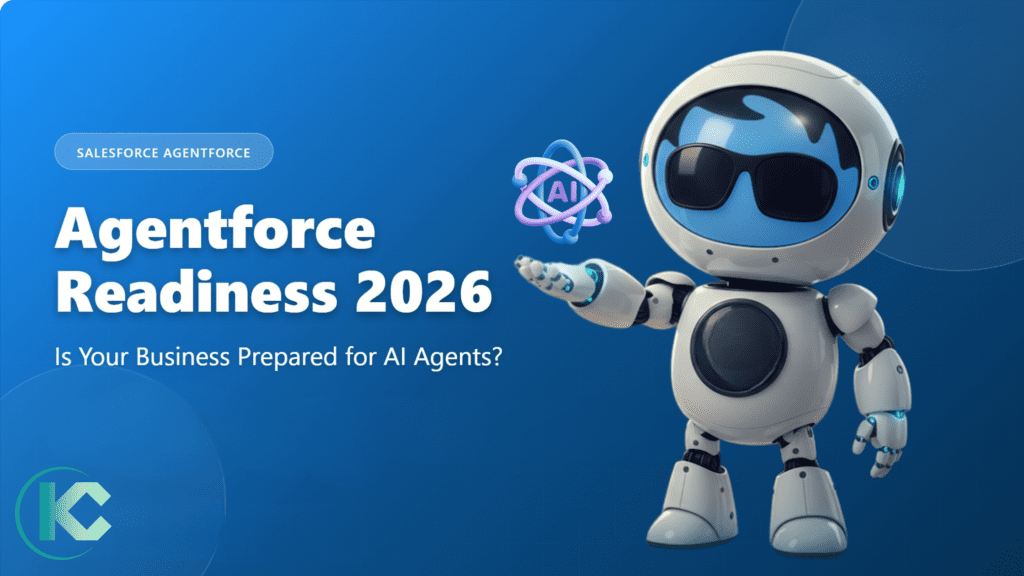
Agentforce Implementation Readiness: Is Your Salesforce Org Ready? (2026 Checklist)
⏱ 5 min read
Quick Answer
Agentforce implementation readiness means your Salesforce org can give AI agents trustworthy data, clean automation, least-privilege access and a clear job to do. Check seven areas before you build: data quality and Data 360 readiness, automation, permissions and security, architecture and integrations, reporting, one measurable use case, and governance for production.
Agentforce agents can answer questions, reason over CRM context and take action inside your Salesforce workflows. Enabling Agentforce takes minutes; being ready for it takes preparation. If your org has duplicate records, conflicting automation, broad permissions or undefined processes, an agent will amplify those weaknesses at scale.
This guide combines a seven-point Salesforce org checklist with the process, people and governance work that turns a pilot into a production agent.
Contents
hide
What Is Agentforce?
Agentforce is Salesforce’s platform for building and deploying AI agents that can understand requests, reason over available context, and take actions within defined business workflows.
Depending on their configuration, agents can answer customer questions, retrieve information, summarize records, route requests and perform defined business actions. They operate within configured permissions, instructions and guardrails, with human escalation where appropriate.
24/7
Support selected workflows beyond traditional working hours.
Context
Use relevant business information and customer context.
Actions
Perform defined tasks inside approved business workflows.
Unlike traditional rule-based automation, AI agents can interpret natural language and use contextual information to determine an appropriate response or action. They still need reliable data, clearly defined permissions, appropriate guardrails and human escalation paths.
Comparing Agentforce with earlier Salesforce bots? Read Agentforce vs. Einstein Bots: What’s the Difference?
Planning a move to Agentforce? Explore key considerations for migrating to Salesforce Agentforce.
Comparing implementation partners? See our guide to Agentforce consulting partners.
How to Check Your Agentforce Readiness
Before beginning an Agentforce implementation, establish where your organization stands. A readiness assessment can identify gaps in data quality, automation, technical architecture, security, reporting, governance and team readiness.
Agentforce Readiness
Find Out Where Your Salesforce Org Stands
Start with the free readiness score for a quick baseline, then use the checklist below to see exactly where your Salesforce org needs work.
The 7-Point Agentforce Readiness Checklist for Your Salesforce Org
Use these seven checks to score your Salesforce org before you build your first agent. Each one maps to a common reason Agentforce pilots stall. Review the questions, document gaps and assign an owner to each priority.
CHECK 01
1. Data Quality and Data 360 Readiness
AI agents rely on the quality, freshness and relevance of the information available to them. Duplicate records, inconsistent fields, missing values and outdated information can undermine the context an agent uses to respond or act.
Duplicates
Are duplicate customer and business records identified and controlled?
Consistency
Are fields, formats and business definitions standardized?
Freshness
Is important information maintained and updated reliably?
What you need:
- Clean and accurate customer data.
- Controlled duplicate records and consistent field values.
- Clear data ownership and quality rules.
- Reliable connections between relevant systems.
- Appropriate access controls for sensitive information.
For a practical foundation, read 7 best practices to organize CRM data.
If your agents need context beyond core CRM objects, such as web engagement, ERP orders or support history, assess Data 360 readiness as well: which sources connect, how identities resolve into one customer profile, and which data streams an agent is allowed to ground on. Our guide to Data 360 implementation readiness covers modeling, connectivity and consumption in depth.
CHECK 02
2. Automation Health: Flows, Apex and Integrations
Agentforce operates in an existing Salesforce environment. Conflicting record-triggered flows, overlapping automation, undocumented Apex logic and unreliable integrations can create unexpected outcomes when an agent interacts with business records.
Review these areas:
- Identify active flows and automation that affect the objects your agent will use.
- Check for duplicate, conflicting or redundant automation.
- Document Apex triggers, dependencies and business rules.
- Test integrations, error handling and retry behavior.
- Confirm that agent actions will not trigger unintended downstream processes.
A practical sequence
Inventory existing automation → identify conflicts → simplify business logic → test agent-triggered actions → monitor results.
For help reviewing your technical foundation, explore Salesforce development and implementation.
CHECK 03
3. Permissions, Sharing and Security
An agent should access and change only the information necessary for its assigned tasks. Review the permissions and sharing rules that govern the agent’s actions, including access to sensitive records and connected systems.
Ask these questions:
- Are agent permissions aligned with least-privilege principles?
- Can the agent access only the records and fields required for its job?
- Are object permissions, field-level security and sharing rules appropriate?
- Are sensitive actions logged and auditable?
- Are privacy policies, data handling requirements and retention rules documented?
- Are approval and human escalation paths defined for higher-risk actions?
Document the agent’s permitted actions, data boundaries, audit requirements and escalation procedures before moving toward production.
Not Sure If Your Salesforce Org Is Ready?
Identify gaps in your data, automation, security and architecture before they affect an Agentforce implementation.
CHECK 04
4. Architecture and Integrations That Match Your Business
An agent may need information or actions that span Salesforce and external applications. Your architecture should make those interactions reliable, secure and observable.
| Area | Readiness question |
|---|---|
| Connectivity | Can required systems exchange information reliably? |
| APIs | Are APIs documented, secured, monitored and suitable for expected workloads? |
| Data flow | Is it clear where information originates and how it reaches the agent? |
| Failure handling | Are timeouts, failed requests and unavailable systems handled safely? |
| Monitoring | Can teams detect integration errors and investigate unexpected actions? |
Map API connectivity, integration dependencies, monitoring and access controls before allowing agents to act across systems.
CHECK 05
5. Reports Your Team Trusts
Your team needs confidence in the reports and business metrics used to evaluate decisions and outcomes. Inconsistent dashboards, unclear metric definitions and incomplete records make it harder to establish a reliable baseline for an AI initiative.
Check that:
- Key business metrics have consistent definitions.
- Reports reflect reliable and sufficiently complete data.
- Teams understand the limitations of their dashboards.
- Baseline performance can be measured before deployment.
- Agent outcomes can be compared with the same baseline after implementation.
CHECK 06
6. One Agentforce Use Case and One Success Metric
Start with a clearly defined business problem instead of trying to automate everything at once. Choose a use case with a specific owner, defined boundaries, an achievable scope and a measurable outcome.
Sales
Support account research, routine follow-ups or sales administration.
Service
Answer common questions, retrieve approved information or route cases.
Operations
Support repeatable internal workflows and information retrieval.
Define at least one primary metric before the pilot. Depending on the use case, that could be resolution time, task completion rate, escalation rate, data accuracy or employee time saved. Establish a baseline and evaluate results before expanding.
CHECK 07
7. Governance Before Production
Production readiness requires clear ownership, monitoring and procedures for handling failures or unexpected behavior. Governance should cover the full lifecycle of an agent, from initial design and testing through ongoing operation and updates.
Minimum Agentforce Governance Framework
- Name an accountable business owner and a technical owner.
- Document permitted actions, data access and prohibited behaviors.
- Define testing, approval and release procedures.
- Monitor performance, errors, escalations and unexpected actions.
- Establish incident response and human escalation procedures.
- Review privacy, compliance and audit requirements.
- Reassess governance when agents, workflows or connected systems change.
Review your Salesforce org on a schedule as well. Our Salesforce health check guide lists what to review every six months.
Beyond the Org: Process and People Readiness
A clean org is necessary but not sufficient. Agents follow your processes and work alongside your people, so both need to be ready too.
Process Documentation and Clarity
Before automating a process, understand how the process works in practice. Workflows may contain exceptions, approvals, manual decisions and dependencies that are not reflected in formal documentation.
Ask yourself:
- Are important business processes documented?
- Do employees follow consistent workflows?
- Are decision points and business rules clearly defined?
- Have exceptions and escalation scenarios been identified?
- Can you determine which steps are appropriate for automation?
Key principle: Fix the flow before adding intelligence.
Team Skills and Change Management
Agentforce implementation changes how some tasks are completed and how employees collaborate with technology. Teams need practical training, clear responsibilities and confidence about when to rely on an agent and when to involve a person.
- Provide practical AI and Agentforce training.
- Identify AI champions and business stakeholders.
- Communicate workflow changes and expected benefits.
- Define human review and escalation responsibilities.
- Give employees channels to report issues and share feedback.
- Measure adoption alongside technical performance.
AI-Ready vs. Not Yet Ready: Quick Self-Check
Use this table to identify gaps across your Salesforce org, business processes and operating model. If several areas need attention, prioritize the foundations before expanding your Agentforce implementation.
| Foundation | AI-Ready | Needs Attention |
|---|---|---|
| Data | Clean and consistent; duplicates controlled | Duplicates and stale records |
| Automation | Documented and consolidated | Conflicting legacy logic |
| Security | Least privilege; clear agent permissions | Unclear access boundaries |
| Systems | Integrated or reliable APIs available | Data moved manually between apps |
| Processes | Workflows, decisions and exceptions documented | Teams follow different approaches |
| Use case | Specific and measurable | Broad AI experimentation |
| Leadership | Sponsor, objective and resources agreed | No defined use cases, owners or metrics |
| People | Teams know where AI helps and where humans decide | Past rollouts struggled with adoption |
| Governance | Owner, monitoring and escalation | No clear accountability |
Your Agentforce Readiness Roadmap
A phased approach can reduce implementation risk and help organizations build confidence before expanding Agentforce across the business.
1
Assess Your Current State
Evaluate data, processes, technology, people, security and governance. Establish a baseline and prioritize the highest-impact gaps.
2
Improve Your Data Foundation
Deduplicate records, standardize data, address missing information, establish quality rules and review access.
3
Document and Optimize Processes
Map workflows, identify bottlenecks, document decisions and exceptions, and prioritize processes for AI automation.
4
Build the Technical Foundation
Review Salesforce architecture, integrations, permissions, security controls, APIs, monitoring and system connectivity.
5
Prepare Your Team
Train employees, identify AI champions, communicate the strategy and define human-AI workflows.
6
Pilot a Focused Use Case
Choose a high-value workflow, establish KPIs, test the agent in a sandbox and with a small user group, monitor performance and gather feedback.
7
Scale Based on Results
Expand successful agents, introduce new use cases gradually and continuously measure performance and business impact.
Common Agentforce Readiness Mistakes to Avoid
01. Skipping the Assessment
Implementation without understanding readiness gaps can create unnecessary rework.
02. Automating Broken Processes
AI does not automatically fix inefficient or inconsistent workflows.
03. Ignoring Change Management
Even a technically successful agent can fail if employees do not adopt the new workflow.
04. Setting Unrealistic Expectations
Agents need clear boundaries, testing, monitoring and appropriate human oversight.
05. Treating Data Quality as an Afterthought
Reliable AI requires reliable business context and data.
What Can Organizations Achieve With Agentforce?
The potential business impact depends on the use case, process maturity, data quality and implementation approach. Establish a baseline and measure results against defined KPIs instead of assuming universal percentage improvements.
Customer Service
Handle routine questions, retrieve information, summarize interactions and route complex issues.
Operational Efficiency
Reduce repetitive manual work and give employees more time for higher-value activities.
Sales Productivity
Assist with account information, customer interactions, follow-ups and selected administrative tasks.
Faster Responses
Support selected customer and business interactions beyond traditional working hours.
Get an Agentforce Readiness Assessment
Agentforce implementation connects business objectives with data architecture, Salesforce configuration, integrations, security, governance, testing and adoption. Kizzy Consulting’s Agentforce readiness assessment reviews your org against the seven checks above, plus the process and people factors, and gives you a prioritized gap list and a recommended first use case.
The goal isn’t to deploy as many agents as possible. It’s to deploy the right agents, in the right workflows, with the right data and controls.
Benefits of Expert Guidance
- Identify practical, high-value AI use cases.
- Assess organizational readiness and prioritize gaps.
- Identify data and architecture issues.
- Design integrations between Salesforce and external systems.
- Establish guardrails, permissions and escalation paths.
- Test agents before production deployment.
- Measure business outcomes against defined KPIs.
- Scale successful implementations systematically.
The goal isn’t to deploy as many agents as possible. The goal is to deploy the right agents, in the right workflows, with the right data and controls.
Ready for Agentforce?
Build Your Agentforce Readiness Roadmap
Identify your readiness gaps and create a prioritized path toward Agentforce implementation.
Frequently Asked Questions About Agentforce Readiness
What is Agentforce implementation readiness?
Agentforce implementation readiness is the point at which your Salesforce org, data, processes, team and governance can support AI agents safely in production. In practice it means reliable CRM data, consolidated automation, least-privilege permissions, an architecture that matches the business, trusted reporting, one measurable use case and a named owner for every agent.
How do I know if my Salesforce org is ready for Agentforce?
Your org is ready when duplicates are controlled, automation on key objects is documented and free of conflicts, agent permissions follow least privilege, required external data reaches Salesforce reliably, teams trust their reports, and you have one use case with a success metric. If several of these checks fail, fix them before you build the agent.
What is an Agentforce readiness assessment?
An Agentforce readiness assessment is a structured review of your Salesforce org and operating model before you build agents. It scores data quality, automation, security, architecture, reporting, use cases and governance, then produces a prioritized list of gaps and a recommended first use case, so implementation starts on a stable foundation.
What does Agentforce data readiness involve?
Data readiness means the records and knowledge an agent uses are accurate, current, deduplicated and consistently structured, with clear ownership and access controls. If agents need data from outside core CRM objects, it also covers Data 360 readiness: connected sources, identity resolution and which data streams the agent may use for grounding.
How long does it take to become Agentforce-ready?
The timeline depends on your starting point. Organizations with clean data, documented processes, established integrations and strong governance can move quickly, while organizations with significant foundational gaps may need several months of preparation. A readiness assessment sets the timeline for your org instead of applying a fixed estimate to every business.
Can Agentforce be implemented in phases?
Yes. A phased approach is often the most practical path. Begin with one or two well-defined use cases, set success metrics, test the agents in a sandbox and then with a small user group, gather feedback, and expand into additional workflows based on measured results.
Final Thoughts
Agentforce readiness is not about having the newest technology. It is about having the right foundation to use that technology responsibly and effectively.
Clean data, reliable automation, appropriate permissions, connected systems, trusted reporting, prepared teams and clear governance help organizations build agents that are useful, controlled and measurable.
Build the foundation before you build the agent.
Start with your current state. Identify the gaps. Fix the flow. Then add intelligence.