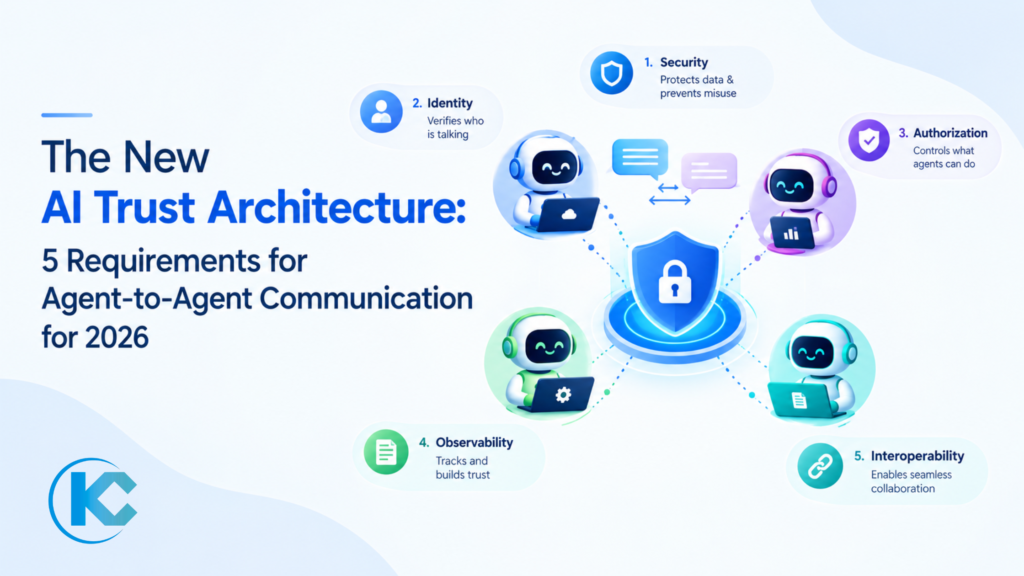
The New AI Trust Architecture: 5 Requirements for Agent-to-Agent Communication for 2026
⏱ 4 min read
AI agents are moving from isolated assistants to autonomous systems that can communicate, exchange data, call tools, and act on behalf of businesses. But when agents communicate with other agents, enterprises face a critical question: How can one AI agent trust another? This guide explains the five requirements for trusted agent-to-agent communication and how enterprises can build a practical AI trust architecture.
Executive Quick Answer
AI trust architecture is the combination of identity, authorization, governance, monitoring, accountability, boundaries, and human oversight that allows autonomous AI agents to operate safely.
Trusted agent-to-agent communication requires five capabilities:
- Standards that augment rules
- Identity and reputation that travel with the agent
- Boundaries instead of rigid scripts
- Structured accountability
- Calibrated human escalation
These capabilities should operate alongside Zero Trust principles such as least privilege, continuous verification, data governance, monitoring, and incident response.
5
Core trust requirements
3.5M+
Comments analyzed across 78,000 AI agents in the Salesforce AI Research study
Zero Trust
Never grant implicit trust
4
Progressive autonomy levels
Why Agent-to-Agent Communication Changes AI Security
Traditional enterprise AI often follows:
User → AI Agent → Enterprise System
Multi-agent environments are more complex:
Agent A → Agent B → Agent C → APIs → Databases → Humans
Authentication alone cannot answer important questions such as:
- Who operates the agent?
- What is it authorized to do?
- What data can it access?
- Has it behaved reliably?
- Who is accountable for its actions?
- When should it involve a human?
This is why agent-to-agent communication security requires identity, policy, behavioral controls, accountability, and continuous verification.
Salesforce’s emerging AI trust architecture and the Cloud Security Alliance’s Agentic Trust Framework both point toward this broader model of trust.
What Is an AI Trust Architecture?

An AI trust architecture is the technical and governance layer used to determine whether an AI agent can safely communicate and act.
It combines:
- Agent identity and authentication
- Authorization and least privilege
- Behavior monitoring
- Data governance
- Action boundaries
- Auditability
- Human oversight
- Incident response
Can we continuously verify what this agent is, what it is doing, what it can access, and whether it should continue?
The 5 Requirements for Agent-to-Agent Communication
1. Standards
Combine deterministic rules with contextual standards for situations requiring judgment.
2. Identity & Reputation
Agents need persistent identity, ownership, capabilities, authority, and behavioral history.
3. Boundaries
Define what an agent can access and do without trying to script every possible situation.
4. Accountability
Agent actions must be attributable, auditable, and connected to responsible owners.
5. Calibrated Escalation
Agents should act autonomously at low risk and escalate decisions with greater consequences.
1. Standards Must Augment Rules
Traditional automation relies heavily on deterministic rules. Agentic AI introduces situations where context matters.
For example, an AI agent negotiating a supplier contract may need to determine how much to negotiate, what information can be shared, and when a concession becomes inappropriate.
| Rules | Standards |
|---|---|
| Deterministic | Contextual |
| Binary decisions | Judgment-based decisions |
| Known scenarios | Dynamic environments |
Enterprise AI governance needs both policy enforcement and decision-quality evaluation.
2. Identity and Reputation Must Travel With the Agent
A receiving agent should not have to treat every incoming agent as an anonymous process.
A trusted agent identity should communicate:
- Operator and organization
- Agent purpose
- Capabilities and limitations
- Authorized actions
- Data access
- Compliance requirements
- Behavioral reputation
This is where concepts such as AI agent identity, agent authentication, agent authorization, credentials, and Agent Cards become important.
Enterprises should also evaluate emerging communication standards such as Google’s Agent2Agent (A2A) protocol and complementary technologies such as Model Context Protocol (MCP).
Key principle: Trust should accumulate through verified behavior rather than reset during every interaction.
Ready to Make Your AI Agents More Trustworthy?
Let’s assess your agents, data access, integrations, guardrails, and escalation paths before autonomous workflows move into production.
Why AI Agent Reputation Matters
Authentication answers “Who are you?” Reputation addresses “Should I trust your behavior?”
Enterprise reputation signals may include:
- Task completion accuracy
- Policy violations
- Security incidents
- Human overrides
- Data-handling compliance
- Audit history
Reputation should not replace authorization. Instead, it can become one input into a broader risk-based trust model.
3. Boundaries Scale Better Than Scripts
Trying to script every possible AI decision quickly becomes impractical. Instead, enterprises should define clear operating boundaries.
Give the agent room to reason inside a clearly defined operating boundary.
| Boundary | Example |
|---|---|
| Data | Which records can be accessed? |
| Action | Which operations are permitted? |
| Financial | What value can be committed? |
| Communication | Who can the agent contact? |
| Transaction | What is the maximum impact of one action? |
This limits the blast radius when an agent is compromised or behaves incorrectly.
Assess Your AI Agent Readiness
Want to understand where your AI agents need stronger governance, security, or automation controls?
Zero Trust for AI Agents
Zero Trust follows a simple principle: never trust, always verify. Applied to AI agents, this means continuously evaluating identity, behavior, data, permissions, and actions.
Who are you?
Identity & authorization
What are you doing?
Behavior & observability
What data are you using?
Data governance
Where can you go?
Segmentation & least privilege
What if you fail?
Containment & response
4. Accountability Must Be Traceable
When an AI agent modifies CRM records, approves transactions, sends customer communications, or triggers workflows, enterprises need to know who is accountable.
Organization → Governance Owner → Agent Owner → AI Agent → System Action → Audit Record
An agent can act autonomously, but autonomy should never eliminate accountability.
This is especially important in regulated or high-impact environments such as healthcare, financial services, insurance, government, and procurement.
5. Calibrated Escalation Prevents Excessive Risk
A trustworthy agent must know when not to act.
Low Risk
Allow autonomous execution.
- Classification
- Summarization
- Routine enrichment
Medium Risk
Apply additional controls.
- Customer drafts
- Recommendations
- CRM updates
High Risk
Escalate to human judgment.
- Major contracts
- Large transactions
- High-impact decisions
The higher the consequence, the stronger the human control should be.
Building a Multi-Agent System?
Before connecting agents to Salesforce, APIs, databases, or customer workflows, make sure identity, permissions, boundaries, monitoring, and escalation are designed into the architecture.
The Agentic Trust Framework
The Cloud Security Alliance’s Agentic Trust Framework (ATF) applies Zero Trust principles to autonomous AI systems.
| ATF Element | Enterprise Question | Primary Control |
|---|---|---|
| Identity | Who is the agent? | Authentication |
| Behavior | What is it doing? | Monitoring |
| Data Governance | What data is moving? | Validation & lineage |
| Segmentation | Where can it go? | Least privilege |
| Incident Response | What happens if it fails? | Containment |
The key idea is simple: trust must be continuously demonstrated.
Prompt Injection and Agent-to-Agent Security
Information received from another agent can influence the receiving agent’s behavior. That creates an additional attack surface.
Agent A → sends manipulated information → Agent B interprets it as instructions → unauthorized action
Enterprise systems should distinguish between:
- Data an agent can consume
- Instructions it is authorized to follow
- Actions it is allowed to perform
Security teams should test for prompt injection, malicious inputs, compromised agents, poisoned data, and unsafe tool responses.
Least Privilege and Agent Segmentation
Every AI agent should have only the access required for its task.
Agent → Specific Objects → Specific Records → Specific Actions
For example, a lead qualification agent may need lead records and approved enrichment APIs. It likely does not need payroll, payment information, system configuration, or unrelated customer records.
Least privilege reduces the blast radius of a compromised or misbehaving agent.
What Happens When an AI Agent Goes Rogue?
Production AI architecture should assume failures will occur. The objective is to detect, contain, investigate, and recover quickly.
- Circuit breakers
- Kill switches
- Session revocation
- State rollback
- Incident alerts
- Graceful degradation
Detect → Stop → Contain → Investigate → Recover → Learn
AI Agent Autonomy Should Be Earned
Enterprises can increase autonomy as an agent demonstrates reliable behavior.
| Level | Autonomy | Human Control |
|---|---|---|
| Intern | Observe & analyze | Continuous oversight |
| Junior | Recommend | Approval required |
| Senior | Execute within guardrails | Monitoring |
| Principal | Autonomous in approved domain | Exception escalation |
More autonomy should require more evidence of trustworthiness.
A Secure Agent-to-Agent Architecture
Agent A
↓
Identity Verification
↓
Capability & Reputation Check
↓
Policy Evaluation
↓
Secure A2A Communication
↓
Data Validation
↓
Agent B
↓
Tool / API Authorization
↓
Action Boundary Check
↓
Human Escalation if Required
↓
Audit Log
↓
Identity Verification
↓
Capability & Reputation Check
↓
Policy Evaluation
↓
Secure A2A Communication
↓
Data Validation
↓
Agent B
↓
Tool / API Authorization
↓
Action Boundary Check
↓
Human Escalation if Required
↓
Audit Log
The key difference from a traditional API call is that enterprises must evaluate both identity and intent.
What Should an AI Agent Card Contain?
Machine-readable agent metadata can help systems discover and evaluate other agents.
| Field | Purpose |
|---|---|
| Identity | Identifies agent and organization |
| Capabilities | Defines what it can do |
| Limitations | Defines restrictions |
| Authority | Defines permitted actions |
| Security & Compliance | Communicates relevant controls |
| Owner | Provides accountability |
Agent metadata should be treated as a trust input, not automatic proof of trust.
What This Means for CRM and Revenue Operations
Trust architecture becomes especially important when AI agents interact with CRM and revenue systems.
Lead Agent → Research Agent → Scoring Agent → Outreach Agent → CRM Agent → Human Sales Rep
At every transition, the receiving agent should verify:
- Who sent the request
- Where the data originated
- Whether the data is validated
- What action is requested
- Whether the action is authorized
- Whether human approval is required
This is particularly relevant for AI sales agents, AI customer service agents, Salesforce agents, Agentforce implementations, lead-generation agents, and autonomous CRM workflows.
How to Build an AI Trust Architecture: 30-Day Roadmap
Week 1
Map Agents
Inventory agents, owners, capabilities, tools, data, and communication paths.
Week 2
Define Controls
Implement identity, authorization, boundaries, logging, and escalation.
Week 3
Test Behavior
Run security, access-control, prompt-injection, and failure tests.
Week 4
Govern & Monitor
Launch bounded autonomy with continuous monitoring and measurable promotion criteria.
The Future of Agent-to-Agent Commerce
As agent ecosystems mature, autonomous systems may discover, authenticate, evaluate, negotiate, exchange information, execute transactions, and monitor obligations on behalf of organizations.
This creates the foundation for agent-to-agent commerce.
Identity
Reputation
Policy
Authorization
Observability
Auditability
Human Oversight
Incident Response
Autonomous commerce cannot scale without a shared trust layer.
Frequently Asked Questions
What is agent-to-agent communication?
Agent-to-agent communication is the exchange of information, requests, instructions, or actions between autonomous AI agents.
What is an AI trust architecture?
It is the combination of identity, authorization, governance, monitoring, boundaries, accountability, and human oversight used to keep AI agents safe.
Why does agent-to-agent communication require a new trust model?
Agents can reason, adapt, call tools, exchange information, and act dynamically. Authentication alone cannot establish whether an action is safe or appropriate.
What are the five requirements for agent-to-agent communication?
Standards that augment rules, identity and reputation, boundaries, structured accountability, and calibrated escalation.
What is Zero Trust for AI agents?
Zero Trust for AI agents means continuously verifying identity, behavior, data access, permissions, and actions rather than granting implicit trust.
What is the Agentic Trust Framework?
The Agentic Trust Framework applies Zero Trust concepts to autonomous AI agents through identity, behavior, data governance, segmentation, and incident response.
How can enterprises secure AI agents?
Use unique identities, least privilege, policy enforcement, validation, prompt-injection defenses, monitoring, audit trails, human escalation, and rapid containment.
What is an AI Agent Card?
An AI Agent Card is machine-readable metadata describing an agent’s identity, capabilities, limitations, authority, and other relevant information.
Why is AI agent reputation important?
Reputation provides historical context about agent behavior and can complement technical authorization and risk controls.
How does human-in-the-loop AI improve agent security?
It provides escalation and approval for decisions with significant financial, regulatory, legal, customer, or operational consequences.
What is multi-agent security?
Multi-agent security protects systems where multiple AI agents communicate, coordinate, share information, and execute actions.
Can Kizzy Consulting help enterprises build trusted AI agents?
Yes. Kizzy Consulting helps enterprises design, integrate, deploy, govern, and manage production AI agents and Salesforce-connected autonomous workflows.
Build AI Agents That Can Be Trusted to Act
Agentic AI becomes more valuable when agents can safely communicate, coordinate, and act across enterprise systems. Kizzy Consulting helps enterprises build secure, governed, and scalable AI agent architectures.
Let’s Talk About Your AI Agent Strategy
Tell us what you’re building and our team can help you identify the right architecture, integrations, governance controls, and automation opportunities.