What is Agentic AI?
⏱ 4 min read
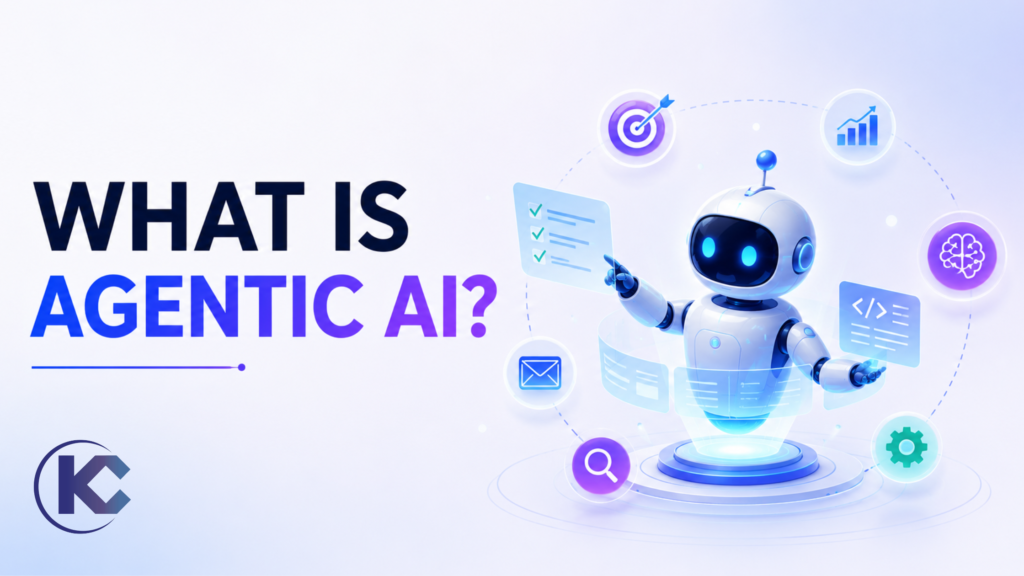
Agentic AI is AI that can independently plan and take actions to achieve a goal, rather than just responding to prompts.
In short: it’s AI that can think, decide, and act in steps to get things done (often using tools, memory, or apps), with less human guidance.
Most businesses have spent the last two years asking chatbots to answer questions. In 2026, the shift is toward AI that doesn’t just answer – it acts. Agentic AI reads your systems, plans a path to a goal, uses real tools, and finishes the job with minimal human steering. Here’s what that actually means, how it works, and where it’s already paying off.
The Problem: Generative AI Stops One Step Too Early
Generative AI tools are excellent at producing an answer, a draft, or a summary – and then they stop. A human still has to take that output, decide what to do with it, and manually push it through five more systems to actually get anything done. That gap is where most operational time still gets lost.
One Answer, Then You’re On Your Own
A chatbot gives you a response to one prompt at a time. Every next step – sending the email, updating the CRM, booking the meeting – falls back on a human.
Knowledge Trapped in Silos
Answers live across CRMs, inboxes, and internal docs that a standard AI tool can’t reach or act on directly.
Work Waits for Business Hours
Leads go cold overnight, tickets pile up over the weekend, and follow-ups slip because nothing is running when your team isn’t.
Scaling Means Hiring
More volume has traditionally meant more headcount – because nothing was actually finishing the work end-to-end.
The Solution: AI That Finishes What It Starts
Agentic AI closes that gap. Instead of handing back a draft and waiting, it takes a goal, breaks it into steps, uses the tools and systems it has access to, and carries the work through to completion – checking its own output along the way and adjusting when something doesn’t go to plan.
Traditional / Generative AI
- ✗ Answers one question at a time
- ✗ Generates content on demand, then stops
- ✗ Needs continuous human direction
Agentic AI
- ✓ Plans entire projects autonomously
- ✓ Uses multiple tools on its own
- ✓ Executes multi-step workflows to completion
Getting It Right
The businesses seeing real results start with a clear objective, clean data, and defined guardrails – not by deploying agents everywhere at once. Agentic AI without governance is expensive chaos; agentic AI with clear roles and escalation rules is a compounding advantage.
Agentic AI vs AI Agent
An AI agent is a single software entity built to perform a specific role. Agentic AI describes the behavior – a system that can plan, decide, and act toward a goal with minimal human input. You can build one AI agent, but “agentic AI” refers to the capability itself.
What Makes AI “Agentic”: Core Capabilities
Autonomy
Operates independently with minimal supervision, working toward a goal instead of waiting on step-by-step instructions.
Planning
Breaks a complex goal into smaller tasks, sequences dependencies, and builds an execution plan on its own.
Tool & System Integration
Connects to databases, CRMs, search, and APIs to gather information and take real action – not just generate text.
Reflection & Learning
Reviews its own output, self-corrects when needed, and improves decision-making across thousands of interactions.
| Feature | Traditional AI | Generative AI | Agentic AI |
|---|---|---|---|
| Acts on its own? | No | No | Yes |
| Multi-step tasks? | No | Limited | Yes |
| Uses external tools? | No | Sometimes | Yes |
| Self-corrects? | No | No | Yes |
| 2026 example platform | Spam filters | ChatGPT, Gemini | Salesforce Agentforce |
Why It’s Different: From Passive to Agentic
Generative AI creates content – text, images, code – in response to a prompt. Agentic AI goes further: it takes that output and acts on it, executing multi-step tasks toward a goal without a new prompt at every step. See the full comparison: AI vs GenAI vs Agentic AI.
Wondering when to use agentic AI instead of traditional automation? See Agentic AI vs Automation: What’s the Real Difference?
Traditional AI
Data Input → Run Math Model → Static Prediction
Generative AI
Human Prompt → LLM Processes Content → Text/Image Output (Stops here)
Agentic AI
Objective → Multi-Step Planning → Tool Execution → Reflection → Goal Completion
Original Insight
Think of AI agents as individual tools in a toolbox – agentic AI is the coordinated use of all those tools to build the entire house. One agent might handle a single task; agentic AI employs multiple agents as an overarching system to reach a broader business outcome.
Use Cases: Agentic AI in Action, 2026
Real Estate
AI Voice Agents for Lead Qualification
Platforms like AgentCalling.ai answer every missed call, qualify the lead, book showings, and send follow-up SMS – 24/7, with zero human involvement.
Sales
Salesforce Agentforce SDR Agents
Research prospects, personalize outreach, handle objections, update CRM records, and book meetings – completely autonomously.
Healthcare
Patient Journey Automation
Manages intake end-to-end – first inquiry, insurance verification, scheduling, and post-visit follow-up.
Finance
Autonomous Compliance Monitoring
Continuously scans transactions, flags anomalies, generates regulatory reports, and escalates suspicious activity.
Read the full case study: AI Solution for Home Care Reporting
Example Workflow: The 4-Step Agentic Loop
Here’s what actually happens inside an agentic AI system, from receiving a goal to delivering a finished result.
01
Perception – The agent reads its environment: emails, databases, PDFs, voice calls, and screen content simultaneously.
02
Planning – Breaks the goal into sub-tasks. An orchestrator agent assigns these to specialist agents in a coordinated network.
03
Action – Sends emails, queries databases, runs scripts, fills web forms, updates CRM records – across systems without asking permission at each step.
04
Reflection – Reviews its own output, self-corrects if needed, and learns from outcomes across thousands of tasks.
05
Learning Loop – Improves decision-making and performance across every interaction that follows.
Benefits: What Teams See in 2026
$110B+
Global agentic AI market size in 2026, up from $47B in 2024 (IDC)
68%
Of Fortune 500 companies have a live agentic AI deployment in 2026 (McKinsey)
15%
Of daily work decisions now made autonomously by AI agents (Gartner)
Scalability
Handle thousands of workflows simultaneously without hiring more staff.
Efficiency
Cut manual busy-work so your team can focus on decisions that need human judgment.
Consistency
Agents follow the same process every time – no bad days, no forgotten steps.
24/7 Operations
Lead qualification, customer queries, and back-office tasks run around the clock.
Measured Business Impact:
- 35% reduction in cost per service interaction – Salesforce Agentforce customer average, early 2026
- 28% increase in lead conversion – when AI agents handle top-of-funnel qualification
- 40-60% drop in operating overhead – agents manage routine back-office updates and routing
Frequently Asked Questions About Agentic AI in 2026
For which type of task is agentic AI most appropriate?
Agentic AI works best for tasks that involve judgment, multiple steps, or changing conditions – such as handling complex customer inquiries, coordinating across systems, or managing workflows where the right next step depends on context rather than a fixed rule.
What is the difference between agentic AI and a chatbot in 2026?
A chatbot responds to one question at a time and waits for the next input. Agentic AI receives a goal, plans a multi-step approach, uses tools across multiple systems, executes a sequence of actions, and delivers a completed result – all without step-by-step human instruction.
What makes Agentic AI different from standard LLMs?
Standard LLMs process information or draft responses to a prompt. Agentic AI couples an LLM with a planning loop, task memory, and software integrations – allowing it to take real actions and solve open-ended goals on its own.
What is multi-agent AI and why does it matter in 2026?
Multi-agent AI is when several AI agents work together on a single goal. An orchestrator agent delegates tasks to specialist sub-agents working in parallel – a research agent, email agent, CRM update agent, and approval agent all working the same workflow simultaneously.
How is Salesforce Agentforce using agentic AI in 2026?
Agentforce enables businesses to deploy AI agents for sales, customer service, field service, marketing, and commerce. Agents access live CRM data, communicate across email, chat, and voice, and operate autonomously within guardrails built on the Einstein Trust Layer.
What is the difference between agentic AI and generative AI?
Generative AI creates content – text, images, code, or video – based on a prompt. Agentic AI goes further: it uses an LLM as a “brain” to orchestrate agents that take real actions in real systems to achieve higher-level goals.
Which type of AI is best for my business?
It depends on your bottleneck. Use Traditional AI for predictive analytics, Generative AI for content creation, and Agentic AI when you want to automate an end-to-end pipeline like client onboarding or invoicing.
Is Claude agentic AI?
Claude is primarily a large language model that generates responses and analyzes information. It is not fully agentic by default, since it does not independently take real-world actions without being connected to tools and integrations.
Which is the best Agentic AI platform in 2026?
There is no single best platform for every use case. Leading options in 2026 include Salesforce Agentforce, ChatGPT, Claude, Gemini, and Microsoft Copilot – the right choice depends on your integrations and automation requirements.
Ready to Build Your Agentic AI Workforce?
Stop wasting human resources on repetitive manual processes. We design robust AI strategies, build custom enterprise GenAI frameworks, and deploy agentic AI solutions that automate complex workflows to drive measurable ROI.
Contact our expert AI integration team today to build your automated future!