


Salesforce and Anthropic have taken another major step toward the agentic enterprise with Claudeforce, a new partnership that brings Anthropic’s Claude AI together with Salesforce data, workflows, business logic, actions, and governance.
The first product from this partnership is Salesforce in Claude, a Claude plugin built for sales teams with 37 prebuilt sales skills. It is designed to let sellers reason over live Salesforce data, review pipeline, prepare for meetings, manage accounts, update records, and take governed actions without constantly switching between Salesforce and Claude.
For enterprises, this is more than another Salesforce AI integration. It points toward a new way of working where AI becomes an interface to enterprise systems while Salesforce continues to provide the trusted data, business rules, permissions, workflows, and governance underneath.
By Sanjeet Mahajan – CEO/Founder of Kizzy Consulting
Executive Quick Answer
What is Claudeforce?
Claudeforce is the expanded partnership between Salesforce and Anthropic that combines Claude’s reasoning capabilities with Salesforce’s trusted enterprise data, workflows, business logic, actions, and governance. The partnership launches with Salesforce in Claude, a plugin that gives sellers access to 37 prebuilt sales skills and allows Claude to work with live Salesforce business context.
The important point is that Claudeforce is not simply about connecting a chatbot to a CRM. It is about allowing AI to reason over trusted Salesforce data and take actions through existing Salesforce permissions and business rules.
What Is Claudeforce?

Claudeforce is the name Salesforce and Anthropic are using for their expanded strategic partnership. The goal is simple: combine Claude’s AI reasoning with the trusted business information and operational controls already inside Salesforce.
Traditional CRM software requires users to navigate screens, reports, dashboards, records, lists, and workflows. An employee may need to open an account, check recent activities, review opportunities, read emails, inspect support history, and then decide what to do next.
Claudeforce changes the interaction model. Instead of manually finding information, a user can ask Claude questions in natural language and allow the AI to reason over the relevant Salesforce context.
The bigger opportunity is action. Claude can work with Salesforce capabilities while Salesforce continues to enforce the user’s permissions and business rules. This means enterprise AI can move from simply answering questions to helping execute business workflows.
For companies already investing in Salesforce Agentforce, Claudeforce is another important development in the move toward autonomous and agentic CRM.
Salesforce and Anthropic: Why This Partnership Matters
Salesforce brings something AI models cannot create by themselves: trusted enterprise context.
- Customer data: Accounts, contacts, opportunities, cases, activities, products, and other CRM information.
- Business workflows: Processes and automations that define how work moves through the organization.
- Business rules: Rules that determine what actions are allowed and how processes should operate.
- Permissions: Existing Salesforce access controls determine what a user or AI system can access.
- Governance: Enterprise controls help organizations manage how AI interacts with business data and systems.
Anthropic brings Claude’s advanced reasoning, agentic tool use, and natural language capabilities. Together, these technologies create a powerful combination: AI that can reason plus enterprise systems that know what is actually true.
This is particularly important for enterprise AI because a powerful model without trusted business context can still produce an answer that sounds correct but does not reflect the company’s actual data.
Salesforce and Anthropic officially announced Claudeforce on August 26, 2026. You can read the Salesforce Claudeforce announcement for the full partnership details.
Is Your Salesforce Org Ready for AI?
Claude, Agentforce, and other AI agents work best when your Salesforce data, permissions, workflows, and architecture are ready for AI.
What Is Salesforce in Claude?
Salesforce in Claude is the first major product announced under the Claudeforce partnership. It is a Claude plugin designed initially for sales teams.


According to Salesforce, the initial release includes 37 prebuilt sales skills. These skills are designed around common revenue workflows rather than generic AI prompts.
| Sales Activity | How Claude Can Help |
|---|---|
| Daily sales briefing | Review pipeline changes, priorities, risks, and recommended actions. |
| Pipeline review | Analyze opportunities and identify deals that need attention. |
| Deal strategy | Create deal plans, identify stakeholders, and prepare responses to objections. |
| Account planning | Understand account history, relationships, opportunities, and potential expansion. |
| Meeting preparation | Create a briefing using relevant CRM and business context. |
| CRM hygiene | Identify missing or outdated Salesforce information and help maintain records. |
What Are the 37 Salesforce in Claude Sales Skills?
The initial Salesforce in Claude experience is built around sales workflows. Salesforce describes these as purpose-built skills designed to use Claude’s reasoning and agentic capabilities with Salesforce business context.
The broader idea is important for sales organizations. Instead of asking an AI assistant to simply summarize a CRM record, the AI can understand the context around the record and help move the sales process forward.
- Daily briefing
- Pipeline review
- Forecast narrative
- Deal health analysis
- Account planning
- Lead triage
- Customer health analysis
- Stakeholder mapping
- Close planning
- Objection handling
- Meeting preparation
- Sales activity management
- CRM hygiene
- Opportunity analysis
The larger opportunity is that these capabilities can become connected sales workflows rather than isolated AI actions.
How Does Claudeforce Use MCP?
One of the most important technologies behind this shift is the Model Context Protocol, or MCP.
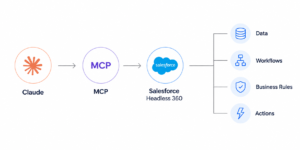
MCP provides a standardized way for AI systems to interact with tools and external systems. In the Salesforce environment, the concept is especially powerful because Salesforce capabilities can become accessible to AI agents without requiring every organization to build separate point-to-point integrations.
For a deeper look at MCP and modern agent protocols, see Kizzy Consulting’s MCP vs A2A guide.
This is where Salesforce’s Headless 360 approach becomes important. Salesforce describes Headless 360 as a way to expose Salesforce data, applications, workflows, agents, and governance as capabilities that AI systems can access directly.
You can also explore Kizzy Consulting’s detailed guide to Salesforce Headless 360 for a deeper explanation of this architecture.
| Traditional Integration | AI + MCP Approach |
|---|---|
| Hard-coded integrations | Standardized AI tool access |
| Point-to-point API workflows | AI can discover and use available capabilities |
| User navigates the application | AI can become the interaction layer |
| Separate authentication and logic | Enterprise permissions and governance can remain part of the system |
Why Salesforce Data Matters to Claude
A large language model can reason well, but reasoning alone is not enough for enterprise work. An AI sales assistant needs to understand the actual state of the company’s pipeline, accounts, opportunities, customer relationships, activities, and business processes.
This is why Salesforce Data Cloud and unified customer data are important to enterprise AI. The better the underlying data, the more useful AI agents can become.
- Customer 360: Build a more complete view of customers and accounts.
- Data quality: Reduce duplicate, outdated, or incomplete records.
- Real-time context: Give AI access to current business information.
- Data governance: Control access and protect sensitive information.
- AI grounding: Reduce the risk of AI generating answers without business context.
Before deploying enterprise AI, organizations should therefore review their Salesforce data foundation. AI does not fix poor CRM data automatically. It can amplify it.
For a broader introduction to agentic systems and how they differ from traditional generative AI, read Kizzy Consulting’s Agentic AI section in the 2026 AI Trends guide.
Ready to Make Salesforce AI-Ready?
Kizzy Consulting can assess your Salesforce data, architecture, workflows, integrations, and AI readiness before you invest in enterprise AI agents.
Claudeforce Use Cases for Enterprise Salesforce
The initial Claudeforce experience focuses on sales, but the broader partnership points toward AI across many Salesforce workflows.
| Use Case | Potential AI Workflow |
|---|---|
| Sales AI | Pipeline analysis, account planning, deal strategy, sales forecasting, lead prioritization. |
| Customer Service AI | Case analysis, knowledge retrieval, response drafting, case routing, resolution assistance. |
| Marketing AI | Campaign planning, customer segmentation, personalization, content generation. |
| Revenue Operations | Forecast analysis, pipeline hygiene, pricing support, quote preparation. |
| Field Service | Scheduling, troubleshooting, technician assistance, asset history analysis. |
| Commerce | Order management, storefront operations, product information, customer assistance. |
Salesforce has indicated that the partnership is expected to expand beyond sales into areas including Service, Marketing, Commerce, Revenue, Field Service, Tableau, Data 360, Informatica, and other enterprise capabilities.
These developments build on the broader Agentforce ecosystem discussed in Kizzy Consulting’s TDX 2026 Highlights, including Headless 360 and Agentforce Vibes 2.0.
The developer side of that evolution is also covered in Kizzy Consulting’s Agentforce Vibes 2.0 guide.
How Claudeforce Handles Salesforce AI Governance
Enterprise AI needs more than intelligence. It needs controls.
- Existing permissions: AI should only access information the user is authorized to access.
- Business rules: AI actions should follow the organization’s Salesforce logic.
- Controlled actions: Organizations can decide how much autonomy AI receives.
- Data security: Sensitive enterprise information requires appropriate security controls.
- Auditability: Enterprise teams need visibility into important AI actions and workflows.
- Human oversight: High-impact actions may require human approval.
Salesforce says Claudeforce is designed so actions route through Salesforce and existing permissions and business rules remain part of the process. This is critical because enterprise AI cannot be treated like a consumer chatbot when it can read and change business data.
Anthropic has also described its broader Salesforce relationship around trusted AI and enterprise safeguards. See the Anthropic and Salesforce partnership announcement for additional context.
What Does Claudeforce Mean for Salesforce Customers?
For Salesforce customers, Claudeforce creates several important opportunities.
| Opportunity | Business Impact |
|---|---|
| Less CRM navigation | Employees can ask AI for business information instead of manually searching through records. |
| Faster sales execution | Sales teams can move from analysis to action faster. |
| Better context | Claude can reason using trusted Salesforce business information. |
| AI workflow automation | AI can participate in multi-step business processes instead of performing isolated tasks. |
| Stronger governance | Existing Salesforce controls can remain part of AI execution. |
How Kizzy Consulting Can Help With Claudeforce and Salesforce AI
Claudeforce is exciting, but the technology is only one part of enterprise AI adoption. The real work is identifying where AI should operate, preparing the data, designing the workflow, connecting systems, and putting governance around the agent.
Kizzy Consulting works across Salesforce and AI engineering, helping organizations connect Salesforce with modern AI models including Claude, GPT, Gemini, and custom AI systems.
| Kizzy Capability | How It Helps |
|---|---|
| Salesforce AI Consulting | Identify where Salesforce AI and Claude can create measurable business value. |
| Agentforce Implementation | Design and deploy autonomous Salesforce agents. |
| AI Integration | Connect Salesforce, Claude, APIs, ERP systems, databases, and other enterprise applications. |
| Data Cloud | Create trusted, unified customer data for AI workflows. |
| AI Governance | Implement security, permissions, human review, monitoring, and AI controls. |
| AI Managed Services | Continuously monitor, optimize, and improve production AI systems. |
How to Prepare Your Salesforce Org for Claude and AI Agents
If your organization is considering Claudeforce, Agentforce, or another Salesforce AI solution, start with the foundation.
- Audit your Salesforce data. Identify duplicate records, incomplete fields, outdated information, and inconsistent data.
- Review your automation. Understand your existing Flows, Apex, integrations, approval processes, and business rules.
- Identify high-value workflows. Look for repetitive sales, service, operations, or administrative processes where AI can save time.
- Define AI permissions. Decide what AI can read, what it can change, and what requires human approval.
- Connect external systems. Determine whether Claude or Salesforce agents need access to ERP, finance, HR, support, or other systems.
- Set measurable KPIs. Track metrics such as time saved, conversion rate, case resolution time, productivity, revenue impact, and cost per outcome.
- Start small and scale. Prove one workflow, measure the result, improve it, and then expand to additional use cases.
The Future: Salesforce Becomes the System Behind the AI Interface
The most interesting part of Claudeforce is not simply that Claude can access Salesforce. The bigger change is the possibility that the AI becomes the primary interface through which employees interact with enterprise software.
Instead of asking employees to learn every screen and workflow, organizations can increasingly let AI interpret business requests and interact with the systems underneath.
But the system of record still matters. Salesforce remains valuable because it contains customer data, relationships, workflows, permissions, business rules, and operational history.
This creates an important enterprise architecture principle:
AI provides the reasoning. Salesforce provides the trusted business context, rules, data, and execution layer.
Frequently Asked Questions About Claudeforce
What is Claudeforce?
Claudeforce is the expanded partnership between Salesforce and Anthropic that combines Claude AI with Salesforce data, workflows, business logic, actions, and governance. The first product is Salesforce in Claude.
How does Claude connect to Salesforce?
Salesforce describes the connection through its broader Headless 360 and MCP architecture, allowing AI systems to access Salesforce capabilities while Salesforce permissions and business rules remain part of the execution process.
Is Salesforce in Claude available now?
Salesforce says Salesforce in Claude is available to select pilot customers, with an open beta planned for September 2026.
Can Claude be used with Agentforce?
Yes. Salesforce has announced that Claude is available within Agentforce, including as a reasoning model for Salesforce’s agent capabilities.
Does my Salesforce org need clean data before using Claude?
Yes. AI is only as useful as the business context it receives. Duplicate, outdated, incomplete, or poorly governed Salesforce data can reduce the quality of AI results and recommendations.
Can Claudeforce help sales teams?
Yes. The first Salesforce in Claude release focuses on sales workflows such as pipeline review, account planning, deal analysis, meeting preparation, sales activity, and CRM hygiene.
Ready for the Next Generation of Salesforce AI?
Claudeforce, Agentforce, MCP, Data Cloud, and AI agents are changing how businesses interact with Salesforce. Kizzy Consulting helps enterprises assess their readiness, design AI workflows, integrate AI models, and deploy production-ready Salesforce AI solutions.