


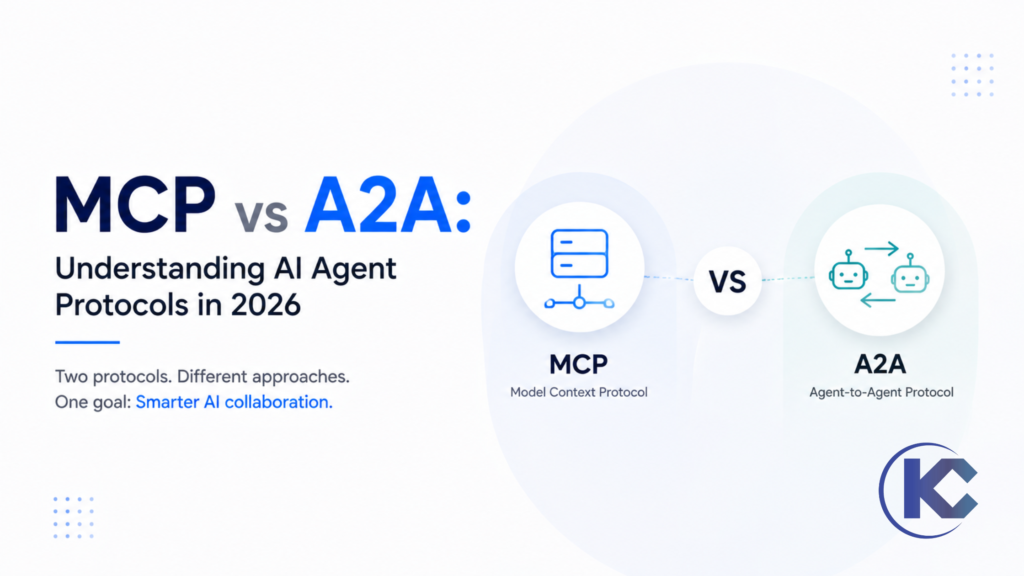
Two protocols are helping define how modern AI agents connect, collaborate, and act: MCP (Model Context Protocol) and A2A (Agent2Agent Protocol). They solve different problems, but they become especially powerful when used together.
MCP connects AI applications and agents to tools, resources, and data. A2A enables independent AI agents to discover one another, communicate, and collaborate on tasks. Together, they provide an important foundation for agentic AI, multi-agent systems, AI orchestration, and enterprise AI automation.
By Sanjeet Mahajan – CEO/Founder of Kizzy Consulting
Executive Quick Answer
What is the difference between MCP and A2A?
MCP connects an AI agent to tools, data, and resources. A2A connects one AI agent to another AI agent. In simple terms, MCP gives an agent access to capabilities it can use, while A2A allows specialized agents to collaborate, delegate work, and exchange task information. They are complementary protocols rather than direct competitors.
Why Protocol Standardization Is Becoming Urgent
The question enterprise leaders are asking has shifted. It is no longer “should we deploy AI agents,” but “how do we get agents to work together reliably.” Gartner forecasts that by 2026 nearly every business application will ship with AI assistants, with roughly 40% integrating task-specific agents within the following year – up sharply from under 5% in 2025.
As adoption accelerates, so does the cost of getting interoperability wrong. Without standardized protocols like MCP and A2A, every new agent-to-tool or agent-to-agent connection becomes bespoke integration work – which is exactly the problem these two protocols were built to remove. Protocol standardization addresses three needs at once: interoperability across vendors and frameworks, scalability without exponential integration overhead, and security through controlled, auditable access patterns.
Separately, Accenture research found that companies with highly interoperable applications grew revenue roughly 6x faster than non-interoperable peers, capturing more than 5 points of incremental annual growth. Protocol choice isn’t just an engineering decision – it’s increasingly a growth lever.
MCP vs A2A: Quick Comparison
The easiest way to understand the difference is to look at what is being connected. MCP focuses on the relationship between an AI application and the tools or resources it needs. A2A focuses on communication between independent agents.
| Aspect | MCP | A2A |
|---|---|---|
| Full Name | Model Context Protocol | Agent2Agent Protocol |
| Origin | Created by Anthropic; now governed under the Linux Foundation’s Agentic AI Foundation | Originally developed by Google; now donated to the Linux Foundation |
| Primary Purpose | Agent/application ↔ tools, resources and data | Agent ↔ agent communication and collaboration |
| Simple Analogy | USB-C for AI tools | A common language for AI agents |
| Task Handling | Stateless by default, per-request tool calls | Stateful, supports long-running, multi-stage tasks |
| Typical Use | Call APIs, query databases, access files, retrieve context | Delegate tasks, discover capabilities, coordinate specialized agents |
| Latest Major State | Rapidly evolving MCP specification and ecosystem | A2A v1.0.0 |
1. What Is MCP (Model Context Protocol)?
Model Context Protocol (MCP) is an open protocol for connecting AI applications with external tools, resources, and data. Anthropic introduced MCP, and in December 2025 the protocol became a founding project of the Agentic AI Foundation under the Linux Foundation.
The protocol has grown rapidly. The MCP project reported more than 97 million monthly SDK downloads and 10,000 active servers, with first-class client support across major AI platforms.
BCG research describes MCP as functioning like a “USB-C port for AI agents” – a standardized link that removes the need for one-off integrations between every model and every tool. Architecturally, MCP is built on a client–server model that shares design lineage with the Language Server Protocol (LSP): a host application embeds an MCP client, which connects to one or more MCP servers, each exposing a defined set of capabilities such as data retrieval, function execution, or enterprise-system integration.
How MCP Works
- MCP Host / Client: The AI application or agent that wants to use external capabilities.
- MCP Server: A program that exposes tools, resources, prompts, or other capabilities to the client.
- JSON-RPC: MCP uses JSON-RPC 2.0 as its messaging format, supporting both lightweight synchronous calls and asynchronous, event-driven workflows.
- Local Connectivity: MCP supports stdio for local server processes.
- Remote Connectivity: Modern MCP specifications use Streamable HTTP for remote communication. The older HTTP+SSE transport has been superseded by Streamable HTTP in newer specifications.
What Can an MCP-Powered Agent Do?
Access Business Data
Query databases, knowledge repositories, documents, and enterprise systems.
Call External Tools
Invoke APIs and business functions without creating a bespoke integration for every model.
Retrieve Context
Give agents access to the information required to reason about a task, including memory and prior tool results.
Execute Actions
Allow approved tools to perform actions inside connected business workflows.
Planning an Enterprise AI Agent?
Kizzy Consulting designs and builds production-ready AI agents, multi-agent workflows, enterprise integrations, and Salesforce-connected AI solutions.
2. What Is A2A (Agent2Agent Protocol)?
Agent2Agent (A2A) is an open standard designed to allow independent AI agents to discover capabilities, communicate, and collaborate even when those agents are built using different frameworks, languages, or vendors.
A2A was originally developed by Google and is now a Linux Foundation project. The latest released specification is A2A v1.0.0, which the project describes as its first stable, production-ready version.
Architecturally, A2A operates on a client–remote agent model. A client agent starts a task and identifies a collaborator through a structured “Agent Card” – a published description of what that agent can do and how to reach it. The remote agent then performs the task autonomously and returns results without exposing the client’s internal context, which respects both agent autonomy and data-privacy boundaries in enterprise deployments.
How A2A Works
- Agent discovery: Agents can publish capability information through Agent Cards.
- Capability negotiation: Agents can understand what another agent supports before requesting work.
- Task-based interaction: Work can be represented as structured tasks with states and outputs.
- Multi-turn collaboration: Agents can continue interactions rather than treating every request as an isolated call.
- Secure transport: OAuth-based authentication and encrypted transport layers protect agent-to-agent traffic.
- Interoperability: A2A is designed for agents built by different teams, organizations, frameworks, or vendors.
Why A2A Matters for Multi-Agent Systems
Imagine a customer asks an enterprise AI assistant to resolve a complex request. One agent could understand the customer, another could check CRM information, another could validate pricing, and another could handle scheduling. A2A provides a standardized communication layer for those independent agents to coordinate.
That makes A2A especially relevant to multi-agent orchestration, autonomous workflows, enterprise AI platforms, AI-to-AI collaboration, and cross-system automation.
3. MCP vs A2A: Key Differences
MCP and A2A should not be treated as competing standards. They operate at different points in an AI agent architecture: MCP standardizes access to capabilities – how an agent interacts with the outside world – while A2A enables collaborative workflows – how agents work with each other.
| Layer | Protocol | Primary Connection |
|---|---|---|
| Tool / Context Layer | MCP | AI agent → tools, resources, data |
| Agent Layer | A2A | AI agent → AI agent |
| Application / Web Layer | Web technologies and emerging agent-web standards | Agent → web experiences and browser-accessible systems |
When Should You Use MCP vs A2A?
| Scenario | MCP | A2A |
|---|---|---|
| Agent needs to query a database | ✓ | – |
| Agent needs to call an external API | ✓ | – |
| Two agents need to collaborate | – | ✓ |
| Agent delegates work to a specialist agent | – | ✓ |
| Agent needs access to documents or resources | ✓ | – |
| Agent uses tools and collaborates with another agent | ✓ | ✓ |
4. The Three-Layer AI Agent Protocol Stack
A practical enterprise AI architecture can be understood as multiple interoperability layers. MCP and A2A sit at the center of this architecture because an autonomous agent usually needs both access to capabilities and the ability to collaborate.
Agent ↔ Web Experiences
Agent ↔ Agent
Agent ↔ Tools / Data / Resources
The important point is that these layers are complementary. An agent can use MCP to access a CRM and simultaneously use A2A to ask another specialized agent to analyze the resulting data.
Need a Multi-Agent Architecture?
Kizzy Consulting builds multi-agent workflows where specialized agents, enterprise systems, APIs, CRMs, and knowledge bases work together through secure orchestration.
5. MCP and A2A Security Considerations
Interoperability makes AI agents more useful, but it also expands the attack surface. Enterprises should treat MCP servers and remote agents as production integrations rather than simply installing another developer tool.
MCP Security Risks
- Untrusted tool servers: A malicious or poorly governed MCP server can expose an agent to unsafe tools or data.
- Tool poisoning: Tool descriptions and returned information should be treated as potentially untrusted input.
- Credential exposure: MCP integrations must be designed so tools receive only the credentials and permissions they actually require.
- Local attack surface: MCP’s own documentation warns that improperly configured HTTP servers can create DNS-rebinding risks and recommends Origin validation, localhost binding for local servers, and authentication.
A2A Security Risks
- Agent impersonation: Organizations need confidence that an advertised agent actually represents the expected service.
- Identity and authentication: Remote agents need strong authentication and authorization controls.
- Data leakage: Agents should not receive more conversation context or business data than required.
- Unsafe delegation: An orchestrator should validate which agents are allowed to perform sensitive operations.
Enterprise Best Practices
- Maintain an inventory of every MCP server and external agent.
- Use least-privilege permissions for tools and agent identities.
- Authenticate remote connections.
- Validate agent capabilities before allowing delegation.
- Log tool calls, agent interactions, failures, and sensitive actions.
- Use human approval for high-impact actions such as financial transfers, production changes, or irreversible record updates.
- Continuously evaluate agent outputs, tool usage, and security events.
6. Governance and Organizational Readiness
Technical security controls are only half the picture. Deploying MCP and A2A successfully also requires organizational trust and right now, that trust is conditional. A Deloitte survey on AI agent autonomy found that 59.7% of respondents trust AI agents to make decisions only within a clearly defined framework, with humans handling judgment calls. Just 2.7% fully trust AI to make all decisions, while 19.9% do not trust AI in any decision-making role.
That gap is closed with governance, not just code. Practical steps include:
- Cross-functional oversight: Form a committee spanning IT, data, and legal to define agent lifecycles and escalation rules, especially for decisions touching regulated processes.
- Standards alignment: Map governance practices to recognized frameworks such as ISO/IEC 42001, along with industry-specific compliance requirements.
- Human-in-the-loop checkpoints: Require human approval at defined decision points, particularly for high-risk or ambiguous scenarios.
- Change management: Bring human teams along with transparent communication and training so they understand how and why agents act – this is what builds durable confidence in autonomous systems, not the technology alone.
- Measurable pilots: Start with a single, measurable workflow that demonstrates safe, explainable agent behavior before expanding the agent network.
Forrester reports that 75% of CX leaders now view AI as a human amplifier rather than a replacement, and 61% of organizations see agentic AI as transformative – but that confidence is earned through governance maturity, not assumed by default.
Kizzy Consulting builds this governance layer alongside the protocol layer – see how it’s structured in our Agentforce consulting and implementation engagements.
7. MCP + A2A Enterprise Use Cases
The real value appears when MCP and A2A are combined inside a business workflow.
| Use Case | MCP Role | A2A Role |
|---|---|---|
| Sales Automation | Access CRM, lead data, calendars and email tools | Sales agent delegates research or qualification to specialist agents |
| Customer Support | Retrieve knowledge, account information and case history | Support agent collaborates with billing, technical or escalation agents |
| Document Processing | Access PDFs, document stores and processing tools | Extraction agent passes structured findings to review or compliance agents |
| Enterprise Operations | Connect ERP, CRM, databases and internal APIs | Operations agents coordinate planning, execution and validation |
| Real Estate AI | Retrieve property, listing, lease and CRM information | Leasing, qualification, property and scheduling agents collaborate |
8. Where MCP and A2A Fit Into Enterprise AI Architecture
For enterprises, protocols are only one part of the architecture. Production AI agents also need secure data access, identity, observability, evaluation, governance, business-process integration, and clear human escalation paths.
This is where an AI agent development strategy becomes different from simply connecting an LLM to an API. Kizzy Consulting develops custom AI agents and multi-agent workflows designed around real business processes.
For Salesforce environments, Kizzy also provides Agentforce consulting and implementation, including agent strategy, workflow automation, integrations, testing, data readiness, and production deployment.
For companies that need a faster route from AI concept to production, Kizzy AI Pods provide a dedicated AI Architect, AI Engineers, and Prompt & Evals Specialist to design, build, and launch a production-ready AI agent.
Think about the architecture this way: MCP answers “What can this agent access?”, while A2A answers “Which other agent can this agent work with?” Your enterprise architecture then adds identity, security, governance, evaluation, observability, and business logic around both.
9. How to Implement MCP and A2A in an Enterprise
Do not begin by connecting dozens of tools or launching a large agent network. Start with one measurable workflow and establish the security and observability foundation first.
- Step 1 – Select the business workflow: Choose a process where AI can produce measurable value.
- Step 2 – Map tools and data: Identify the APIs, databases, documents, CRM records, and applications the agent needs.
- Step 3 – Introduce MCP: Standardize access to approved tools and resources where MCP is appropriate.
- Step 4 – Identify specialist agents: Determine which tasks should be delegated to separate agents.
- Step 5 – Introduce A2A: Use agent-to-agent communication where independent agents need to collaborate or delegate work.
- Step 6 – Add governance: Establish identity, permissions, audit logs, evaluations, monitoring, and human approval paths.
- Step 7 – Measure outcomes: Track task completion, accuracy, latency, cost per outcome, adoption, and business impact.
- Step 8 – Scale carefully: Expand the agent network only after the initial workflow demonstrates reliability and ROI.
MCP vs A2A: The Bottom Line
MCP and A2A solve different problems. MCP provides a standardized way for AI applications and agents to work with tools, resources, and data. A2A provides a standardized way for independent agents to discover capabilities, communicate, and collaborate.
The strongest enterprise architectures will often use both: MCP inside an agent for tool and context access, and A2A between agents for collaboration. The A2A project itself describes this complementary relationship directly.
The simple mental model:
MCP = connect the agent to what it can use.
A2A = connect the agent to who it can work with.
Enterprise architecture = make both secure, observable, governed, and valuable.
Frequently Asked Questions about MCP vs A2A :
Is MCP the same as A2A?
No. MCP is primarily for connecting AI applications and agents to tools, resources, and data. A2A is for communication and collaboration between independent AI agents. They are complementary.
What is the latest version of A2A?
The latest released A2A specification is version 1.0.0. It is described by the A2A project as the first stable, production-ready release of the protocol.
Can MCP and A2A be used together?
Yes. A common architecture is to use MCP for an individual agent’s access to tools and enterprise data while using A2A for collaboration between specialized agents.
Why are MCP and A2A important for enterprise AI?
Enterprise AI agents rarely work in isolation. They need access to business systems, knowledge, APIs, and other specialized agents. MCP and A2A provide standardized interoperability layers that can reduce custom integration work and make multi-agent architectures easier to compose.
What governance practices matter most when deploying MCP and A2A together?
Lifecycle-centered governance: clear rules on agent autonomy, continuous monitoring, cross-functional oversight across IT/risk/business units, alignment with recognized frameworks like ISO/IEC 42001, and human-in-the-loop checkpoints for high-risk or ambiguous decisions.
Ready to Build Your AI Agent Architecture?
Whether you need a single AI agent, a multi-agent workflow, Salesforce Agentforce implementation, RAG architecture, or enterprise AI integrations, Kizzy Consulting can help you move from AI strategy to production.