


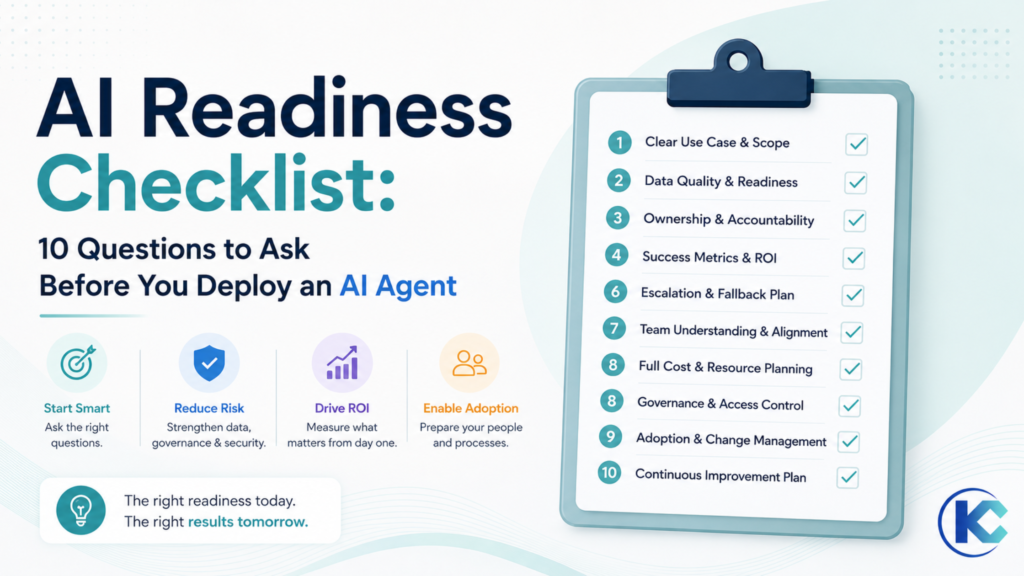
Before investing in AI Agent Development, organizations need a structured AI readiness framework. Gartner projects that more than 40% of agentic AI projects will be canceled by the end of 2027 due to escalating costs, weak governance, and unclear ROI. This guide provides the complete AI Readiness Assessment, a 10-point AI governance checklist, and the AI implementation roadmap required to deploy Enterprise AI, measure agentic AI ROI, and build a durable enterprise AI adoption strategy.
TL;DR
- Gartner predicts 40%+ of agentic AI projects will be canceled by 2027 – mainly due to weak governance and unclear ROI, not model quality.
- Use the 10-point AI readiness checklist below to score your organization’s AI maturity before you spend on licenses or development.
- Focused, low-complexity use cases (like customer service AI agents) hit positive ROI in as little as 4.1 months, versus a 5.1-month median.
Source: Gartner, June 2025 & Enterprise Automation Analytics, 2026
Core Definitions: Understanding the AI Readiness Framework
What is AI Readiness?
AI Readiness is the measurable state of an organization’s ability to successfully adopt, integrate, and scale artificial intelligence. It evaluates data quality, infrastructure, governance, and team alignment to ensure AI initiatives deliver tangible agentic AI ROI without exposing the company to risk.
What is an AI Readiness Assessment?
An AI Readiness Assessment is a comprehensive audit of a business’s technical infrastructure, data architecture, cultural adaptability, and security protocols. It identifies gaps and provides a strategic AI implementation roadmap prior to a full-scale AI Agent Deployment.
Why do AI Agent projects fail?
AI Agent projects primarily fail due to weak AI Data Governance, unclear ROI metrics, lack of executive alignment, and poor change management. Without proper guardrails, generative AI models hallucinate, misinterpret workflows, or inappropriately access restricted enterprise data.
How do you prepare for AI Agent implementation?
Preparation requires completing an AI Readiness Checklist: auditing data silos, establishing an AI Governance Framework, selecting the right platforms (like Salesforce Agentforce), and defining clear KPIs to ensure you can measure and achieve AI ROI.
What is an AI maturity model?
An AI maturity model benchmarks how far an organization has progressed along an enterprise AI adoption strategy – from ad-hoc pilots to a governed, enterprise-wide AI agent deployment strategy with measurable ROI at every stage.
The Business Challenge: Why Do AI Transformations Fail?
Despite the promise of Enterprise Automation, many organizations rush into AI without a solid Generative AI Strategy. When businesses bypass the AI Maturity Assessment phase, they inevitably face bottlenecks that cripple their investments. The staggering statistic that 19% of AI projects never reach payback is a direct result of skipping a proper AI readiness framework before committing budget.
The 4 common mistakes in Enterprise AI Adoption
1. Weak AI Governance & Compliance
- Deploying Agentic AI without strict role-based access controls (RBAC).
- Failing to implement guardrails against AI hallucinations or data leaks.
- Ignoring industry-specific regulatory compliance in automated outputs.
2. Unclear AI ROI and Misaligned Use Cases
- Chasing “cool” technology instead of solving concrete business problems.
- Failing to establish baseline metrics before AI Workflow Automation begins.
- Expecting immediate returns without factoring in implementation costs.
3. Poor Data Infrastructure and Quality
- Training AI on fragmented, siloed, or dirty data sets.
- Lack of real-time data integration, rendering AI outputs obsolete.
- No established pipelines for structured vs. unstructured data management.
4. Ignoring AI Change Management
- Failing to prepare the workforce for human-AI collaboration.
- Assuming AI is an IT-only project rather than an enterprise-wide shift.
- Lack of training, leading to low user adoption and employee resistance.
The 10-Point AI Readiness Checklist
To achieve a positive ROI within 12 months, organizations must systematically evaluate their capabilities. Use this AI governance checklist and AI readiness score methodology to benchmark your organization’s AI Maturity before beginning your next AI project.
1. Executive AI Strategy Alignment
- Is leadership fully committed to the AI Transformation?
- Are AI goals tied directly to overarching business objectives?
- Is there a dedicated budget for deployment and maintenance?
- Do stakeholders understand the limits of Generative AI?
2. High-Impact Use Case Identification
- Have you pinpointed processes ripe for AI Business Automation?
- Are you prioritizing use cases with measurable ROI?
- Is Customer Service AI a potential quick win (4.1 mo payback)?
- Are the selected tasks rules-based or pattern-heavy?
3. AI Data Governance & Quality
- Is your enterprise data centralized, clean, and accessible?
- Do you have a process to prevent AI from accessing PII?
- Is structured and unstructured data properly labeled?
- Who owns data quality across the organization?
4. Security & Compliance Guardrails
- Does the AI Agent framework meet industry standards (HIPAA, GDPR)?
- Are there strict access controls preventing data leakage?
- Do you have an audit trail for AI decision-making?
- Is prompt injection defense integrated into the architecture?
5. Technical Infrastructure & APIs
- Can your current systems integrate via modern APIs?
- Do you have the cloud infrastructure to scale Agentic AI?
- Is your legacy architecture a bottleneck for real-time AI?
- Do you have environments for safe testing and sandbox deployment?
6. Platform & Tech Stack Selection
- Have you evaluated Build vs. Buy for your AI Automation Platform?
- Are you utilizing ecosystems like Microsoft Copilot Studio?
- Is custom AI Agent Development required for your workflow?
- Does the platform allow for future multi-agent orchestration?
7. AI Change Management
- Is there a communication plan to reduce employee AI anxiety?
- Have you developed training programs for AI upskilling?
- Are managers prepared to lead human-AI hybrid teams?
- Is there a feedback loop for employees to report AI friction?
8. AI Talent and Expertise
- Do you have internal AI engineering capabilities?
- Are you partnering with experienced external AI consultants?
- Who will maintain and tune the models post-deployment?
- Is there a dedicated AI product owner?
9. AI Governance Framework
- Is there a centralized committee overseeing the AI Deployment Strategy?
- Are there predefined protocols for handling AI errors or bias?
- Are models regularly audited for drift and degradation?
- Is there a kill-switch for rogue agentic behavior?
10. ROI Measurement Framework
- Have baseline metrics been recorded before implementation?
- Are KPIs tracking time saved, revenue generated, or error reduction?
- Is the payback period projected accurately?
- How frequently is AI ROI reported to the C-suite?
AI Readiness Roadmap: How to Implement an AI Agent Deployment Strategy
Scaling an enterprise AI adoption strategy requires a methodical, five-phase AI implementation roadmap. Skipping phases leads to the 40% cancellation rate predicted by Gartner.
Phase 1: Discovery & AI Readiness Score
- Conduct an extensive AI Maturity Assessment across all departments.
- Evaluate existing technical debt and API infrastructure.
- Identify high-friction workflows ideal for a Document Analysis Agent or Voice Agent.
- Calculate potential AI ROI and secure executive buy-in.
Phase 2: Data Remediation & Preparation
- Audit data lakes, warehouses, and CRMs for accuracy and completeness.
- Establish robust AI Data Governance protocols and access controls.
- Create vector databases or knowledge graphs for Retrieval-Augmented Generation (RAG).
- Anonymize sensitive customer data before model interaction.
Phase 3: Platform Selection & Pilot Design
- Select the appropriate AI Agent Framework (e.g., LangChain, AutoGen).
- Determine if low-code platforms (Microsoft Copilot Studio) fit the use case.
- Design a constrained, low-risk pilot program (e.g., internal AI Knowledge Base Agent).
- Establish precise success criteria and baseline performance metrics.
Phase 4: Deployment & Change Management
- Launch the pilot agent to a restricted group of power users.
- Execute AI Change Management training sessions for the team.
- Monitor user interactions, feedback loops, and hallucination rates closely.
- Refine prompts, system instructions, and RAG retrieval accuracy.
Phase 5: Enterprise Scaling & Optimization
- Roll out the optimized AI agent to the broader enterprise.
- Transition from a single-agent architecture to a multi-agent orchestrated workflow.
- Implement continuous monitoring dashboards for system health and ROI.
- Continuously update the AI Governance policies as new capabilities emerge.
Decision Matrix: Choosing the Right AI Automation Platform
| Platform Approach | Implementation Speed | Flexibility & Control | Best For… |
|---|---|---|---|
| Custom AI Agent Development | Slower (Weeks to Months) | Maximum customization | Proprietary workflows |
| Salesforce Agentforce | Fast (Days to Weeks) | Moderate (CRM restricted) | Customer Service / Sales |
| Microsoft Copilot Studio | Fast (Days to Weeks) | Moderate (M365 Ecosystem) | Internal Knowledge / HR |
| Pre-built SaaS AI Platforms | Instant (Plug-and-play) | Low flexibility | Standardized tasks |
Measuring Agentic AI ROI and Establishing Governance Best Practices
A successful AI Implementation Guide mandates that ROI is not an afterthought, but a core component of the initial Generative AI Strategy. Furthermore, without governance, initial ROI can quickly be eroded by compliance fines or reputational damage.
Key Pillars for Project Success
1. Baseline vs. Post-Implementation Measurement
- How it works: Track current manual handling times (AHT), error rates, and operational costs before deploying any Agentic AI.
- Why it matters: You cannot calculate the 41% success benchmark if you don’t have starting numbers.
- Actionable Tip: Use our AI Readiness Assessment to benchmark your current state.
2. Targeting Short Payback Periods
- How it works: Focus initially on high-volume, low-complexity tasks.
- Why it matters: A Customer Service AI Agent often achieves a blistering 4.1-month ROI payback, significantly faster than the 5.1-month enterprise median.
- Actionable Tip: Avoid massive, cross-departmental overhauls in phase one.
3. Strict AI Governance Controls
- How it works: Implement “Human-in-the-Loop” (HITL) workflows for critical decisions and establish automated compliance scanning.
- Why it matters: It prevents AI hallucinations from reaching end-customers and ensures AI models respect enterprise access permissions.
- Actionable Tip: Appoint an AI Ethics & Governance board prior to launch.
“Without a formal AI readiness assessment, companies are effectively flying blind. Deploying AI agents into a disorganized data environment doesn’t automate business – it just automates chaos at scale.”
Frequently Asked Questions about Enterprise AI Readiness
1. What is an AI Readiness Assessment?
It is a systematic evaluation of an organization’s data quality, IT infrastructure, team skillset, and governance frameworks to determine preparedness for deploying AI technologies.
2. How long does an AI Readiness Assessment take?
Depending on the size of the enterprise, a comprehensive AI Maturity Assessment can take anywhere from 2 to 6 weeks to complete, involving deep dives into data silos and workflows.
3. What is Agentic AI?
Agentic AI refers to autonomous systems capable of understanding goals, formulating plans, interacting with multiple tools or APIs, and executing multi-step tasks without constant human intervention.
4. Why do 40% of AI projects fail according to Gartner?
They frequently fail due to escalating costs, unclear business value, and inadequate risk controls – as detailed in Gartner’s June 2025 press release – compounded by a lack of executive sponsorship and underestimated AI Change Management.
5. How do I calculate AI ROI?
Measure the cost of software, development, and maintenance against the tangible benefits: hours saved (labor cost reduction), increased throughput, lower error rates, and net new revenue generated by the AI system.
6. What is the average payback period for an AI Agent?
The median AI agent payback period is 5.1 months. Highly focused applications, such as Customer Service AI Agents, tend to reach positive ROI faster, averaging 4.1 months.
7. Is Salesforce Agentforce better than custom AI?
Agentforce is excellent for businesses heavily entrenched in the Salesforce ecosystem needing rapid deployment for CRM-based tasks. Custom AI Agent Development is better for proprietary, highly complex, cross-platform workflows.
8. What role does Data Governance play in AI Readiness?
It is the foundation. Without strict AI Data Governance, an AI might surface confidential HR or financial data to unauthorized employees, leading to massive internal or regulatory breaches.
9. How do we manage employee resistance to AI?
Through proactive AI Change Management. Position AI as a co-pilot that eliminates drudgery rather than a replacement. Invest in upskilling and establish clear communication regarding job evolution.
10. Where should a company start with Enterprise AI?
Always start with an AI Readiness Assessment to map existing data and architecture, followed by a small, internal-facing pilot project to validate the tech stack and governance rules safely.
11. What is an AI maturity model?
An AI maturity model is a benchmarking framework that scores an organization’s progress along its AI adoption strategy – from isolated experiments to a fully governed, enterprise-wide AI agent deployment strategy.
Bottom Line: AI Project Success Requires Preparation
Enterprise AI represents a paradigm shift in how businesses operate. However, rushing into AI Agent Deployment without proper technical and cultural foundations is a guaranteed path to failure and financial loss.
Key Takeaways for AI Project Success:
- Don’t skip the assessment: Use the 10-point AI Readiness Checklist to evaluate maturity before spending on licenses or development.
- Clean your data: AI Workflow Automation relies entirely on the quality, structure, and security of the underlying enterprise data.
- Focus on fast payback: Target use cases that can realistically beat the 5.1-month median payback period to build momentum.
- Prioritize governance: Establish your AI Governance Framework on day one to mitigate risk, hallucinations, and compliance issues.
By embracing a structured AI readiness framework, organizations can bypass the pitfalls that trap their competitors and unlock the true value of enterprise automation.
Not sure if your organization is ready for AI Agents?
Assess your data, governance, workflows, and ROI potential before investing. Protect your business from becoming part of the 40% failure statistic.
Book your 3-min AI Readiness Assessment today.