


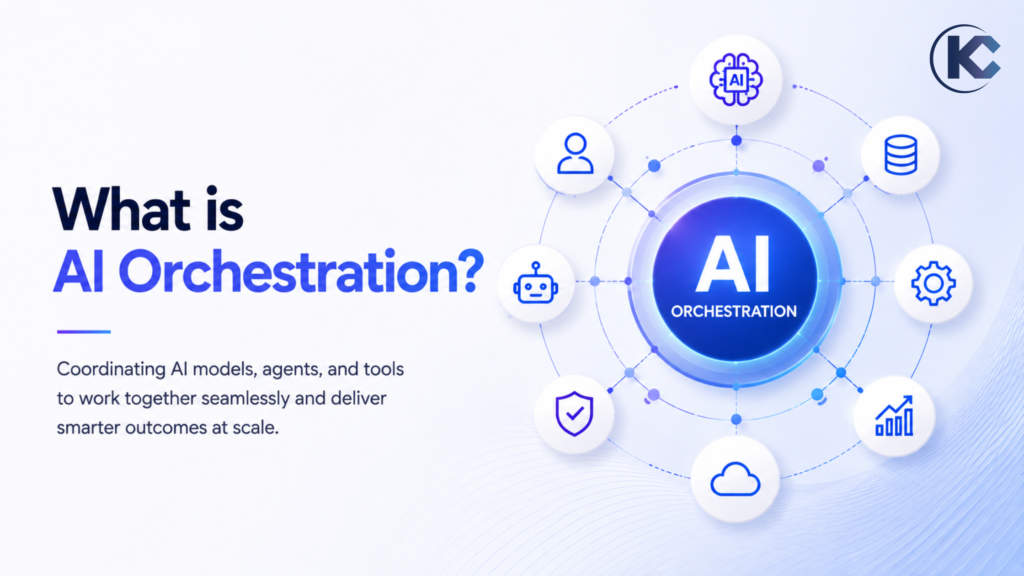
AI orchestration is the strategic coordination and management of artificial intelligence (AI) models, systems, tools, and integrations. It covers the effective deployment, implementation, integration, and maintenance of the components in a greater AI system, workflow, or app.
This comprehensive guide explores how AI orchestration unifies deployment, data pipelines, and governance so AI scales efficiently and securely. We will also explore how platforms like UiPath Maestro represent the cutting edge – where agentic automation meets seamless orchestration.
Executive Quick Answer
How does AI orchestration work?
Why AI Orchestration Matters Now
AI adoption is accelerating, but measurable impact is lagging. The challenge isn’t building models – it’s coordinating, governing, and operationalizing them across complex business environments. When pilots stay siloed, costs rise, governance falters, and scaling stalls.
AI orchestration addresses these roadblocks. Organizations that adopt it report stronger returns. The urgency is only growing: as multi-agent systems and Generative AI (Gen AI) emerge, organizations are implementing LLM orchestration techniques to build and maintain more capable chatbots and apps. Orchestration ensures that diverse models, agents, people, and robots work together productively – collaborating, handing off tasks, and learning from shared data to deliver real enterprise value.
The Definitive Guide to Agentic Orchestration
Find out how orchestration transforms agentic AI from potential into performance. Discover how UiPath Maestro coordinates robots, agents, and humans to automate complex pipelines.
How AI Orchestration Works: The Three Pillars
AI orchestration bridges the gaps between the components of an AI workflow. It brings together the building blocks of AI – models, data pipelines, AI agents, automations, and workflows – operating as one cohesive capability. The three pillars that facilitate this are:
1. AI Integration (Systems, APIs, Data Pipelines)
AI integration connects tools, databases, and enterprise systems. Critical to this are data pipelines – the automated processes that organize, store, and move data. Data engineers design these pipelines for reliable data quality and access. Integration also covers real-time communication between machine learning (ML) models, linking them with tools through APIs for function calling. For example, a credit union might link its check fraud detection model directly with transaction databases and customer service platforms.
2. AI Automation (Workflow, Decisioning, Compute)
Automation is the completion of tasks without human intervention. In AI orchestration, tools automate decision-making processes, such as an LLM triggering an API function call at exactly the right moment. Orchestration platforms also self-manage compute usage, dynamically prioritizing memory and server resources where they are needed most to address urgent, high-volume demands in real-time.
3. AI Management & Governance (Scaling, Monitoring, Ethics)
AI management ensures oversight of an application’s entire lifecycle. It scales models efficiently, monitors for performance degradation and model drift, and manages versioning. Crucially, it enforces governance: applying guardrails for compliance (GDPR, HIPAA), securing sensitive data through encryption, and ensuring decisions are explainable. Strong data protections keep enterprises aligned with legal and ethical requirements.
AI Orchestration vs. Other AI Technologies
It is easy to get confused by overlapping terms in the automation landscape. AI orchestration is the connective tissue that makes adjacent technologies work together.
- Vs. Workflow Orchestration: Workflow orchestration focuses on automating task sequences (usually rules-based). AI orchestration embeds intelligence into those end-to-end processes, coordinating models so decisions are adaptive rather than rigid.
- Vs. MLOps (LLMOps): MLOps focuses on the lifecycle of machine learning models (training, testing, deployment). AI orchestration takes the next step – integrating those live models into actual business processes at scale.
The Traffic Light Analogy: AI Orchestration vs. AI Agents
An AI agent is a singular model that autonomously plans and executes tasks. Imagine an AI agent as a smart traffic light connected to a local sensor. It can change colors to manage its specific intersection well. However, it has no idea what traffic conditions look like across the whole city. If lights aren’t synced, traffic jams happen.
AI orchestration is the centralized city-wide system. It coordinates the timing of all the traffic lights (agents) to keep vehicles moving smoothly across the entire grid, preventing duplicated efforts and system-wide bottlenecks.
Benefits and Scaling Capabilities
By applying AI technology toward the creation of systems that scale efficiently, businesses unlock several critical advantages:
| Technical & Scaling | Business & Efficiency | Governance & Collaboration |
|---|---|---|
| Greater Scalability: Uses tools like Kubernetes to automate deployment and dynamically allocate container resources. | Increased Efficiency: Automates workflows, removing repetitive tasks and lowering infrastructure costs. | Centralized Policies: Enforces strict access controls, data handling rules, and system-wide security. |
| Improved Performance: Monitors telemetry in real-time to prevent latency and manage API rate limits. | Faster Time to Value: Unifies tooling under one layer, abstracting execution to reduce vendor lock-in. | Better Collaboration: Low-code interfaces empower cross-functional teams (IT, Ops, Data Science) to build together. |
Real-World Use Cases & Orchestration Tools
Advanced Capabilities Enabled by Orchestration
- Retail Personalization: Retailers use orchestration to unify recommendation engines, inventory systems, and behavior analytics in real-time, instantly routing data through a model to update recommendations as a user browses.
- Retrieval Augmented Generation (RAG): Connecting a proprietary database with a natural language processing LLM to create a chatbot that gives employees secure, conversational access to internal data.
- Predictive Maintenance: Logistics providers rely on APIs to connect IoT sensor data, vector databases to analyze disruptions, and LLM frameworks to suggest optimized rerouting instantly.
The Tooling Ecosystem
A growing ecosystem of tools has emerged to handle these complex requirements:
- Open-Source Frameworks: Tools like Apache Airflow, LangChain, and Haystack provide modular solutions for chaining models and managing data pipelines as code.
- Enterprise Platforms (UiPath Maestro): Out-of-the-box orchestration with business-grade scale. UiPath brings orchestration to business users via visual workflow builders, prebuilt SaaS connectors, and role-based governance.
- Agentic Frameworks: Tools like CrewAI and LangGraph are purpose-built for coordinating autonomous AI agents, letting you define roles, memory, and task delegation.
How to Implement AI Orchestration
Scaling AI requires a reliable orchestration layer. Implementation should follow a disciplined, five-step roadmap:
Implementation Best Practices Checklist
- Ensure platforms support modular architectures and tool interoperability to prevent lock-in.
- Prioritize data quality and context propagation across all agents and tools.
- Maintain absolute visibility with real-time dashboards and comprehensive audit logs.
- Embed human oversight (human-in-the-loop), especially where errors carry high financial or compliance risk.
The Future of AI Orchestration & Conclusion
AI orchestration is quickly moving from an emerging capability to a foundational enterprise layer – on par with data platforms and cloud infrastructure. Future advancements will focus heavily on supporting multimodal systems (routing seamlessly between an LLM, a vision model, and a structured analytics engine) and dialing autonomy, where enterprises can dynamically calibrate how much autonomy agents possess based on confidence thresholds and risk.
Conclusion: AI orchestration is fast becoming an essential layer in the modern tech stack. As capabilities multiply, orchestration ensures they work together securely, intelligently, and at scale. From coordinating autonomous agents to enforcing rigorous data pipelines, the organizations that succeed will be those that can orchestrate AI effectively. Now is the time to invest in the tools, talent, and strategy to make it a reality.
Evaluating Your Enterprise AI Orchestration Strategy?
Stop running isolated pilots. Start with a comprehensive AI readiness assessment and receive a tailored roadmap that aligns your data pipelines, agentic workflows, and governance models for enterprise-scale ROI.
AI Orchestration: Frequently Asked Questions
Q: What is AI orchestration in simple terms?
A: AI orchestration is the system that makes different AI tools, models, APIs, and data sources work together. It connects them into coordinated workflows that can run autonomously, securely, and reliably at scale.
Q: How does AI orchestration differ from workflow orchestration?
A: Workflow orchestration automates rigid, step-by-step task sequences. AI orchestration goes much further by embedding intelligence and context-awareness into workflows, ensuring dynamic AI models and autonomous agents trigger properly across complex systems.
Q: Is AI orchestration the same as agentic automation?
A: Not exactly. AI orchestration is the overarching infrastructure managing how all AI components interact. Agentic automation uses orchestration specifically to coordinate autonomous AI agents, models, and function calls to solve complex problems.
Q: What are the main challenges of scaling AI without orchestration?
A: Without orchestration, organizations face severe integration complexity, shadow AI, heightened security risks, vendor lock-in, and an inability to track the true ROI of fragmented, siloed pilots.
Evaluating Your Enterprise AI Orchestration Strategy?
Stop running isolated pilots. Start with a comprehensive AI readiness assessment and receive a tailored roadmap that aligns your data pipelines, agentic workflows, and governance models for enterprise-scale ROI.