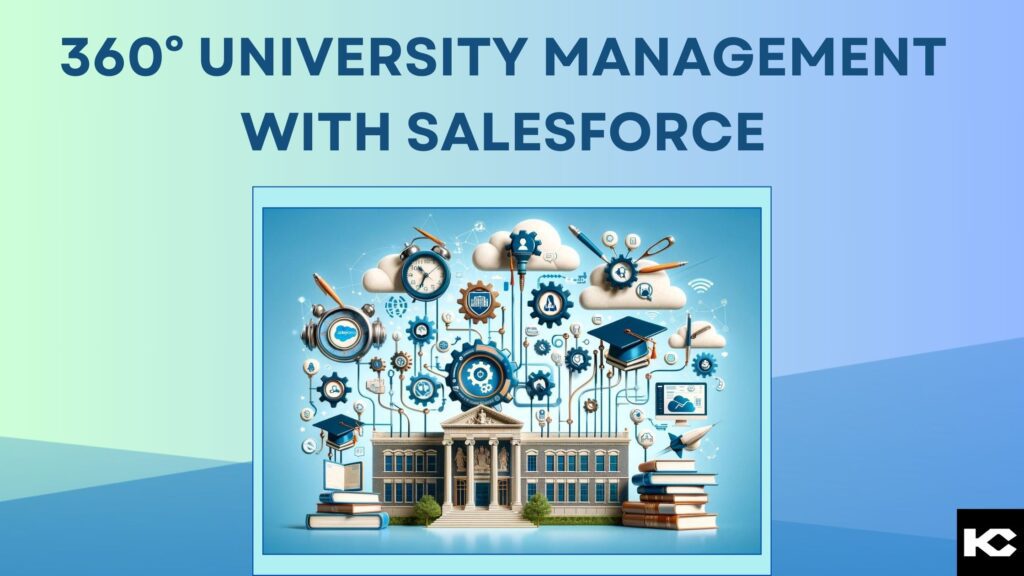
University Management with Salesforce: Education Cloud Case Study
⏱ 3 min read
How a U.S. university centralized student data across 55 departments, launched a secure student portal, automated communications, and improved operational efficiency using Salesforce Education Cloud.
University Management with Salesforce: Quick Overview
The university had student, academic, financial, and advisory information distributed across multiple CRM systems and department-level applications. Kizzy Consulting consolidated the Salesforce ecosystem using Education Cloud as the central data and process layer, creating a unified student lifecycle view and improving access to accurate information.
55+Departments
20%Data Management Efficiency Gain
30%Faster Case Resolution
25%Higher On-Time Task Completion
University Overview
Client: University based in Princeton, USA
Salesforce Clouds & Edition: Sales Cloud, Education Cloud, Experience Cloud, Enterprise Edition
System Overview and Challenges
The university had a large base of students and teaching staff distributed across more than 55 departments. Students also had active financial plans managed by Student Advisors, creating the need for academic and financial information to remain connected throughout the student lifecycle.
Over time, the institution had implemented multiple CRM systems and department-level tools to manage admissions, academics, financial planning, and student services. While each system supported individual processes, information was fragmented across platforms.
This fragmentation created several operational and data challenges:
Duplicate Records
Student records were duplicated across different systems.
Inconsistent Data
Academic and financial information could differ between departments.
Fragmented Lifecycle
There was no unified view of the complete student lifecycle.
Manual Reconciliation
Teams manually reconciled academic, financial, and advisory information.
Reporting Discrepancies
Disconnected data sources affected reporting consistency.
Limited Advisor Visibility
Advisors lacked a consolidated view of student information.
In addition to solving these data challenges, the university wanted:
- A CRM system to track courses, academic history, and student progress.
- A secure portal where students could review academic and financial information.
- Time-logged automated updates for students, teachers, and advisors.
The Core Challenge:
The problem was not a lack of technology. It was the lack of a
single source of truth
for student information.
The problem was not a lack of technology. It was the lack of a
single source of truth
for student information.

Solution: A Unified Salesforce Education Cloud Ecosystem
To address the university’s challenges, Kizzy Consulting enhanced and consolidated its Salesforce ecosystem using Education Cloud as the central data and process layer.
Instead of replacing every existing system, the implementation focused on creating a consistent Salesforce foundation by:
- Standardizing and centralizing student data within Salesforce.
- Defining a unified student lifecycle model across departments.
- Cleaning and deduplicating records across CRM environments.
- Establishing clear data ownership and governance.
Explore Salesforce Education Cloud Use Cases
Education Cloud can support student recruitment, enrollment, advising, student success, campus engagement, analytics, and other stages of the education lifecycle.
Unified CRM Architecture
The Kizzy team implemented Education Cloud to centralize student information across all 55 departments, including course enrollment, academic history, financial plans, and progress tracking.
The solution introduced:
Standardized Data Model
A consistent structure for managing student information.
Consolidated Records
Academic and financial records were brought together.
Cross-Department Visibility
Advisors and administrators gained broader access to relevant information.
Connected Relationships
Students, advisors, courses, and financial plans were structured within the CRM.
The result was a 360° view of each student, helping eliminate reporting inconsistencies and disconnected data silos.
The Importance of Organized CRM Data
A reliable student experience starts with reliable data. Standardization, deduplication, governance, and unified records can help institutions turn fragmented CRM data into a more usable operational foundation.
Student Portal for Self-Service and Support
A user-friendly portal was developed within Salesforce Experience Cloud, allowing students to securely log in and access important academic and financial information.
Academic Records
Access to relevant academic information.
Financial Details
Visibility into financial information and balances.
Active Plans
Access to active financial plans and balances.
Advisor Communication
Case management and communication with advisors.
Role-based access controls differentiated information and access between Students, Advisors, Faculty, and the Admin team.
Advisors received visibility into fees and available balances for students under their guidance. KPI indicators were also implemented to proactively identify students below defined financial thresholds, enabling earlier intervention.
Build Secure Self-Service Portals with Salesforce
Experience Cloud can connect external users to the information and services they need through secure, CRM-connected digital experiences.
Automated Communication System
With student data centralized, Salesforce automation was used to improve communication between students, teachers, advisors, and other stakeholders.
The automation framework supported:
- Time-logged updates for students, teachers, and advisors.
- Deadline reminders for course registrations and assignments.
- Notifications related to financial aid and payment updates.
- Personalized communication based on academic status and lifecycle stage.
Key principle:
Automation was built on clean, unified data, helping maintain consistency and accuracy across communications.
Automation was built on clean, unified data, helping maintain consistency and accuracy across communications.
Results
The Salesforce Education Cloud implementation delivered measurable improvements across data management, case resolution, task completion, and financial visibility.
20%
Higher Data Management Efficiency
Within six months
30%
Faster Case Resolution
Within the first three months
25%
Higher On-Time Task Completion
Within the first semester
15%
Reduction in Defaulting Accounts
Through improved financial visibility
The university also gained sharper data accuracy and accessibility through centralized student records. Most importantly, leadership gained a consolidated reporting structure powered by a unified data model, enabling more reliable, real-time decision-making.
Key Takeaways from the Salesforce University Management Case Study
- Centralizing student data can create a more complete view of the student lifecycle.
- Data standardization and deduplication are critical when multiple systems contribute information.
- Experience Cloud can provide secure self-service access to CRM-connected information.
- Automation becomes more reliable when it is built on governed, unified data.
- Role-based access can help ensure that students, advisors, faculty, and administrators see the information relevant to their responsibilities.
- Real-time reporting can help institutional leadership make decisions using a more consolidated information base.
Looking for a Salesforce Partner for University Management?
Kizzy Consulting helps educational institutions design and implement Salesforce solutions that connect student data, automate workflows, improve visibility, and create more connected digital experiences.
Frequently Asked Questions About University Management with Salesforce
How can Salesforce be used for university management?
Salesforce can support university management by centralizing student information, managing admissions and enrollment, supporting academic advising, connecting financial information, automating communication, and providing self-service experiences through portals.
What is Salesforce Education Cloud?
Salesforce Education Cloud is a Salesforce platform designed for educational institutions. It can support student recruitment, enrollment, student success, advising, campus engagement, alumni relationships, analytics, and other education-focused processes.
How does Salesforce provide a 360-degree view of students?
A Salesforce-based student 360 view can connect relevant information such as academic history, course enrollment, financial plans, advising activity, cases, and other lifecycle information within a structured CRM environment.
Can Salesforce provide a student self-service portal?
Yes. Salesforce Experience Cloud can be used to build secure portals and digital experiences where students can access relevant information, submit cases, communicate with advisors, and interact with connected Salesforce data.
How can Salesforce automation improve university communication?
Salesforce automation can trigger reminders, notifications, updates, and other communications based on defined events, deadlines, academic status, financial activity, or student lifecycle stages.
What are the benefits of using Salesforce for higher education?
Potential benefits include centralized student data, improved visibility across departments, more consistent reporting, automated communication, self-service capabilities, streamlined advising, and better access to information for students, faculty, advisors, administrators, and leadership.
Conclusion
This university management Salesforce case study demonstrates how a fragmented technology environment can be transformed by creating a unified CRM architecture around student data and processes.
By using Education Cloud as the central data and process layer, combined with Experience Cloud and Salesforce automation, the university created a more connected student lifecycle, improved advisor visibility, streamlined communication, and strengthened institutional reporting.
The broader lesson is that successful Salesforce transformation is not simply about adding another platform. It is about creating a reliable data foundation and connecting people, processes, and systems around a common source of information.
Kizzy Consulting
Kizzy Consulting is a Salesforce consulting and implementation partner based in Panchkula, India. Kizzy helps organizations across industries with Salesforce consulting, implementation, integration, automation, data, and AI solutions.
For a consultation, email [email protected] or use the consultation form above.