


Traditional Robotic Process Automation (RPA) and basic workflow automation are excellent for repetitive, rules-based tasks. However, they struggle the moment a business process becomes dynamic or unexpected. This is where AI agents step in. Powered by Generative AI and Large Language Models (LLMs), AI agents go far beyond simple automation. They have the ability to reason, retrieve critical enterprise knowledge, interact with your business tools, and complete multi-step workflows with very little human intervention.
This guide explains the clear signs that your business is ready for AI agent development. We will explore how autonomous AI agents differ from basic AI copilots, how to approach AI implementation safely, and the practical steps needed to achieve a successful AI transformation across your organization.
By Sanjeet Mahajan, Founder & CEO, Kizzy Consulting – AI Expert
Executive Quick Answer
When is it time to deploy AI agents? If your team members are spending hours switching between different systems, manually routing work, reviewing routine approvals, or constantly fixing broken software bots, it is time for an upgrade. Enterprise AI agents deliver true intelligent automation. They manage end-to-end AI workflow automation, improve your decision-making speed, and significantly reduce overall operational costs.
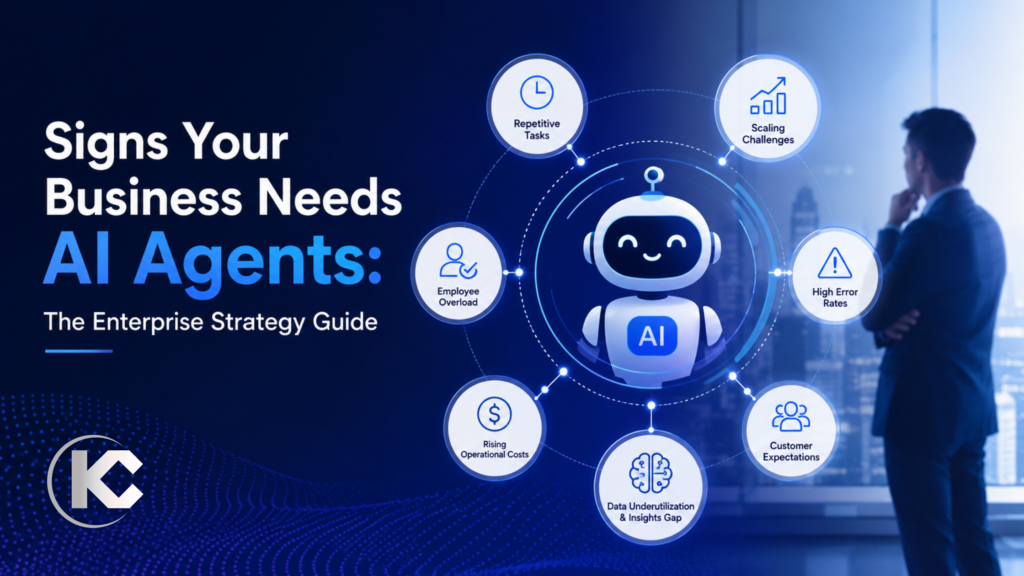
6 Definitive Signs Your Business Needs AI Agents
If your operations, IT, or customer service departments routinely encounter the following bottlenecks, your current technology stack is actively preventing you from scaling. Here are the core indicators that it is time to build a robust AI strategy and pursue professional AI consulting services for an enterprise rollout.


1. Data Isn’t Ready for AI
The Problem: Your data is scattered, hard to access, or lacks proper governance.
The Solution: Organize your data, connect systems, and use secure access controls so AI agents can find the right information.
2. Dashboards Show Problems, But Don’t Solve Them
The Problem: Teams spend too much time reviewing reports instead of taking action.
The Solution: AI agents analyze data, recommend next steps, and automate decisions where appropriate.
3. Too Many Repetitive Processes
Problem: Employees spend hours on repetitive, multi-step tasks across different systems.
Solution: AI agents automate routine workflows while escalating only exceptions to people.
4. AI Assistants Aren’t Enough Anymore
Problem: AI copilots help with individual tasks but can’t complete end-to-end business processes.
Solution: AI agents work across multiple systems, use tools, and complete tasks with minimal human input.
5. Your AI Tools Don’t Work Together
Problem: Standalone AI tools create isolated solutions that are difficult to scale.
Solution: Build a unified AI platform where agents can securely connect to data, systems, and workflows.
6. Teams Aren’t Ready for AI Adoption
Problem: Without training and alignment, AI projects struggle to deliver value.
Solution: Prepare employees with AI education, clear processes, and collaboration between business and IT teams.
Are Operational Inefficiencies Slowing Your Business Down?
Replace repetitive manual work with enterprise AI agents that streamline operations, boost efficiency, and protect your business data.
How AI Agents Fit Into Existing Enterprise Systems
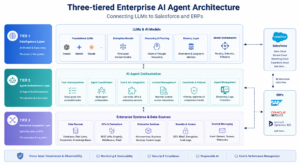
Many leaders think AI requires replacing legacy ERP systems. It doesn’t. AI agents work on top of your existing software, connecting systems through APIs to automate tasks without changing your core infrastructure.

High-ROI Enterprise AI Agent Use Cases
The most successful AI adoption strategies target specific, high-volume operational workflows. Broad, generalized use cases often fail; narrow, specialized agents deliver measurable business value. Leading organizations utilizing expert AI consulting services are deploying agents in the following areas:
IT Helpdesk & Infrastructure Agents
Automates Level 1 and Level 2 IT ticket resolution. The agent reads incoming support tickets, provisions necessary cloud resources via APIs, resets active directory credentials, and updates the end-user without requiring a human IT technician.
Financial Reconciliation Agents
Deploys multi-agent systems where one agent extracts data from incoming vendor PDFs, a second queries the ERP database to match purchase orders, and a third flags any pricing discrepancies for the accounting team to review.
Supply Chain Operations Agents
AI agents actively monitor global weather APIs, port congestion data, and local inventory levels. When a disruption is detected, the agent autonomously emails alternative suppliers to request expedited quotes, securing your supply chain.
HR Onboarding & Compliance Agents
Manages the entire employee onboarding lifecycle. It seamlessly generates employment contracts, triggers IT hardware procurement, schedules orientation meetings, and audits compliance forms, ensuring a flawless new-hire experience.
Sales Development Agents
Rather than relying on generic bulk email outreach, this agent researches a prospect’s recent company filings, synthesizes a highly personalized pitch, responds to inbound leads in real-time, and schedules meetings autonomously.
Legal Contract Analysis Agents
Audits hundreds of legacy contracts during an acquisition event. The agent extracts specific liability clauses, compares them against a master risk template, and generates a unified risk exposure report for the general counsel.
The Enterprise AI Agent Maturity Roadmap
Deploying Agentic AI frameworks requires a phased approach to manage operational risk and properly validate financial returns. Attempting to leap directly to full, unsupervised autonomy usually results in failure. We recommend the following five-phase maturity model to guide your digital transformation:
AI Governance Considerations & ROI Expectations
Warning: Governance is Non-Negotiable
Allowing an AI agent “Write” access to your enterprise systems without strict guardrails introduces catastrophic operational risk. Robust AI deployments require Role-Based Access Controls (RBAC) at the agent level. An agent should inherit the exact same permissions as the human employee it assists. Furthermore, all agent decisions must be cryptographically logged for clear auditability and regulatory compliance tracing.
ROI Expectations for Business Process Automation
Enterprise investments in AI agent development generate returns across three distinct vectors:
- Cost Avoidance: Processing significantly higher transactional volumes without needing to expand your back-office payroll footprint.
- Time-to-Value Acceleration: Shrinking manual contracting, employee onboarding, or data reporting cycles from days to mere minutes.
- Error Reduction: Completely eliminating the data entry mistakes and typos inherent in human copy-pasting across platforms.
Structured pilot programs managed by experienced AI consulting partners typically show a measurable ROI signal well before the 60-day mark, proving the power of enterprise AI.
Signs You Are NOT Ready for AI Agents
It is equally important for executives to recognize when their infrastructure cannot support autonomous AI. Premature implementation leads to high failure rates. You are likely not ready if:
- Your data is entirely unstructured and un-digitized: AI agents cannot process paper files sitting in filing cabinets. Digital transformation must precede AI transformation.
- You lack modern API infrastructure: If your core legacy systems cannot be accessed via secure APIs or webhooks, agents simply cannot take action within them.
- Leadership views AI purely as a headcount reduction tool: Treating AI merely as a way to fire staff, rather than a scalability driver, creates internal hostility that guarantees project sabotage and failure.
- There is no internal champion for governance: If no executive is willing to own the ongoing monitoring, evaluation, and security of the AI system post-deployment, do not build it.
The Future of Enterprise AI Agents
The transition from isolated task automation to complex agentic reasoning is accelerating rapidly. Future enterprise automation architectures will heavily leverage standardized protocols to unify how AI models access disparate internal databases securely.
The competitive moat for modern enterprises will no longer simply be proprietary software; it will be cognitive infrastructure. Organizations that deploy AI agents today will capture invaluable, proprietary data on how AI solves their unique business processes, tuning specialized models that will become mathematically impossible for late adopters to replicate.
Enterprise AI Agents: Frequently Asked Questions
1. What is an AI agent for business?
An AI agent is an autonomous software program that uses large language models to understand a goal, formulate a multi-step plan, use external tools via APIs, and complete the objective with minimal human intervention.
2. How are AI agents different from RPA (Robotic Process Automation)?
RPA follows strict rule-based scripts and breaks when UI or data formats change. AI agents use semantic understanding to adapt to data variations, handle exceptions, and reason through probabilistic workflows without breaking.
3. What are the main signs my business needs AI agents?
Key signs include: highly paid employees spending excessive time switching between disconnected systems, customer support failing to scale profitably, manual approvals causing operational bottlenecks, and existing automation bots constantly breaking.
4. Is our corporate data safe when using generative AI agents?
Yes, provided the architecture utilizes enterprise-grade model instances where data is explicitly not used to train public models, and rigorous Role-Based Access Control (RBAC) is enforced at every layer.
5. Do AI agents replace human employees?
Agents primarily replace repetitive tasks, not vital roles. They eliminate low-value, repetitive swivel-chair integration work, elevating employees to focus on strategic, empathetic, and complex problem-solving duties.
6. What is the difference between an AI Copilot and an AI Agent?
An AI copilot requires constant human prompting and oversight to assist with individual, localized tasks. An autonomous agent acts independently over longer time horizons, executing multiple steps across various systems to achieve an overarching goal.
Evaluating Enterprise AI Partners?
Start with a comprehensive AI readiness assessment and receive a tailored, milestone-based proposal designed around your operational challenges, technology landscape, and business objectives.