


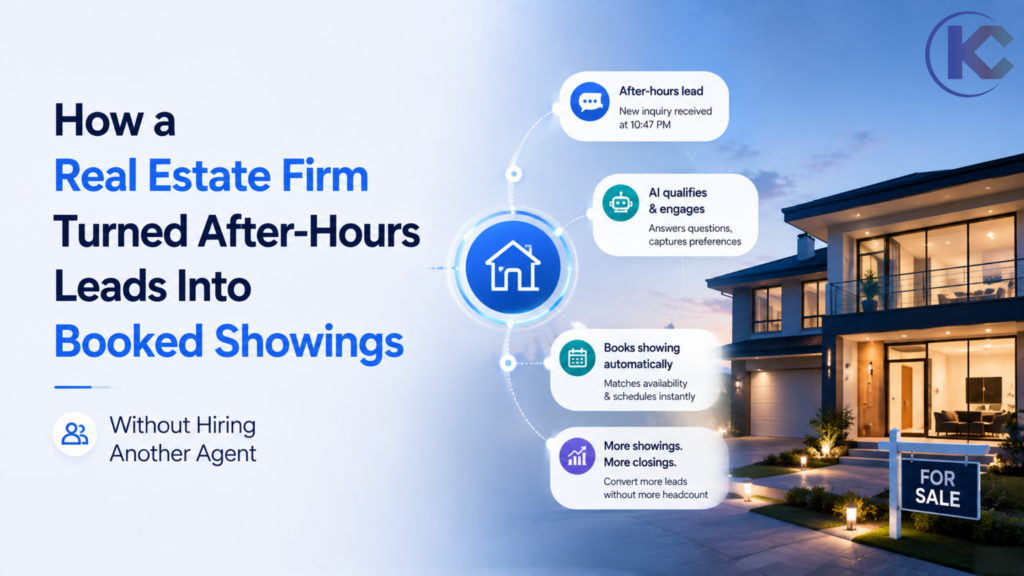
A mid-market real estate brokerage and property management firm was losing high-intent inquiries to voicemail, especially during evenings and weekends. Kizzy Consulting deployed a focused AI Voice Agent to answer property questions, qualify prospects, and book showings – giving the team 24/7 first-touch coverage without hiring another leasing or sales agent.
Results referenced from Kizzy Consulting’s real estate AI Voice Agent case study. Results vary based on call volume, listing data, integrations, lead quality, and implementation.
The Challenge: Real Estate Leads Were Going Cold After Hours
The firm had a familiar real estate problem: the phone kept ringing after the leasing and sales team had gone home.
Prospects were calling with questions that often signaled immediate buying or renting intent: “Is this property still available?” “What’s included in the rent?” “Do you allow pets?” “Can I schedule a viewing?”
When those calls went to voicemail, the response was often delayed until the next business day. By then, a high-intent prospect could already be speaking with another brokerage or property manager.
What was slowing the real estate team down?
1. After-hours inquiries were difficult to capture
- Prospects called during evenings, weekends, and other periods with limited staff coverage
- Voicemail introduced a delay between inquiry and response
- High-intent prospects could quickly move to competing listings
- Agents had to follow up manually when they returned to work
2. Agents were spending valuable time on repetitive questions
- Availability questions were repeatedly answered by leasing staff
- Prospects asked about rent, property features, pet policies, utilities, and other listing details
- Routine questions interrupted agents working with active prospects
- Call notes and lead entry added more administrative work
3. Showing scheduling created unnecessary back-and-forth
- Prospects had to wait for an agent to confirm availability
- Agents manually coordinated showing times
- Rescheduling created additional administrative work
- Some prospects abandoned the process before a showing was booked
4. Peak periods created a capacity problem
- Inbound call volume could increase sharply during active rental and sales periods
- Small leasing and sales teams had limited capacity to absorb call spikes
- Adding staff solely for peak periods was difficult to justify
- The firm needed a way to increase response capacity without proportional headcount growth
The Solution: A 24/7 AI Voice Agent for Real Estate Inquiries
Rather than attempting to automate the entire sales cycle, the engagement focused on one measurable outcome: handle the first-touch inquiry and move qualified prospects toward a booked showing.
The Kizzy AI Pod deployed an AI Voice Agent designed to answer inbound calls, understand natural language, retrieve property information, qualify prospects, and schedule appointments.
The agent was positioned as a first-touch layer for the human team – not a replacement for leasing or sales professionals. Routine conversations could be handled automatically while qualified or complex opportunities could be routed to the appropriate person.
The workflow can connect telephony, listing data, CRM systems, calendars, and other business systems so that the phone conversation becomes part of the firm’s existing lead-management process.
Explore Kizzy’s AI Voice Agent for Real Estate.
What could the AI Voice Agent handle?
| Capability | What it does |
|---|---|
| 24/7 Call Answering | Answers inbound property calls during business hours, evenings, weekends, and other periods without live coverage. |
| Property Availability | Retrieves connected listing information to answer configured availability questions. |
| Property Details | Answers questions about pricing, pet policies, utilities, property features, and other configured listing information. |
| Lead Qualification | Captures information such as budget, preferred property type, location, and move-in timeline. |
| Showing Scheduling | Checks connected calendar availability and books property viewings during the conversation. |
| CRM Synchronization | Captures caller details, qualification data, activities, and call summaries for the CRM workflow. |
| Human Handoff | Routes qualified or complex opportunities to human leasing and sales professionals. |
How the Kizzy AI Pod Was Implemented
The project was structured as a focused Kizzy AI Pod. Instead of attempting to transform every real estate workflow at once, the team concentrated on a single production use case: first-touch inquiry handling and showing booking.
Weeks 1-2: Readiness assessment and scope definition
- Mapped the existing inbound call and lead-response workflow
- Identified the most common property questions
- Defined which conversations the AI could handle independently
- Established escalation rules for human handoff
- Defined the information required to qualify a lead
- Reviewed listing, CRM, calendar, and telephony systems
The key decision: keep the scope narrow.
The objective was not to make the AI responsible for the entire sales process. It was to make sure a prospect could call, get an immediate answer, provide qualification information, and move toward a showing without waiting for a human agent.
Weeks 3-6: Build, integration, and evaluation
- Built the conversational AI Voice Agent
- Connected relevant property and listing information
- Integrated CRM lead capture and activity logging
- Connected calendar availability for showing appointments
- Configured qualification questions and routing rules
- Tested common questions and edge-case conversations
- Evaluated response accuracy, latency, qualification quality, and handoff behavior
For brokerages using Salesforce, the workflow can also become part of an existing Salesforce environment, creating a natural path for CRM-based lead management and, where appropriate, future Agentforce workflows.
Weeks 7-8: Production launch and team handoff
- Moved the AI Voice Agent into the production call workflow
- Monitored real conversations and qualification outcomes
- Refined prompts, routing, and escalation behavior
- Trained the leasing and sales team on qualified-lead handoffs
- Delivered implementation documentation and knowledge transfer
- Established an ongoing evaluation and optimization process
The Results: More Calls Answered, More Showings Booked
The most important operational change was simple: prospects no longer had to wait for an available leasing agent before the conversation could begin.
In Kizzy’s published real estate AI Voice Agent case study, the system handled 82% of inbound calls without human assistance and was associated with a 45% increase in property showings booked. The agent also delivered response latency below 850 milliseconds, supporting a more natural phone experience.
Without human assistance
After AI implementation
Including nights and weekends
What changed operationally?
Faster response to high-intent prospects
- Before: After-hours prospects could wait until the next business day.
- After: The AI answered inbound calls immediately.
- Business impact: Prospects could begin the conversation while their interest was still active.
More showing opportunities moved directly to the calendar
- Before: Agents manually coordinated showing availability.
- After: The AI could check connected calendar availability and schedule during the call.
- Business impact: Fewer prospects were lost because of scheduling delays.
Agents spent less time on repetitive inquiries
- Before: Leasing staff repeatedly answered basic listing questions.
- After: The AI handled configured property questions automatically.
- Business impact: Human agents could focus more time on qualified prospects and revenue-generating conversations.
AI Voice Agent vs. Another Hire: The Real Estate Business Case
For a brokerage owner, the business case is not simply about replacing a receptionist or answering service. The more useful question is: how much additional inbound demand can the team handle without increasing headcount at the same rate?
A focused AI Pod can create capacity by handling the repetitive first-touch work while human agents concentrate on qualified leads, negotiations, client relationships, and closing activity.
| Area | Traditional approach | AI Voice Agent | Business impact |
|---|---|---|---|
| After-hours coverage | Voicemail, answering service, or on-call staff | 24/7 automated response | Fewer missed opportunities |
| Property questions | Human agent handles each call | AI handles configured questions | Less repetitive work |
| Showing booking | Manual coordination | Calendar-based booking | Faster path from inquiry to showing |
| Peak demand | Additional staff, overtime, or missed calls | Elastic call capacity | Scale response without proportional hiring |
| Lead data | Manual notes and CRM entry | Structured automated capture | Cleaner handoffs and reporting |
Before and After: From Missed Calls to Booked Showings
| Area | Before | After | Result |
|---|---|---|---|
| Lead response | After-hours calls could wait until the next business day | Immediate AI response | 24/7 coverage |
| Call handling | Human-first response | AI first-touch handling | 82% automated |
| Showing scheduling | Manual coordination | Automated calendar booking | 45% increase |
| Property questions | Handled manually | Configured questions handled automatically | Lower admin load |
| Lead information | Manual notes | Structured CRM capture | Cleaner handoffs |
Why This Matters for Real Estate Teams
Respond while intent is high
- Answer calls outside office hours
- Reduce dependence on voicemail
- Start conversations immediately
- Capture weekend and evening demand
Qualify leads automatically
- Capture budget and timeline
- Identify preferred property type
- Understand buyer or renter intent
- Route qualified prospects to human agents
Move prospects toward showings
- Check calendar availability
- Book property tours during the call
- Support rescheduling workflows
- Reduce scheduling friction
Give agents time back
- Automate repetitive property questions
- Reduce manual call notes
- Create structured lead records
- Let agents focus on qualified opportunities
Connect conversations to the CRM
- Synchronize caller information
- Capture qualification data
- Log conversation activity
- Create cleaner sales and leasing handoffs
Scale response capacity
- Handle higher call volumes
- Support seasonal demand spikes
- Extend coverage without another shift
- Increase capacity without proportional headcount growth
Frequently Asked Questions About AI Voice Agents for Real Estate
How does an AI Voice Agent help real estate firms after hours?
An AI Voice Agent answers inbound calls 24/7, handles configured property questions, qualifies prospects, and can schedule showings without requiring a human agent to answer every call.
Can an AI Voice Agent answer property availability and pricing questions?
Yes. When connected to relevant listing or property-management data, the AI can retrieve configured information about availability, pricing, pet policies, utilities, square footage, and other property details.
Can an AI Voice Agent book property showings?
Yes. The agent can check connected calendars, identify available slots, and schedule property viewings during the call. Rescheduling and cancellation workflows can also be configured.
How much can an AI Voice Agent improve property showings?
Kizzy’s published real estate AI Voice Agent case study reported a 45% increase in property showings booked after implementation. Actual results depend on call volume, lead quality, listing availability, calendar integration, and the overall conversion workflow.
Closing Thoughts
For real estate firms, a missed call can represent more than a missed conversation. It can mean a missed showing, a missed application, or a prospect who moves on to another property.
This is where a focused AI Voice Agent can create practical value. Instead of asking a small leasing or sales team to extend its working hours, the system handles the first conversation, answers routine questions, qualifies the prospect, and moves qualified opportunities toward a showing.
- 24/7 lead response – prospects can reach the business outside normal office hours
- 82% automated call handling – the published case study showed most inbound calls could be handled without human assistance
- 45% increase in showings – automated qualification and scheduling supported more booked property tours
- Less repetitive work – agents spend less time answering basic property questions
- Scalable response capacity – firms can absorb more inbound demand without automatically adding another shift or junior agent
The real opportunity is not simply putting AI on the phone. It is connecting the conversation to the firm’s listing data, CRM, calendar, qualification workflow, and human handoff process so every inbound call has a clear next step.
Stop Losing Real Estate Leads to Voicemail
Kizzy Consulting can scope a focused AI Pod around one measurable outcome – such as 24/7 lead response, automated qualification, or showing booking – then build, integrate, evaluate, and hand off the production agent to your team.