


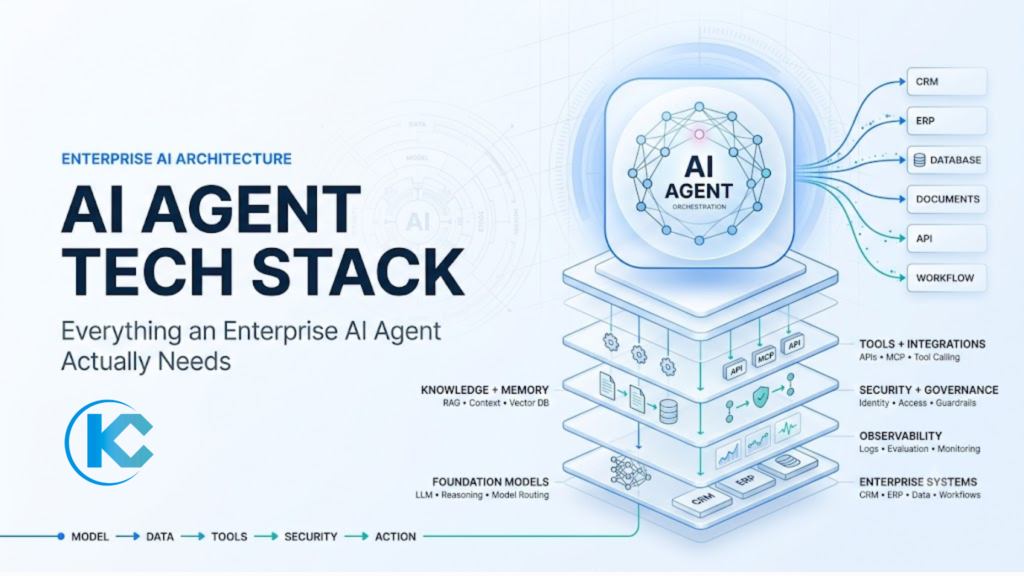
Building an enterprise AI agent is not simply a matter of choosing a powerful LLM. A production-ready agent requires an entire AI agent tech stack covering foundation models, orchestration, enterprise data, memory, RAG, tools, APIs, security, observability, evaluation, and deployment infrastructure. The difference between an impressive AI demo and a reliable enterprise AI agent is the architecture underneath it.
Quick Answer: What Does an Enterprise AI Agent Need?
An enterprise AI agent typically needs these core technology layers:
- Foundation Model: Provides reasoning and language capabilities.
- Agent Orchestration: Controls planning, state, workflows, and tool execution.
- Enterprise Context & Data: Provides trusted business knowledge and real-time information.
- Memory & RAG: Enables persistent context and retrieval from enterprise knowledge.
- Tools & Integrations: Allows the agent to interact with APIs, CRM, ERP, databases, and applications.
- Security & Governance: Controls permissions, privacy, guardrails, and human approvals.
- Observability & Evaluation: Measures quality, cost, latency, failures, and agent behavior.
- Deployment Infrastructure: Runs and scales the agent reliably in production.
Enterprise AI Agent Stack at a Glance
Why the AI Agent Tech Stack Matters
Enterprise AI agents are expected to do more than answer questions. They need to understand business context, make decisions, use tools, retrieve information, execute workflows, and operate within organizational security boundaries.
From Answers to Actions
Tools and APIs allow agents to update CRM records, retrieve information, trigger workflows, and interact with enterprise systems.
From Generic AI to Business AI
RAG, enterprise context, and governed data give agents access to the information needed for business-specific decisions.
From Prototype to Production
Evaluation, observability, security, and deployment infrastructure make agents maintainable and scalable.
From Isolated Agent to Enterprise System
Integration layers connect AI agents with CRM, ERP, databases, knowledge systems, communication platforms, and APIs.
The Enterprise AI Agent Architecture
A practical enterprise architecture can be viewed as a stack where each layer solves a different problem. The model provides intelligence, orchestration controls behavior, context provides business knowledge, tools provide action, and governance keeps the entire system within defined boundaries.
Web Apps • Salesforce • Slack • Teams • Voice • Portals
LangChain • LangGraph • CrewAI • Agentforce • Agent Frameworks
LLMs • RAG • Embeddings • Vector Databases • Memory • Enterprise Context
APIs • MCP • Functions • CRM • ERP • Databases • SaaS Applications
RBAC • Guardrails • Evaluation • Observability • Audit • Deployment
1. Foundation Models: The Reasoning Engine
The foundation model is the cognitive core of an AI agent. It interprets instructions, reasons about tasks, generates responses, and decides which actions or tools may be required.
Enterprise teams may use commercial frontier models, enterprise-hosted models, or open-weight models depending on requirements for performance, cost, data residency, latency, and control.
- Reasoning and planning
- Natural language understanding
- Structured output generation
- Tool and function calling
- Multimodal processing where required
The important architectural decision is not simply choosing the “best” LLM. Model selection should match the workload, risk level, latency requirements, context requirements, and total cost of the agent.
2. Agent Orchestration Framework
The orchestration layer controls how an AI agent thinks, plans, remembers state, calls tools, handles failures, and completes multi-step tasks. This is what transforms an LLM call into an agent workflow.
LangChain / LangGraph
Useful for tool-based workflows, stateful execution, and more controlled agent graphs.
CrewAI
Designed around role-based multi-agent collaboration and task delegation.
Microsoft Agent Framework / AutoGen
Useful for structured agent interactions and Microsoft-oriented enterprise environments.
Agentforce
Useful when autonomous AI needs to operate directly within Salesforce business processes.
The right framework depends on whether the requirement is a simple task-running agent, stateful workflow, multi-agent system, document-heavy RAG application, or deeply integrated enterprise agent.
If your organization is building custom agents across Salesforce, enterprise applications, APIs, and knowledge systems, explore
AI Pod Services for Custom AI Agents
for an architecture designed around your data, systems, workflows, and business rules.
3. Enterprise Data and Context Layer
One of the biggest differences between a consumer AI assistant and an enterprise AI agent is access to trusted business context.
An agent may have an excellent model, but that model does not automatically know your organization’s current policies, customer records, product catalog, contracts, internal procedures, or operational rules.
The enterprise context layer connects the agent to governed information and provides the definitions, relationships, business rules, and current data required for reliable decisions.
- CRM and customer data
- ERP and financial systems
- Knowledge bases and SOPs
- Documents and contracts
- Data warehouses and data lakes
- Business definitions and metadata
- Real-time operational data
This is why AI data foundation services are becoming an important part of enterprise AI architecture: agents need clean, governed, connected data before they can reliably act on it.
Ready to Architect Your Enterprise AI Stack?
Our experts at Kizzy Consulting will help you design an AI foundation that scales securely across your data and workflows.
4. RAG, Embeddings and Vector Databases
Retrieval-Augmented Generation (RAG) gives an AI agent access to external knowledge without requiring that information to be permanently encoded into the foundation model.
A typical enterprise RAG pipeline looks like this:
- Ingest: Collect documents, records, policies, and enterprise knowledge.
- Chunk: Break large documents into useful information segments.
- Embed: Convert content into vector representations.
- Store: Store embeddings in a vector database or supported enterprise data platform.
- Retrieve: Find relevant information using semantic search.
- Generate: Provide retrieved context to the LLM for a grounded response.
RAG is particularly useful for customer support, internal knowledge assistants, contract analysis, policy lookup, research agents, and enterprise search.
Connect With Us to Optimize Your Workflow
Fill out the form below to get personalized guidance on setting up your AI infrastructure.
5. Memory: Giving Agents Continuity
Memory allows an agent to maintain useful information beyond a single model interaction. Production architectures may use several forms of memory.
Working Memory
Current conversation, instructions, retrieved context, and recent tool results.
Episodic Memory
Historical interactions, tasks, outcomes, and previous activities.
Semantic Memory
Facts, relationships, domain knowledge, and enterprise information.
Procedural Memory
Rules, workflows, instructions, and repeatable behaviors.
6. Tools, APIs and MCP
Tools are what allow an AI agent to move from generating text to performing useful work. A tool can be an API, database query, function, workflow, browser capability, CRM action, or enterprise application.
For example, a sales agent could retrieve an account from Salesforce, check an order in an ERP, generate a proposal, and create a follow-up task without requiring a user to manually perform every step.
- REST and GraphQL APIs
- Database queries
- CRM and ERP actions
- Workflow automation
- Custom functions
- Web and search tools
- Model Context Protocol (MCP)
MCP can provide a standardized approach for connecting AI systems with external tools and data sources. In enterprise environments, these connections still need authentication, authorization, logging, and appropriate permission boundaries.
For complex Salesforce environments, Salesforce integration services can connect AI agents with external APIs, ERP platforms, databases, and business applications.
7. Security, Governance and Control Plane
Enterprise AI agents can access sensitive data and perform real actions. Security therefore cannot be added after development. It needs to be designed into the architecture.

Identity & Access
Use authentication, authorization, RBAC, least privilege, and scoped permissions.
Guardrails
Define what agents can and cannot say, access, modify, or execute.
Human Approval
Require human authorization for high-risk actions such as financial or contractual decisions.
Auditability
Maintain logs and traces of agent actions, API calls, decisions, and outcomes.
The enterprise control plane should govern permissions and actions, while the context layer provides the business knowledge the agent needs. These are related but distinct architectural responsibilities.
8. Evaluation and Observability
An agent that works in a demonstration environment may behave very differently in production. Evaluation and observability help engineering teams understand what happened and continuously improve the system.
- Accuracy: Did the agent produce a correct result?
- Grounding: Was the answer supported by trusted enterprise context?
- Tool Success: Did the correct tool execute successfully?
- Latency: How long did the agent take to complete the task?
- Cost: How much model and infrastructure usage did the task consume?
- Safety: Did the agent stay within its policies and permissions?
- Task Completion: Did the agent actually achieve the intended business outcome?
Tracing platforms and evaluation frameworks can capture agent runs, tool calls, retrieval steps, model responses, errors, and performance trends. This becomes essential as agents move from pilots to production.
Production AI Agent Tech Stack
| Layer | Purpose | Example Technologies |
|---|---|---|
| Foundation Model | Reasoning and generation | OpenAI, Anthropic, Google, open-weight models |
| Orchestration | Planning and agent workflows | LangGraph, LangChain, CrewAI, Agentforce, AutoGen |
| Context & Data | Business knowledge | Data Cloud, Snowflake, databases, knowledge bases |
| RAG | Grounded retrieval | Embeddings, vector databases, semantic search |
| Tools | Real-world actions | REST, GraphQL, functions, MCP, enterprise APIs |
| Security | Risk and access control | RBAC, OAuth, guardrails, policy engines |
| Observability | Monitoring and tracing | Tracing, evaluations, logs, alerts |
| Infrastructure | Deployment and scaling | Cloud, containers, APIs, CI/CD, databases |
How to Choose the Right AI Agent Tech Stack
There is no universal technology stack for every enterprise AI agent. The architecture should be selected based on the business problem and operational requirements.
Start With the Business Outcome
Define what the agent must accomplish before selecting models and frameworks.
Map the Required Data
Identify CRM, ERP, documents, databases, APIs, and knowledge sources the agent needs.
Define Risk Boundaries
Determine which actions require approval, which data is restricted, and what must be audited.
Design for Operations
Plan evaluation, monitoring, versioning, incident handling, and continuous improvement from day one.
Unlock the Power of Enterprise AI
Need help navigating models, integrations, and deployment security? Let’s discuss your custom roadmap today.
Where Salesforce Fits Into the Enterprise AI Agent Stack
For organizations already running Salesforce, the CRM can become an important engagement, data, and action layer for enterprise AI agents.
- Sales Cloud: Lead qualification, opportunity intelligence, follow-ups, and sales assistance.
- Service Cloud: Case summarization, customer support, knowledge retrieval, and autonomous service workflows.
- Data Cloud: Unified customer context and data activation.
- Agentforce: Autonomous agents and business actions inside Salesforce.
- Integrations: APIs and middleware connect Salesforce AI to external enterprise systems.
Kizzy Consulting helps organizations architect and deploy this layer through
Agentforce consulting and implementation,
including agent strategy, data readiness, custom actions, integrations, and enterprise deployment.
Common AI Agent Tech Stack Mistakes
- Choosing the LLM First: A powerful model cannot compensate for poor architecture or missing enterprise context.
- Ignoring Data Quality: Agents grounded in incomplete or conflicting data can produce unreliable decisions.
- Skipping Observability: Without traces and evaluation, production failures become difficult to diagnose.
- Over-Automating High-Risk Actions: Financial, legal, security, and customer-impacting workflows may require human approval.
- Building Point-to-Point Integrations: Unstructured integrations become difficult to maintain as the number of agents and systems grows.
- Treating AI as Set-and-Forget: Models, data, prompts, policies, tools, and business processes change continuously.
Enterprise AI Agent Implementation Roadmap
01. Discover
Identify high-value use cases, workflows, users, data sources, and business outcomes.
02. Architect
Design the model, orchestration, data, RAG, tool, integration, and security layers.
03. Build & Test
Develop tools, retrieval pipelines, workflows, guardrails, and evaluation datasets.
04. Deploy & Optimize
Launch gradually, monitor performance, collect feedback, and continuously improve the agent.
Conclusion
The AI agent tech stack is much larger than an LLM. Enterprise-grade AI agents require a coordinated architecture spanning foundation models, orchestration frameworks, enterprise context, RAG, memory, tools, APIs, security, governance, evaluation, observability, and production infrastructure.
The most successful organizations will not necessarily be those using the newest model. They will be the organizations that build reliable systems around their models—connecting AI to trusted data, business processes, enterprise applications, and measurable outcomes.
For businesses moving from AI pilots to production, the goal should be simple: build an AI agent that can reason, retrieve, act, and operate safely within the enterprise.
Frequently Asked Questions about AI Agent Tech Stack:
What is an AI agent tech stack?
An AI agent tech stack is the collection of technologies used to build and operate an AI agent, including foundation models, orchestration, memory, RAG, enterprise data, tools, APIs, security, observability, and deployment infrastructure.
What is the most important layer in an enterprise AI agent?
There is no single most important layer. Model capability matters, but enterprise reliability also depends heavily on trusted context, data quality, tool integration, security, governance, evaluation, and observability.
Do enterprise AI agents need RAG?
Not every agent requires RAG, but it is highly useful when an agent needs access to changing, proprietary, or domain-specific information such as policies, documents, customer records, contracts, or knowledge bases.
What is the difference between an AI agent and a chatbot?
A chatbot primarily responds to user messages. An AI agent can reason through a task, retrieve information, call tools, interact with enterprise systems, execute workflows, and potentially complete actions with limited human intervention.
How do you make an AI agent production-ready?
Production readiness requires reliable data, controlled tool access, security and governance, evaluation, observability, failure handling, testing, deployment infrastructure, and continuous monitoring.
Building an Enterprise AI Agent?
Kizzy Consulting helps businesses design and implement production-ready AI agents across Salesforce, enterprise applications, APIs, knowledge systems, and business workflows. From AI strategy and data readiness to RAG, orchestration, Agentforce, integrations, governance, and ongoing optimization, we build the technology stack around your actual business requirements.
Explore our AI Integration & Implementation Services to see how enterprise AI agents can be integrated into your existing technology stack.